




Meeting every pharmaceutical GMP compliance step is no longer a documentation exercise. It is a patient safety obligation backed by escalating regulatory enforcement. The FDA issued 94 warning letters to drug manufacturing sites in 2023 alone, and the citations keep pointing to the same root causes: inadequate procedures, poor process controls, and breakdowns in quality culture. For QA professionals in pharmaceutical manufacturing, that pattern is a clear signal. This guide walks through nine core pillars of GMP compliance, giving you a practical, step-by-step framework you can apply directly to your operation.
Table of Contents
- Key takeaways
- Pharmaceutical GMP compliance steps: the QMS foundation
- Personnel qualifications and GMP training programs
- Facilities, equipment controls, and environmental monitoring
- Production controls, documentation, and validation
- QC testing, labeling, and distribution controls
- My perspective on what actually drives GMP success
- How Jjccgroup supports your GMP compliance program
- FAQ
Key takeaways
| Point | Details |
|---|---|
| Build QMS before you build anything else | A well-structured Quality Management System is the governing framework that makes every other GMP step sustainable. |
| Training must be role-specific and verified | Generic training fails audits; competency must be documented, assessed, and tied to specific job responsibilities. |
| Facilities and equipment require continuous qualification | One-time qualification is not enough; environmental monitoring and calibration must be ongoing and documented. |
| Data integrity is non-negotiable | ALCOA+ principles must govern every batch record, deviation log, and QC result to withstand regulatory scrutiny. |
| Leadership drives compliance culture | GMP programs stall without active senior management engagement in governance and quality decision-making. |
Pharmaceutical GMP compliance steps: the QMS foundation
The Quality Management System is where every pharmaceutical GMP compliance step originates. Without it, you have procedures that exist in isolation, training that does not connect to practice, and audit findings that repeat cycle after cycle. The PQS ensures quality is designed into every process, not inspected after the fact.
Building a functional QMS requires four integrated components:
- Risk management. Apply ICH Q9 methodology to assess and prioritize risks across manufacturing operations, from raw material sourcing through distribution.
- Change control. Every process modification, equipment replacement, or formulation adjustment should pass through a formal change control workflow before implementation. Appointing a change control owner early in design phases significantly improves regulatory outcomes.
- Corrective and preventive action (CAPA). Document root causes and verify effectiveness. A CAPA that closes without confirmed resolution is worse than no CAPA at all.
- Product quality review. Conduct annual reviews that examine batch data, complaint trends, OOS results, and stability findings. This connects your QMS to real manufacturing performance.
Senior leadership engagement is the piece most organizations underestimate. GMP non-compliance is frequently a leadership failure, not just a procedural one. Regulators following ICH Q10 and EU GMP Chapter 1 expect to see active senior management involvement in quality governance. That means leadership reviewing quality metrics, sponsoring CAPA programs, and physically participating in management review meetings.
Pro Tip: Schedule quarterly quality governance reviews at the executive level where batch rejection rates, CAPA closure rates, and audit findings are presented as business performance indicators, not compliance checkboxes.
Personnel qualifications and GMP training programs
You can have the best SOPs in the industry, but if the person executing the process does not understand why each step matters, your compliance posture is fragile. Without well-defined roles for deviation handling and CAPA management, training often stays incomplete and audits become stressful because of poor traceability.
Effective GMP compliance training programs share three characteristics:
- Role specificity. Training mapped to a job description, not to a generic GMP curriculum. A packaging operator and a QC analyst have different training needs. Treat them differently.
- Competency verification. Written tests and observation-based assessments confirm understanding. Signing a training record does not confirm competency.
- Retraining triggers. Define the events that require refresher training: a deviation involving a specific procedure, an SOP revision, or a regulatory finding in a similar operation.
Documentation of training completion must be traceable. Each record should reference the version of the procedure trained, the date of training, the method of assessment, and the outcome. Qualified Person (QP) oversight and site management accountability must be explicitly assigned, not assumed.
For GMP compliance training rollout, build a training matrix that maps every employee to the procedures they are responsible for executing. Update that matrix when roles change or procedures are revised. Jjccgroup’s GMP training consulting services support organizations in building training matrices, competency frameworks, and verified assessment programs tailored to FDA expectations.
Pro Tip: Treat repeat training deviations (cases where an individual failed the same procedure twice) as a process problem, not a people problem. The root cause is almost always inadequate training design, not individual incompetence.
Facilities, equipment controls, and environmental monitoring
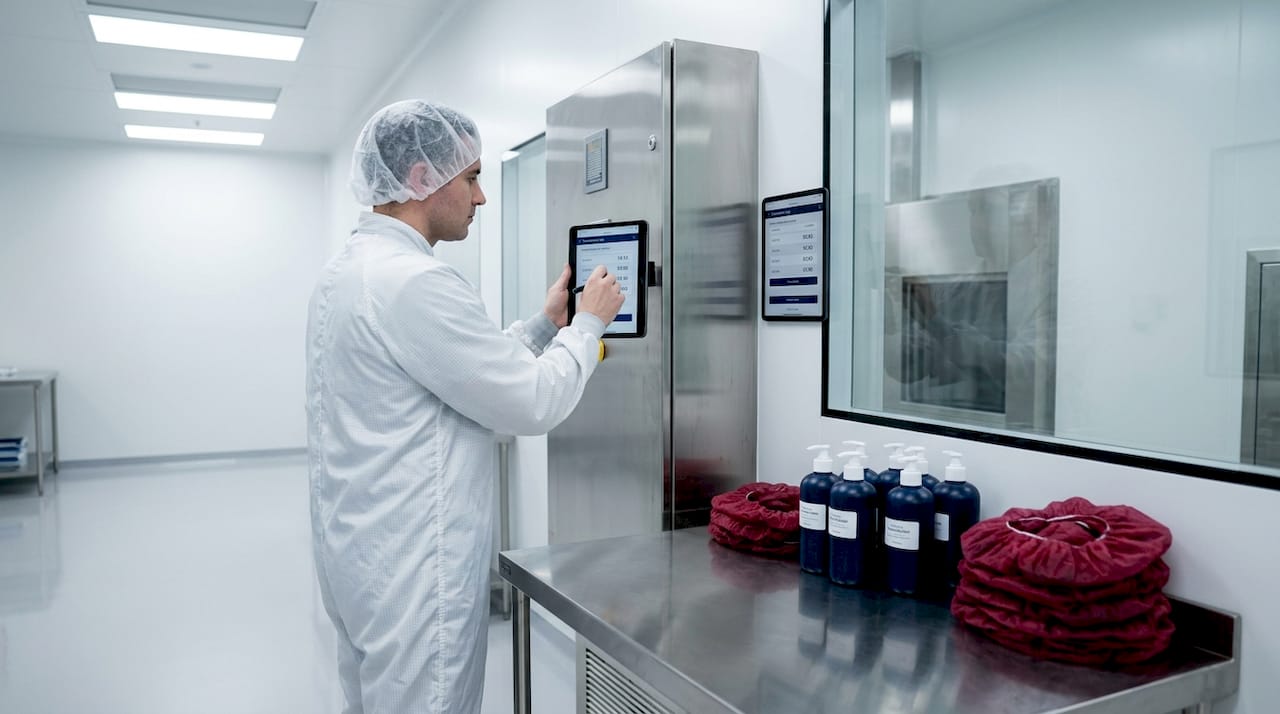
The physical environment where you manufacture directly shapes product quality. Contamination control begins at the facility design stage and is sustained through qualification, calibration, and environmental monitoring programs. The revised EU GMP Annex 1 reinforced this by making the Contamination Control Strategy a living document for continuous improvement, not a one-time submission.
The table below summarizes key facility and equipment controls with their GMP compliance implications:
| Control area | Requirement | Common pitfall |
|---|---|---|
| Cleanroom classification | ISO-aligned classification with defined alert and action limits | Limits set too wide or not reassessed after facility changes |
| Equipment qualification | IQ, OQ, PQ documented for all critical equipment | Qualification not repeated after major repairs or software changes |
| Calibration program | Scheduled calibration with out-of-tolerance investigation | Calibration records incomplete or instruments used past due date |
| Cleaning validation | Validated procedures for product contact surfaces | Cleaning not revalidated after formulation or equipment changes |
| Environmental monitoring | Viable and non-viable particle monitoring per defined schedule | Trending data not reviewed for out-of-trend excursions |
Critical utilities including water for injection (WFI), clean steam, and compressed gases are often overlooked in qualification programs. Each utility that contacts your product or product contact surfaces must be qualified and monitored continuously.
Pro Tip: Do not treat your Contamination Control Strategy as a document. Treat it as a program with ownership, scheduled reviews, and connections to your environmental monitoring data.
Production controls, documentation, and validation
Production controls are where your GMP compliance guidelines translate from paper to practice. Every batch manufactured is an opportunity to generate data that either supports or undermines your regulatory standing. The goal is a manufacturing process that is fully validated, thoroughly documented, and deviation-managed with discipline.
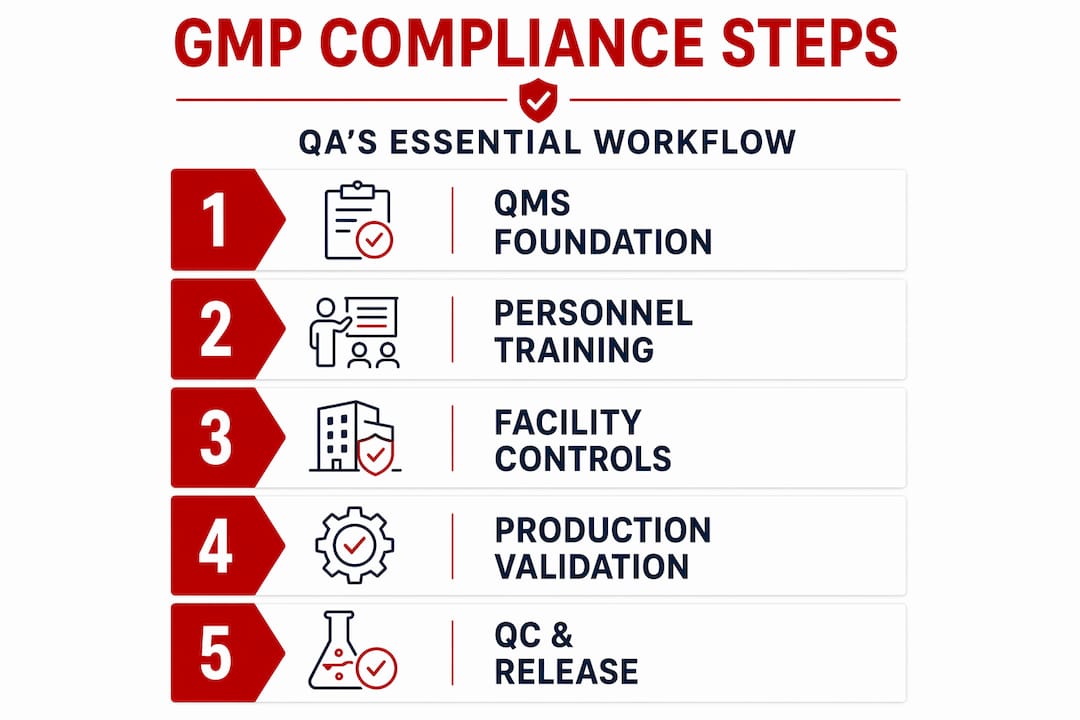
Start with validated production procedures. The IQ/OQ/PQ (Installation, Operational, Performance Qualification) framework applies to both processes and the equipment executing them. Process validation should confirm that your procedure consistently produces product meeting specifications across a defined range of operating conditions.
Documentation discipline is equally critical. The ALCOA+ principles govern every GMP record:
- Attributable. Every entry is signed or initialed by the person making it.
- Legible. Records are readable, permanent, and not obscured by correction fluid.
- Contemporaneous. Entries are made at the time of the activity.
- Original. First-capture records are retained; copies are controlled.
- Accurate. Values reflect what actually occurred.
The “+” additions cover completeness, consistency, enduring, and available. Every deviation from a batch procedure must be captured in real time, not reconstructed after the fact.
Automated document control systems are reducing one of the most persistent compliance gaps. In 2025, 29% of FDA pharmaceutical warning letters specifically cited missing or inadequate written procedures. Moving SOP management to an electronic platform eliminates version control errors and reduces the time SOPs sit in review cycles. More directly, electronic batch records cut review time by half on average and reduce human errors in batch documentation by 50%.
Pro Tip: If you are planning your first compliance automation project, start with batch records. The scope is contained, the metrics are measurable, and the cross-functional benefit is immediate and visible to leadership.
QC testing, labeling, and distribution controls
Quality control in pharmaceutical manufacturing is not a final checkpoint. It is an independent verification function operating in parallel with production. QC labs serve as independent gatekeepers with strict regulatory requirements covering instrument qualification, method validation, reference standards management, and analyst training.
The key QC and release controls to build and maintain include:
- Method validation records that confirm accuracy, precision, specificity, linearity, and robustness
- Calibration and qualification records for every instrument, with out-of-tolerance investigation protocols
- A formal OOS (out-of-specification) investigation procedure, including Phase I laboratory investigation and Phase II manufacturing investigation
- Reference standard management: source, qualification, storage, and expiry documentation
- Stability programs that generate ongoing data supporting shelf-life claims
Packaging and labeling controls deserve particular attention because label mix-ups remain a recurring source of product recalls. Your controls must cover line clearance procedures before each packaging run, label reconciliation at batch close, and 100% verification of printed lot numbers and expiry dates against the batch record.
For distribution controls, Good Distribution Practice (GDP) integration is required when product leaves your facility. Maintain chain of custody documentation, temperature excursion management procedures, and formal qualification for cold chain carriers.
- Qualify every contract manufacturer or laboratory through a formal vendor audit and technical assessment.
- Establish Quality Technical Agreements that clearly assign GMP responsibilities between your organization and the contract organization. Manufacturers and contract organizations share GMP responsibility through supplier qualification, audits, and these formal agreements.
- Schedule periodic re-audits on a risk-based frequency tied to the criticality of the activity being outsourced.
My perspective on what actually drives GMP success
I have worked through enough GMP audits, warning letter responses, and quality system overhauls to form a clear opinion on what separates organizations that sustain compliance from those that chase it. The difference is almost never in the procedures. The procedures are usually fine. The gap is in leadership ownership.
I have seen QA teams produce technically sound QMS documentation while senior management treats quality as a cost center rather than a governance function. When that happens, CAPA programs stall at root cause definition, deviations get closed without real investigation, and training records accumulate without verified competency. Regulators notice. They are specifically trained to identify active senior management engagement as a quality indicator.
My honest take on digital transformation in GMP: it is worth pursuing, but pick your starting point carefully. Batch record digitization delivers the fastest and most measurable compliance return. It has a contained scope, and the results translate directly into fewer review errors and shorter release cycles. Starting with CAPA or SOP automation tends to expose gaps in governance that slow the project down before you see results.
The organizations I have watched build genuinely mature pharmaceutical quality assurance programs share one trait: they treat quality data as business intelligence, not compliance evidence. When batch rejection rates and CAPA cycle times appear in executive dashboards alongside revenue and production metrics, quality stops being a QA department problem and becomes an organizational priority. That shift, more than any procedure or system, is what makes GMP compliance sustainable.
— Mike
How Jjccgroup supports your GMP compliance program
GMP compliance in pharmaceutical manufacturing involves every function in your organization: operations, QA, QC, supply chain, IT, and leadership. Getting all of those moving in the same direction requires both regulatory knowledge and operational experience. Jjccgroup brings over 30 years of FDA compliance expertise to pharmaceutical manufacturers facing exactly these challenges.

From gap assessments that identify your highest-priority compliance risks, to pharmaceutical compliance consulting that covers training program design, document control automation, audit preparation, and CAPA management, Jjccgroup provides a structured path from current state to audit-ready. Their team works alongside your QA function, not around it, translating regulatory expectations into practical, site-specific action plans. For manufacturers working toward FDA approval or managing the aftermath of a warning letter, Jjccgroup’s FDA compliance consulting services offer the experience and resources to close gaps faster and with greater confidence.
FAQ
What are the core pharmaceutical GMP compliance steps?
The core steps cover establishing a Quality Management System, qualifying personnel through role-specific training, controlling facilities and equipment, validating production processes, maintaining data integrity, and implementing QC testing and distribution controls. Each step builds on the previous one.
How does a GMP audit checklist differ from a QMS?
A GMP audit checklist is an inspection tool that verifies whether specific regulatory requirements are met at a point in time. A QMS is the governing system that makes those requirements operational on a daily basis.
Why is leadership engagement critical for GMP compliance?
Regulators under ICH Q10 and EU GMP Chapter 1 expect active senior management participation in quality governance. Without it, CAPA programs stall and training gaps persist, which are the most common drivers of repeat audit findings.
What is ALCOA+ and why does it matter for GMP documentation?
ALCOA+ is a framework of data integrity principles requiring that every GMP record be attributable, legible, contemporaneous, original, accurate, complete, consistent, enduring, and available. FDA inspectors use this framework to evaluate whether batch records and laboratory data can be trusted.
How do electronic batch records improve GMP compliance?
Electronic batch records reduce human documentation errors by 50% on average and cut review cycle time significantly, according to industry data. They also generate audit-ready, version-controlled records that support both release decisions and regulatory submissions.
Recommended
- GMP Compliance Training: A Step-by-Step Guide – J&J Consulting Group- FDA Regulatory Compliance
- Your GxP Compliance Checklist: A Step-by-Step Guide
- Pharmaceutical Compliance Consulting: Your Guide to FDA Approval – J&J Consulting Group- FDA Regulatory Compliance
- Drugs and Bioscience – J&J Consulting Group- FDA Regulatory Compliance
