




An FDA corrective action plan response is the formal written document submitted to the FDA following Form 483 inspection observations, and its quality directly determines whether your organization faces escalating enforcement action or demonstrates credible regulatory commitment. The FDA’s March 2026 draft guidance formalized expectations that compliance professionals in pharmaceutical and medical device companies have long navigated without a standardized framework. Under that guidance, responses are due within 15 business days of Form 483 issuance. A late or superficial submission does not delay warning letters. It accelerates them. This article breaks down every structural, investigative, and communicative element your organization needs to submit a response that satisfies FDA scrutiny and reflects genuine corrective intent.
What are the essential elements of an FDA corrective action plan response?
The FDA’s 2026 draft guidance specifies that responses include eight defined elements to standardize clarity and completeness across submissions. Understanding each element is the foundation of any credible FDA compliance response.
The eight required components are:
- Establishment information: Full legal name, address, FEI number, and contact details for the responding facility.
- Copy of the Form 483: Include the issued Form 483 as a reference document within the submission package.
- Preparer identification: Name, title, and contact information for the individual responsible for compiling the response.
- Executive summary table: A structured table mapping each observation to its CAPA number, remediation status, target dates, and progress category.
- Detailed investigation report: A scientifically justified account of the root cause analysis methodology, findings, and scope.
- CAPA plans: Specific corrective and preventive actions with named owners, measurable deliverables, and realistic timelines.
- Signed attachments: Supporting documentation, protocols, and records signed by accountable personnel.
- Communication plan: A schedule of progress updates and milestone reports for observations requiring extended remediation.
The executive summary table deserves particular attention. A well-structured summary table allows FDA reviewers to assess completeness and progress status without reading the entire submission. It should include observation number, category, a brief summary, the corresponding CAPA number, target completion dates, and a current progress indicator such as “in progress,” “completed,” or “pending verification.”
Pro Tip: Use the full 15-business-day window. A premature but incomplete response carries no regulatory benefit and signals that your organization prioritized speed over substance.
| Observation | CAPA # | Remediation Summary | Target Date | Status |
|---|---|---|---|---|
| Observation 1 | CAPA-001 | Process redesign for sterile fill line | 60 days | In progress |
| Observation 2 | CAPA-002 | SOP revision and retraining | 30 days | Completed |
| Observation 3 | CAPA-003 | Equipment qualification protocol | 90 days | Pending |
How to conduct a root cause analysis for your FDA corrective action plan
Root cause analysis is the analytical core of any credible FDA action plan. The FDA’s 2026 draft guidance is explicit: investigations must be comprehensive, scientifically justified, and must include lateral spread assessments that consider whether the same deficiency affects other products, processes, or facilities. Excluding any operational area from the investigation scope requires documented scientific justification. Without it, FDA reviewers will question whether the investigation was designed to find problems or avoid them.
A structured investigation process follows these steps:
- Define the investigation scope in writing. Document which products, processes, and facilities are included, and provide scientific rationale for any exclusions. Vague scope definitions are a common FDA red flag.
- Assemble a multidisciplinary team. Quality assurance, manufacturing operations, engineering, and senior management must each contribute. Investigations led solely by quality personnel often miss operational root causes.
- Apply a recognized root cause methodology. Tools such as Fishbone (Ishikawa) diagrams, 5-Why analysis, and Failure Mode and Effects Analysis (FMEA) provide structured, defensible frameworks that FDA reviewers recognize.
- Conduct the lateral spread review. Assess whether the identified root cause exists in analogous processes, product lines, or sister facilities. Document findings regardless of outcome.
- Assess systemic risk. Determine whether the observation reflects an isolated event or a systemic quality system failure. Systemic findings require broader CAPA scope and typically longer remediation timelines.
- Produce a formal investigation report. The report must document methodology, data reviewed, personnel interviewed, findings, and conclusions. It becomes a permanent quality record subject to future FDA review.
Pro Tip: Avoid the single-cause trap. Most Form 483 observations trace back to multiple contributing factors across people, processes, and systems. An investigation that identifies only one root cause rarely satisfies FDA reviewers and often results in recurrence.
The quality testing rigor applied during investigations directly influences whether your CAPA addresses the actual failure mechanism or merely its surface symptoms. Organizations that invest in thorough investigations consistently produce more durable corrective actions.

Best practices for developing effective CAPA plans
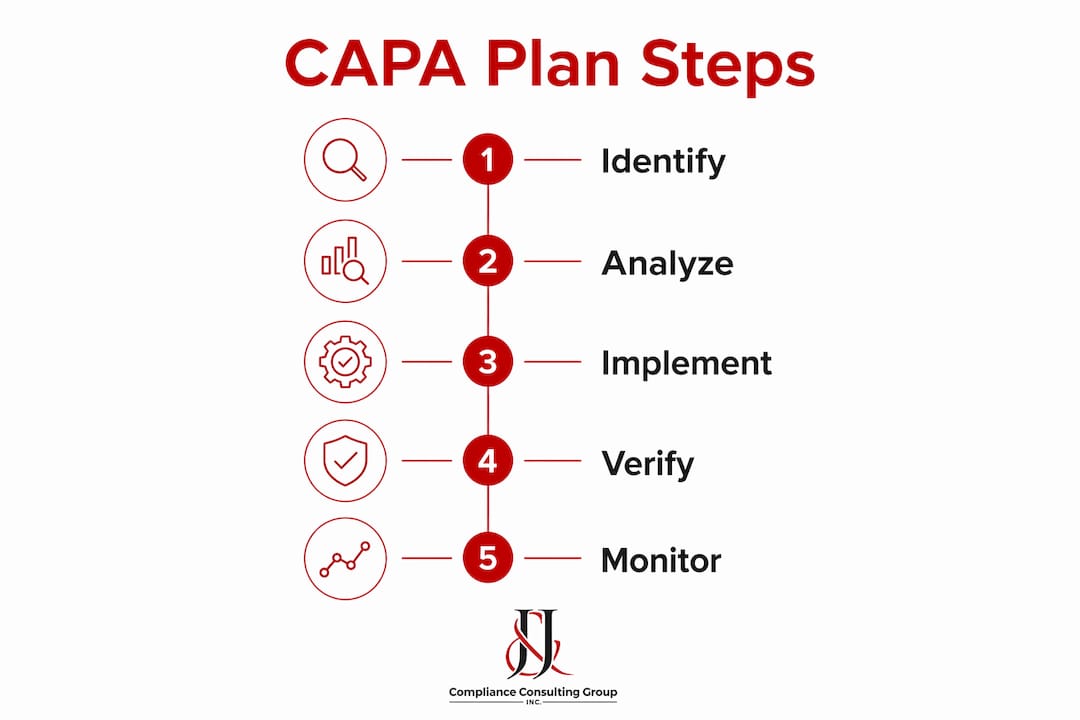
Corrective and preventive actions, commonly referred to as CAPA, must address root causes rather than observable symptoms. This distinction separates responses that satisfy FDA from those that invite follow-up enforcement. Assigning CAPA ownership to named individuals rather than departments is a non-negotiable practice. When a department owns a CAPA, accountability diffuses. When a named individual owns it, accountability is auditable.
Strong CAPA plans share several characteristics:
- Root cause alignment: Each CAPA maps directly to a specific root cause identified in the investigation report. If the investigation found three contributing factors, the CAPA plan addresses all three.
- Hierarchy of controls: Process redesign and engineering controls rank above procedural revisions, which rank above training. Training alone is insufficient as a standalone corrective action for any observation involving systemic failures.
- Realistic timelines: Deadlines must reflect the actual complexity of the task. Generic 30-day timelines applied uniformly across all CAPAs signal to FDA reviewers that the plan was drafted without genuine operational assessment.
- Interim control measures: When full remediation extends beyond the initial response window, interim controls must be documented and implemented immediately. These measures protect product quality and patient safety while permanent corrections are completed.
- Effectiveness verification criteria: Measurable verification criteria must be defined before implementation begins, not after. Routine testing alone does not constitute adequate verification.
The table below illustrates the difference between weak and strong CAPA effectiveness checks:
| CAPA element | Weak approach | Strong approach |
|---|---|---|
| Effectiveness check | “Monitor for recurrence” | Zero deviations in 90-day post-implementation audit of 50 batch records |
| Ownership | Quality Department | Jane Smith, Quality Systems Manager |
| Timeline | 30 days (all actions) | 15 days (SOP revision), 45 days (retraining), 90 days (verification) |
| Root cause linkage | “Address observation” | Directly maps to identified cause: inadequate change control process |
Pro Tip: If an effectiveness check fails after implementation, the CAPA effectiveness evaluation requires revisiting the root cause analysis. A failed check is not a compliance failure. Failing to revisit the root cause after a failed check is.
Reviewing a CAPA and root cause analysis guide before drafting your plan helps compliance teams structure verification protocols that meet FDA’s current expectations.
How to manage FDA communication after submitting your corrective action plan
FDA communication management is not optional once a corrective action plan is submitted. The 2026 draft guidance establishes that when full remediation cannot be completed within 15 business days, the organization must include a communication plan that outlines progress updates, milestone deliverables, and a defined update schedule. This expectation applies to the majority of complex observations, where root cause investigations and system-level CAPAs routinely extend over 60 to 180 days.
An effective communication plan addresses the following:
- Update frequency and format: Specify whether updates will be submitted monthly, quarterly, or at defined milestones. Written updates submitted proactively signal organizational control.
- Milestone deliverables: Each update should reference specific CAPA milestones, such as completion of an investigation report, SOP revision approval, or retraining completion, rather than general progress statements.
- Executive authorization: Executive management involvement is critical. FDA expects signed responses that demonstrate accountability beyond quality personnel. Updates signed only by quality managers may signal that senior leadership is not engaged.
- Scientific rationale for delays: If a milestone is missed or a timeline requires revision, the update must explain why with documented scientific or operational justification. Unexplained delays erode FDA confidence.
- Tone and clarity: Updates must be factual, concise, and free of defensive language. The goal is to demonstrate progress and organizational competence, not to argue with the original observations.
Consulting a resource on responding to FDA warning letters helps compliance teams understand how communication missteps during the corrective action phase can escalate to formal enforcement. The tone and substance of every update contributes to the FDA’s overall assessment of your organization’s compliance culture.
Key takeaways
A credible FDA corrective action plan response requires a comprehensive investigation, individually owned CAPAs with measurable verification criteria, executive authorization, and a proactive communication plan submitted within 15 business days of Form 483 issuance.
| Point | Details |
|---|---|
| Submit within 15 business days | Use the full window to produce a substantive response; early incomplete submissions carry no regulatory benefit. |
| Include all eight required elements | The 2026 FDA draft guidance specifies eight components, including the executive summary table and communication plan. |
| Conduct a lateral spread investigation | Assess all potentially affected products, processes, and facilities with documented scientific justification for any exclusions. |
| Assign CAPA ownership to individuals | Named individuals with complexity-based deadlines produce more auditable and credible corrective action plans. |
| Define effectiveness criteria before implementation | Measurable verification criteria must be set in advance; failed checks require revisiting the root cause analysis. |
Why the quality of your FDA response reflects your entire compliance culture
After working with pharmaceutical and medical device manufacturers across dozens of FDA inspection cycles, one pattern stands out clearly: organizations that treat Form 483 responses as a documentation exercise consistently face escalating enforcement, while those that treat them as a genuine quality improvement opportunity build lasting regulatory credibility.
The most common mistake I see is a response that addresses the letter of each observation without confronting the systemic conditions that produced it. A manufacturer might revise a single SOP and call the observation closed, when the actual root cause was a quality management system that lacked adequate change control oversight across the entire facility. FDA reviewers are experienced enough to recognize when a response is designed to close observations rather than fix problems.
FDA 483 responses are technically voluntary, but practically mandatory. An absent or inadequate response is one of the clearest signals an organization can send that it does not take its compliance obligations seriously. I have seen companies receive warning letters not because their observations were severe, but because their responses were generic, lacked executive signatures, and contained no measurable commitments.
The organizations that handle this process best are the ones where compliance professionals lead multidisciplinary teams, where executive management is genuinely engaged rather than simply signing documents, and where the root cause investigation is treated as an institutional learning exercise. The 15-business-day window is not a sprint to produce paperwork. It is an opportunity to demonstrate that your quality system is capable of identifying, analyzing, and correcting its own failures.
— Mike
How Jjccgroup supports your FDA corrective action plan response

Jjccgroup brings over 30 years of regulatory consulting experience to pharmaceutical and medical device manufacturers facing FDA inspection outcomes. Whether your organization needs support structuring a Form 483 response, conducting a defensible root cause investigation, or developing CAPA plans that meet the FDA’s 2026 draft guidance standards, Jjccgroup provides expert guidance at every stage. Their FDA compliance services cover the full spectrum from initial response drafting through effectiveness verification and ongoing FDA communication management. For organizations managing complex observations or extended remediation timelines, Jjccgroup’s regulatory approval consulting offers a structured, experienced approach to reducing enforcement risk and restoring FDA confidence. Contact Jjccgroup to discuss your specific situation and build a response strategy grounded in current regulatory expectations.
FAQ
What is an FDA corrective action plan response?
An FDA corrective action plan response is a formal written submission addressing Form 483 observations issued at the conclusion of an FDA drug cGMP inspection. It documents root cause investigations, CAPA plans, timelines, and a communication schedule for ongoing remediation.
How long do you have to respond to a Form 483?
The FDA’s 2026 draft guidance recommends submitting a comprehensive response within 15 business days of Form 483 issuance. Responses submitted after this window generally do not delay warning letters or other enforcement actions.
What happens if your FDA corrective action plan response is inadequate?
Inadequate or absent responses increase the risk of warning letters and regulatory escalation. FDA reviewers assess response quality as a signal of organizational compliance culture and management commitment.
Does executive management need to sign the FDA response?
Yes. FDA expects responses signed by executive management, not only quality personnel, to demonstrate that leadership is accountable for resource allocation and CAPA feasibility. Updates submitted without executive authorization may signal insufficient organizational commitment.
What is a lateral spread review in a root cause investigation?
A lateral spread review assesses whether the identified root cause affects other products, processes, or facilities beyond the specific observation cited. Scientific justification is required for any operational area excluded from the investigation scope.
