


GMP compliance is defined as adherence to the regulatory quality standards that govern how pharmaceuticals, food products, and medical devices are manufactured to protect public health. The FDA enforces these requirements under 21 CFR Parts 210 and 211, while the European Medicines Agency applies EudraLex Volume 4, and the WHO provides harmonized guidelines adopted by more than 50 countries. Understanding what GMP compliance means in practice goes far beyond passing an audit. It requires building quality into every stage of manufacturing, from raw material sourcing through final batch release, and maintaining documented evidence that proves it.
What is GMP compliance and why does it matter?
GMP compliance is the ongoing state of meeting minimum regulatory requirements set by authorities like the FDA, EMA, and WHO to ensure consistent product quality. The FDA refers to its version as Current Good Manufacturing Practice, or cGMP, with the “current” signaling that manufacturers must adopt up-to-date methods and technologies, not just meet a static checklist from a prior decade. Regulators treat GMP as a living standard.
The GMP compliance definition covers every dimension of manufacturing: personnel qualifications, facility design, equipment calibration, process validation, documentation integrity, and quality system management. A product can pass final laboratory testing and still be considered adulterated if the manufacturing process lacked controls. That distinction is the core principle regulators enforce.

For quality assurance specialists, the practical implication is significant. GMP compliance is not a certification you earn once and archive. The FDA does not issue GMP certificates at all. It inspects. The EU issues GMP confirmations tied to re-inspection cycles, not permanent status. Compliance is demonstrated continuously, not declared.
What are the core regulatory frameworks governing GMP?
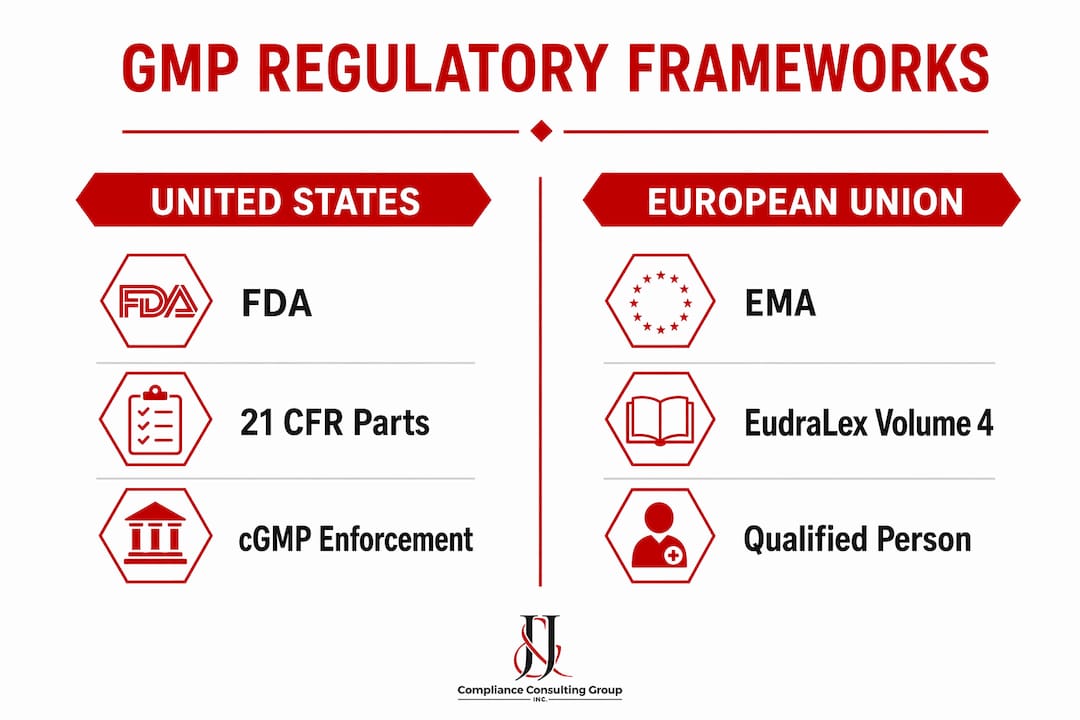
Three major regulatory frameworks define GMP standards requirements globally: FDA regulations in the United States, EudraLex Volume 4 in the European Union, and WHO GMP guidelines used internationally.
FDA regulations: 21 CFR and beyond
The FDA enforces cGMP under 21 CFR Parts 210 and 211 for finished pharmaceuticals, with separate regulations under 21 CFR Part 820 for medical devices and additional rules for biologics and PET drugs. These regulations specify requirements for buildings, equipment, laboratory controls, production processes, and records. Non-compliance with any of these parts can result in a product being deemed adulterated under the Federal Food, Drug, and Cosmetic Act.
EU GMP: EudraLex Volume 4 and the Qualified Person
The EU GMP framework under EudraLex Volume 4 is modular, with a core set of principles supplemented by specific annexes covering areas like sterile manufacturing, computerized systems, and parametric release. EU GMP inspections occur typically every two years, conducted by national competent authorities. A defining feature of the EU system is the Qualified Person requirement. The Qualified Person bears legal accountability for certifying each batch before it enters the market. This individual accountability has no direct equivalent in the US system, where responsibility is distributed across the company’s quality unit.
WHO GMP and PIC/S harmonization
More than 50 countries use WHO GMP and Pharmaceutical Inspection Co-operation Scheme (PIC/S) guidelines as their national standards. PIC/S membership enables mutual recognition of GMP inspections across member countries, reducing duplicative audits for manufacturers exporting to multiple markets. The International Council for Harmonisation (ICH) further drives convergence by encouraging adoption of the highest common regulatory standards to ease global market access.
| Framework | Governing Body | Key Regulation | Inspection Cycle |
|---|---|---|---|
| US cGMP | FDA | 21 CFR Parts 210/211, 820 | Risk-based, no fixed cycle |
| EU GMP | EMA / National Authorities | EudraLex Volume 4 | Typically every 2 years |
| WHO GMP | WHO | WHO Technical Report Series | Varies by country |
| PIC/S | PIC/S Secretariat | PIC/S GMP Guide | Mutual recognition |
What are the primary elements required for GMP compliance?
GMP compliance requires a documented Quality Management System as its foundation. The QMS defines how every process is controlled, monitored, and improved. Without it, individual good practices remain disconnected and unverifiable during an inspection.
The core elements QA specialists must address include:
- Quality Management System (QMS): Establish written procedures for all critical operations, including change control, deviation management, and corrective and preventive actions (CAPA).
- Personnel training and qualification: Document initial training and ongoing competency assessments for every role that touches product quality.
- Facility and equipment qualification: Qualify buildings, utilities, and equipment through Installation Qualification (IQ), Operational Qualification (OQ), and Performance Qualification (PQ) protocols.
- Process validation: Demonstrate through documented studies that manufacturing processes consistently produce a product meeting its specifications.
- Documentation and record keeping: Apply ALCOA+ principles: records must be Attributable, Legible, Contemporaneous, Original, Accurate, and also complete, consistent, enduring, and available.
- Deviation and change control management: Investigate every deviation from approved procedures and assess the impact of any proposed change before implementation.
Pro Tip: Treat your deviation log as a leading indicator of systemic risk. A cluster of similar deviations in one area often signals a process or training gap before it becomes a major finding during an FDA inspection.
Documentation integrity deserves special emphasis. Regulators consistently cite documentation failures in enforcement actions. A process that works perfectly but lacks contemporaneous records is, from a regulatory standpoint, a process that cannot be verified. The record is the proof.
How do regulatory inspections enforce GMP standards?
FDA inspections evaluate adherence to cGMP and carry real enforcement consequences. Non-compliance can result in warning letters, recalls, seizures, injunctions, and criminal charges. Documentation failures rank among the most frequently cited observations in FDA Form 483s and warning letters. A product manufactured under deficient conditions is legally adulterated, regardless of whether it passes finished product testing.
Key facts about the inspection process:
- FDA inspections are unannounced for domestic facilities and risk-based in frequency. Investigators use the Compliance Program Guidance Manual to guide their review.
- EU inspections follow a scheduled cycle, typically every two years, and result in a GMP compliance confirmation rather than a permanent certificate. Continued market access depends on maintaining compliance between cycles.
- Self-inspections are a GMP requirement under EU guidelines and a best practice under FDA expectations. A rigorous internal audit program identifies gaps before regulators do.
- Corrective action plans submitted in response to inspection findings must be specific, time-bound, and verifiable. Vague commitments to “improve training” do not satisfy regulators.
Audit readiness is not a pre-inspection sprint. It is the result of maintaining systems that generate reliable records every day. QA specialists who treat inspections as a test of their documentation discipline, rather than a review of their products, consistently perform better.
What strategies help QA specialists maintain GMP compliance?
Maintaining GMP compliance over time requires more than meeting baseline requirements. The most effective approach combines harmonized standards, continuous training, risk management, and technology-supported documentation.
Adopt harmonized standards that exceed your baseline. If your primary market is the US but you export to the EU, align your QMS with EudraLex Volume 4 requirements, including the Qualified Person concept as an internal accountability model. Meeting the stricter standard protects you in both markets.
Treat cGMP as genuinely current. The FDA’s use of the word “current” is deliberate. Processes validated a decade ago using outdated analytical methods may not satisfy today’s expectations. Schedule periodic process reviews against current scientific standards, not just against your original validation protocols.
Integrate risk management into daily operations. ICH Q9 provides a formal framework for pharmaceutical quality risk management. Apply it to prioritize resources toward the highest-risk processes and materials, rather than distributing attention uniformly across all operations.
Pro Tip: Map your critical quality attributes (CQAs) and critical process parameters (CPPs) explicitly in your batch records. Inspectors who can trace a product’s quality directly through its manufacturing documentation gain confidence quickly, which shortens inspection duration.
Additional practices that strengthen compliance readiness include:
- Conduct mock FDA inspections using your inspection readiness checklist at least annually.
- Use electronic quality management systems with audit trails to satisfy 21 CFR Part 11 requirements for electronic records.
- Engage external consultants for gap assessments before scheduled EU re-inspections or after significant process changes.
- Build a pharmaceutical GMP compliance training calendar that addresses role-specific requirements, not just annual general awareness sessions.
Technology plays a growing role in documentation integrity and traceability. Electronic batch records, automated deviation capture, and validated laboratory information management systems (LIMS) reduce transcription errors and provide the audit trail depth that regulators expect.
Key Takeaways
GMP compliance is a continuous, documented state of meeting regulatory quality standards, not a one-time certification, and it requires quality to be built into manufacturing processes rather than tested in at the end.
| Point | Details |
|---|---|
| GMP compliance definition | Adherence to FDA, EU, and WHO quality standards governing manufacturing processes for product safety. |
| Documentation is the proof | Records must meet ALCOA+ principles; documentation failures are among the most cited FDA enforcement findings. |
| No permanent GMP certificate | The FDA inspects and does not certify; EU issues confirmations tied to re-inspection every two years. |
| Qualified Person accountability | EU law requires a named individual to certify each batch, adding personal legal accountability absent in the US system. |
| Harmonize to the highest standard | Aligning your QMS with the strictest applicable framework protects market access across multiple regulatory jurisdictions. |
GMP compliance is a discipline, not a destination
After working with manufacturers across pharmaceutical, food, and medical device sectors, the pattern I see most often is this: companies invest heavily in their initial GMP build-out and then treat compliance as maintenance mode. That mindset is where problems start.
Regulatory expectations evolve. FDA guidance documents are updated. EU annexes are revised. A QMS that was genuinely current in 2020 may have gaps by 2026 if no one has systematically reviewed it against new guidance. The organizations that perform best in inspections are the ones that schedule annual reviews of their quality systems against current regulatory publications, not just against their own SOPs.
The other underestimated factor is culture. A quality culture means that a line operator stops a batch when something looks wrong, not because a procedure says to, but because they understand why it matters. No QMS document creates that. Leadership does, through consistent behavior and visible commitment to quality over output pressure. I have seen facilities with excellent documentation fail inspections because the workforce did not understand the purpose behind the procedures they followed.
My practical advice: stop measuring GMP compliance by the number of SOPs you have. Measure it by how quickly your team can explain, in plain language, why each critical control exists. That clarity is what regulators are actually testing.
— Mike
Jjccgroup’s GMP consulting services for regulated manufacturers
Jjccgroup brings over 30 years of regulatory consulting experience to pharmaceutical, food, medical device, and dietary supplement manufacturers navigating GMP requirements. Whether you are preparing for an FDA inspection, closing gaps identified in an EU audit, or building a QMS from the ground up, Jjccgroup provides expert guidance tailored to your specific regulatory context.

Their team supports FDA compliance services across the full product lifecycle, from facility qualification through post-market surveillance. Jjccgroup’s consultants have guided companies through warning letter responses, pre-approval inspections, and global harmonization projects. If your organization needs a clear path to audit readiness and sustained compliance, contact Jjccgroup for a consultation.
FAQ
What is the GMP compliance definition?
GMP compliance is adherence to the regulatory quality standards set by authorities like the FDA, EMA, and WHO that govern manufacturing processes for pharmaceuticals, food, and medical devices to ensure consistent product safety and quality.
Does the FDA issue GMP certificates?
The FDA does not issue GMP certificates. It conducts inspections and issues observations or enforcement actions; the EU issues GMP compliance confirmations tied to re-inspection cycles, typically every two years.
What does cGMP mean compared to GMP?
cGMP stands for Current Good Manufacturing Practice, the FDA’s term emphasizing that manufacturers must use up-to-date methods and technologies, not just meet a fixed historical standard.
What are the consequences of GMP non-compliance?
Non-compliance with GMP regulations can result in FDA warning letters, product recalls, seizures, injunctions, and criminal charges, as well as products being legally classified as adulterated.
How does the EU Qualified Person differ from the US system?
The EU requires a named Qualified Person who bears individual legal accountability for certifying each batch before market release. The US system distributes quality responsibility across the company’s quality unit rather than assigning it to a single individual.
