




CGMP is defined as current Good Manufacturing Practice, the FDA-enforced regulatory framework requiring manufacturers to use up-to-date science and technology to produce consistently safe, effective, and quality products. Codified under 21 CFR Parts 210, 211, and 820, CGMP covers the entire product lifecycle, from raw material sourcing through facility design, personnel training, process validation, and documentation. For professionals in pharmaceuticals, medical devices, dietary supplements, and food and beverage manufacturing, understanding the CGMP definition is not optional. It is the foundation of every quality system, every FDA inspection, and every product release decision your organization makes.
What does CGMP mean for regulatory compliance?
CGMP stands for current Good Manufacturing Practice. The word “current” carries legal weight that most professionals underestimate. It establishes a continuous obligation to adopt the most advanced scientific and technological practices available. A process that was fully compliant a decade ago may now be non-compliant if better methods exist and your organization has not adopted them.
FDA enforces CGMP through 21 CFR Part 210 (general requirements), 21 CFR Part 211 (finished pharmaceuticals), and 21 CFR Part 820 (medical devices). Each regulation sets minimum legal standards for production and quality control. Failure to meet those standards does not require a defective product. A manufacturer can produce a product that passes all specifications and still be found non-compliant if the underlying systems are outdated.
The five foundational components of any CGMP program are known as the 5 Ps:
- People: Trained, qualified personnel who understand their role in quality
- Premises: Facilities designed and maintained to prevent contamination and error
- Processes: Validated manufacturing procedures that deliver consistent results
- Products: Materials and finished goods that meet defined specifications
- Procedures: Written, controlled documents that govern every critical operation
These five elements appear across every major regulatory framework globally, not just FDA. They form the structural backbone of what CGMP compliance looks like in practice.
Documentation sits at the center of all five components. ALCOA+ principles govern data integrity requirements: records must be Attributable, Legible, Contemporaneous, Original, and Accurate. Data integrity failures are a leading cause of FDA warning letters, even when the physical product meets all quality specifications. That distinction matters. A batch can pass every test and still trigger enforcement action if the records supporting that batch are incomplete or inaccurate.
Pro Tip: Build documentation review into your daily operations, not just your batch release process. Real-time record-keeping prevents the data integrity gaps that trigger FDA warning letters regardless of product quality.
FDA also requires written testing standards, batch testing, sterility testing where applicable, and retention of equipment cleaning logs and status labels. These are legal minimums, not best practices. Meeting them is the floor, not the ceiling.
How does cGMP differ from GMP, and why does “current” matter?
GMP and cGMP are often used interchangeably, but the distinction is legally significant. GMP refers to the general concept of good manufacturing practices, a broad quality standard used globally. CGMP, as defined by FDA, adds the word “current” as a legal obligation, not a descriptor.

| Feature | GMP | CGMP (FDA) |
|---|---|---|
| Scope | General quality principles | Legally binding, technology-specific requirements |
| Update obligation | Varies by jurisdiction | Continuous; outdated systems may render products adulterated |
| Enforcement body | Multiple global agencies | FDA (21 CFR Parts 210, 211, 820) |
| Documentation standard | Good practice | ALCOA+ data integrity principles required |
| Consequence of non-compliance | Varies | Warning letters, recalls, production stoppages |
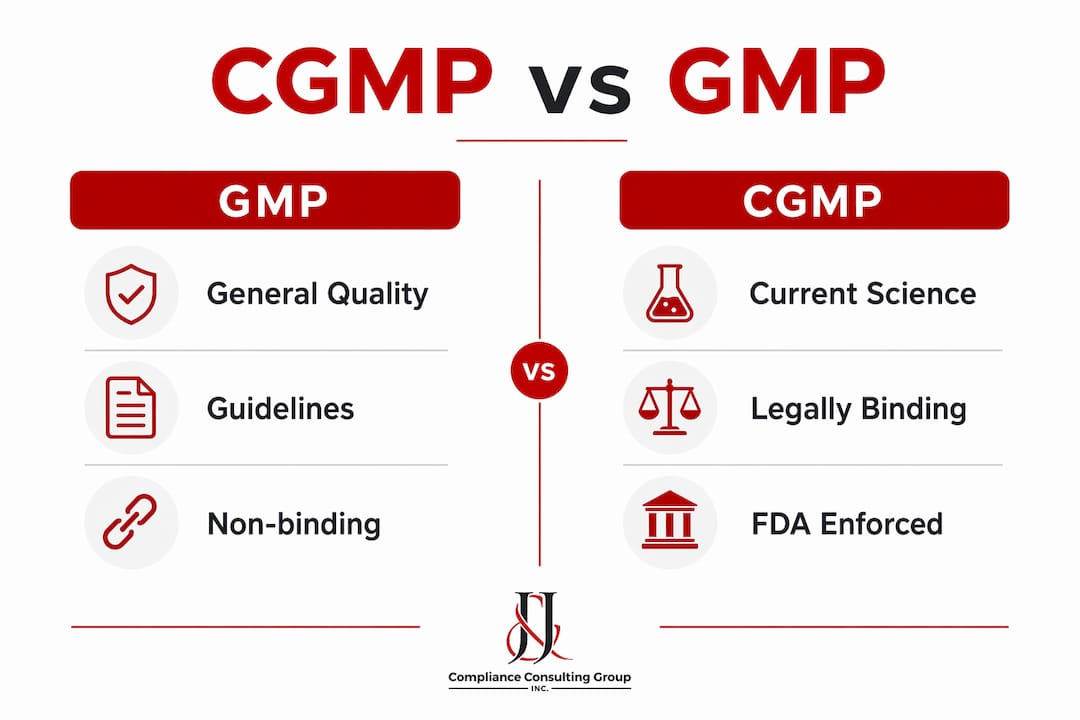
The legal consequence of falling behind is severe. Under FDA’s interpretation, using outdated systems can render a product adulterated under the Federal Food, Drug, and Cosmetic Act, even if the product itself is safe. That is the practical force of the word “current.” It shifts compliance from a point-in-time certification to an ongoing obligation.
Technology and science evolve continuously. Analytical methods improve. Contamination detection becomes more sensitive. Process automation creates new validation requirements. Organizations that treat their quality systems as fixed infrastructure rather than living programs accumulate compliance risk with every passing year.
Non-compliance consequences include FDA warning letters, production stoppages, product recalls, financial penalties, and reputational harm. For publicly traded companies, an FDA warning letter can move stock prices. For smaller manufacturers, a production stoppage can be existential.
Pro Tip: Schedule an annual review of your SOPs against current FDA guidance documents and industry standards. Regulatory expectations shift faster than most quality calendars account for.
What is the global context of CGMP compliance?
CGMP is an FDA-specific term, but the underlying principles apply worldwide. Every major regulatory body enforces equivalent frameworks with region-specific variations. Understanding those differences is critical for manufacturers operating in multiple markets.
The primary global regulatory bodies enforcing GMP and CGMP-equivalent standards include:
- FDA (United States): Enforces CGMP under 21 CFR Parts 210, 211, and 820 for drugs, biologics, and medical devices
- EMA (European Medicines Agency): Enforces EU GMP guidelines under Eudralex Volume 4 for pharmaceuticals
- Health Canada: Enforces Division 2 of the Food and Drug Regulations for drug manufacturers
- PMDA (Japan): Enforces GMP standards aligned with ICH Q10 pharmaceutical quality system guidelines
- NMPA (China): Enforces Chinese GMP regulations, increasingly aligned with ICH standards
The 5 Ps appear universally across these frameworks. People, Premises, Processes, Products, and Procedures are recognized quality pillars regardless of jurisdiction. The differences lie in specific documentation requirements, inspection frequency, and the degree of prescriptiveness in the regulations.
Mutual recognition agreements (MRAs) between regulatory bodies reduce duplicative inspections for manufacturers operating in multiple markets. The FDA-EU MRA, for example, allows each agency to rely on the other’s inspection findings for certain pharmaceutical facilities. That reliance only works when both parties trust the underlying quality systems, which means your CGMP program must meet the higher of the two standards, not just the minimum of your home jurisdiction.
The requirement to use the most current scientific and technological practices is a universal regulatory expectation, not an FDA-specific demand. EMA, Health Canada, and PMDA all expect manufacturers to keep pace with evolving science. The label may differ by country, but the obligation is the same.
For manufacturers seeking global market access, building a quality system that satisfies FDA CGMP requirements typically provides a strong foundation for meeting other jurisdictions’ standards. FDA’s requirements are among the most detailed and prescriptive in the world. Meeting them positions organizations well for EMA and Health Canada inspections.
What practical implications does CGMP have for your organization?
CGMP is a dynamic quality system, not a checklist you complete once and file away. Proactive CGMP compliance reduces batch failures, accelerates time-to-market, and prevents FDA warning letters. Organizations that treat CGMP as a living program gain measurable operational advantages over those that treat it as a compliance burden.
Audit readiness is the most immediate practical implication. FDA inspections can occur with limited advance notice, particularly for facilities with prior compliance issues. Your quality system must be inspection-ready at all times, not just during scheduled audits. That requires:
- Continuous training programs: Personnel must receive documented, role-specific training on current procedures. Training records must be current and accessible during inspections.
- Validated processes: Every critical manufacturing process requires documented validation showing it consistently produces the intended result. Validation is not a one-time event. Process changes trigger revalidation requirements.
- Data integrity controls: Electronic systems must meet 21 CFR Part 11 requirements for audit trails, access controls, and electronic signatures. Paper systems must meet ALCOA+ standards. Data integrity failures are a focal point of FDA inspections regardless of product quality.
- Change control systems: Any change to a validated process, facility, equipment, or procedure requires formal change control documentation before implementation.
- Corrective and preventive action (CAPA) programs: Deviations and non-conformances must be investigated, root causes identified, and corrective actions implemented and verified.
FDA’s 2026 integration of ISO 13485:2016 into 21 CFR Part 820 represents a significant shift for medical device manufacturers. The Quality Management System Regulation (QMSR) aligns US requirements with international standards, reducing regulatory burden for manufacturers already certified to ISO 13485. This harmonization signals a broader trend toward international alignment that pharmaceutical manufacturers should also monitor.
Pro Tip: If your organization holds ISO 13485 certification, map your existing quality management system to the new QMSR requirements now. The overlap is substantial, and early gap analysis prevents costly last-minute remediation.
The strategic benefit of proactive CGMP compliance extends beyond avoiding enforcement action. Manufacturers with mature quality systems win contracts with larger partners, access regulated markets faster, and build the institutional knowledge that makes each subsequent product launch less risky.
Key takeaways
CGMP compliance is a continuous legal obligation requiring manufacturers to adopt current science and technology, document every critical process under ALCOA+ principles, and maintain audit-ready quality systems across all five foundational components.
| Point | Details |
|---|---|
| CGMP definition | Current Good Manufacturing Practice, enforced by FDA under 21 CFR Parts 210, 211, and 820. |
| The 5 Ps framework | People, Premises, Processes, Products, and Procedures form the universal foundation of any compliant quality system. |
| “Current” is a legal obligation | Outdated systems can render products adulterated even when they pass all quality specifications. |
| Data integrity is non-negotiable | ALCOA+ documentation failures trigger FDA enforcement regardless of product quality outcomes. |
| Global alignment is growing | FDA’s 2026 QMSR harmonization with ISO 13485 signals a broader trend toward international regulatory convergence. |
Why CGMP is the most misunderstood standard in regulated manufacturing
After working with manufacturers across pharmaceuticals, medical devices, and dietary supplements for years, one pattern stands out clearly. Most compliance failures are not caused by ignorance of the regulations. They are caused by treating CGMP as a destination rather than a direction.
I have seen facilities with beautifully written SOPs that nobody follows. I have seen quality teams that excel at documentation but have never walked the production floor to verify that documented procedures match actual practice. The gap between paper compliance and operational compliance is where FDA finds its most damaging observations.
The misconception that CGMP focuses primarily on final product testing is widespread and dangerous. FDA’s framework is explicitly designed to prevent errors before they reach the final product. By the time a batch fails a specification test, the quality system has already failed. The test result is just the evidence.
What I consistently advise professionals facing regulatory inspections is this: your quality system should be able to tell the story of every batch, every decision, and every deviation without you in the room. If an FDA investigator can walk through your records and reconstruct exactly what happened and why, you have a defensible quality system. If they cannot, you have a documentation problem regardless of how good your products are.
The organizations that build CGMP culture into their daily operations, where every employee understands their role in quality, are the ones that pass inspections with minimal observations and bring products to market faster. That is not an accident. It is the return on consistent investment in a living quality system.
— Mike
How Jjccgroup supports your CGMP compliance program
Navigating FDA’s CGMP requirements across pharmaceuticals, medical devices, dietary supplements, and food and beverage manufacturing requires more than reading the regulations. It requires applied experience across hundreds of real inspections, submissions, and quality system builds.

Jjccgroup brings over 30 years of regulatory expertise to manufacturers who need more than generic compliance advice. From CGMP compliance consulting that addresses your specific product category and facility profile, to FDA compliance services covering audit readiness, documentation systems, and personnel training, Jjccgroup provides the depth that regulated manufacturers need. Whether you are building a quality system from the ground up or remediating observations from a recent inspection, the team at Jjccgroup has the regulatory approval expertise to guide you through every step. Compliance is not a one-time project. Jjccgroup treats it the same way FDA does: as an ongoing commitment to quality.
FAQ
What does CGMP stand for?
CGMP stands for current Good Manufacturing Practice. It is the FDA-enforced regulatory framework requiring manufacturers to use up-to-date science and technology to produce consistently safe and quality products under 21 CFR Parts 210, 211, and 820.
How is CGMP different from GMP?
GMP refers to general good manufacturing principles used globally, while CGMP adds a legal obligation to continuously adopt the most current scientific and technological practices. Under FDA’s interpretation, using outdated systems can render products adulterated even if they pass quality testing.
What are the 5 Ps of CGMP?
The 5 Ps are People, Premises, Processes, Products, and Procedures. These five components form the foundational framework of any CGMP-compliant quality system and appear across major regulatory bodies worldwide, including FDA, EMA, and Health Canada.
What is ALCOA+ and why does it matter for CGMP?
ALCOA+ stands for Attributable, Legible, Contemporaneous, Original, and Accurate. These principles govern data integrity requirements under CGMP, and documentation failures that violate ALCOA+ are a leading cause of FDA warning letters regardless of product quality.
Does CGMP apply outside the United States?
CGMP is an FDA-specific term, but equivalent frameworks are enforced by EMA, Health Canada, PMDA, and NMPA. The core principles, including the 5 Ps and the obligation to use current scientific practices, are universal expectations across all major regulatory jurisdictions.
