



An FDA Pre-Submission meeting, formally known as a Pre-Sub under the Q-Submission program, is a voluntary mechanism that gives companies documented, official FDA feedback on specific regulatory questions before filing a premarket application or initiating clinical studies. This process applies across 510(k), PMA, De Novo, IDE, and IND pathways, making it one of the most broadly useful tools in the FDA submission process. Unlike informal phone calls or emails, a Pre-Sub creates a formal record that enters the regulatory file. For regulatory affairs professionals and product developers in pharma, medical devices, and food, understanding this process is the difference between a confident submission and a costly, avoidable deficiency.
What is the FDA q-submission program?
The FDA Q-Submission (Q-Sub) program is the formal feedback mechanism that allows sponsors to interact with FDA review staff outside of a formal submission. The Pre-Submission meeting is the most common type within this program. It is the structured format most teams use when they need specific, documented answers before committing to a development or submission strategy.
The Q-Sub program covers several interaction types, each serving a distinct purpose:
- Pre-Submission (Pre-Sub): The primary format for obtaining FDA feedback on regulatory pathway, study design, testing strategy, and manufacturing questions before a formal submission.
- Informational Meeting: Used to share development updates or data with FDA without requesting specific feedback.
- Submission Issue Meeting: Requested after FDA raises a deficiency during review of a formal submission.
- Study Risk Determination: Specific to IDE applications, used to determine whether a study poses significant or non-significant risk.
The voluntary nature of the Pre-Sub program is worth emphasizing. FDA does not require it, but the agency actively encourages early interaction because it improves submission quality and reduces review cycle times. For medical device sponsors, Pre-Sub meetings are particularly valuable before 510(k), De Novo, PMA, or IDE submissions. For drug and biologic sponsors, the equivalent is the Pre-IND meeting, which falls under the PDUFA framework and focuses on nonclinical safety, clinical study design, and manufacturing controls.
The key distinction between a Pre-Sub and informal communication is permanence. An email exchange with an FDA reviewer does not carry the same weight as a documented Pre-Sub response. The formal FDA feedback record created through a Pre-Sub is one that both parties can reference throughout the product’s regulatory lifecycle.

How do you prepare a pre-submission meeting request?
Preparation quality determines the quality of FDA’s response. A well-structured Pre-Sub package produces specific, useful feedback. A poorly scoped package produces generic answers that do not advance your program.
A complete Pre-Sub meeting request includes the following components:
- Cover letter: Identifies the product, the submission type you are targeting, and the type of Q-Sub interaction requested.
- Device or product description: Provides FDA reviewers with enough technical context to understand the questions. Keep this focused, not exhaustive.
- Proposed questions: The core of the package. FDA limits Pre-Sub topics to a maximum of four primary questions to maintain meeting utility and focus.
- Supporting data or study summaries: Attach only the data directly relevant to your questions. Irrelevant attachments dilute reviewer attention.
- Proposed agenda: Outline how you plan to use the meeting time.
Sponsors submit Pre-Sub packages through FDA’s ESG NextGen platform or the Unified Submission Portal (USP). FDA acknowledges receipt, confirms acceptance, and schedules the meeting. Written feedback from FDA is typically issued 3–5 days before the meeting date. The typical Pre-Sub meeting runs approximately 60 minutes and follows a structured agenda: introduction and background, question-by-question discussion, and a summary of next steps.
Meeting formats include virtual, in-person, teleconference, and written response only. Written response is increasingly common for straightforward questions and avoids scheduling delays. After the meeting, the sponsor drafts meeting minutes and submits them to FDA for review and agreement. Those agreed-upon minutes become the official record.
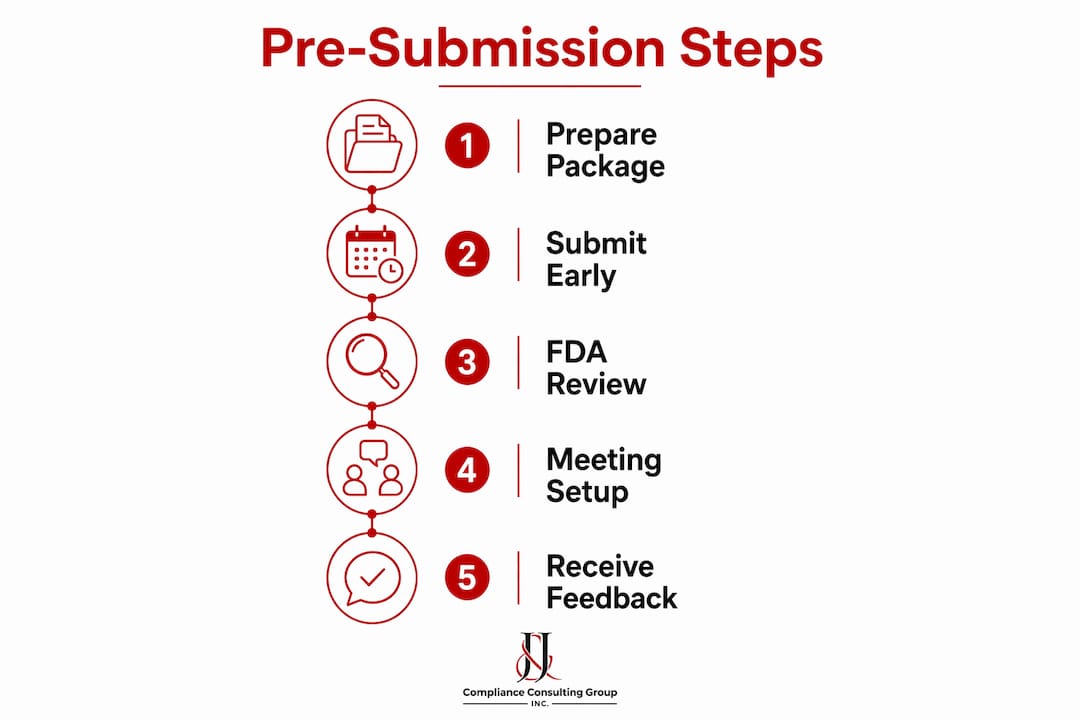
Pro Tip: Submit your Pre-Sub package at least 70 days before you need FDA’s feedback. FDA targets a 70-day response timeline from acceptance, and delays in submission directly compress your planning window.
What questions are best suited for a pre-submission meeting?
Question selection is where most teams either maximize or waste the value of a Pre-Sub. Overbroad questions produce generic answers; questions tied to specific regulatory decision points produce specific, usable guidance.
Appropriate Pre-Sub question categories include:
- Regulatory pathway: “Does FDA agree that our device meets the predicate criteria for a 510(k) submission based on the following substantial equivalence argument?”
- Study design: “Does FDA agree that the proposed clinical protocol, including sample size and endpoints, is sufficient to support a PMA?”
- Testing strategy: “Is the proposed biocompatibility testing plan, following ISO 10993-1, adequate for the intended use?”
- Manufacturing and quality controls: “Does FDA have concerns with the proposed manufacturing process controls for sterility assurance?”
Compare these to an overbroad question: “What does FDA think about our overall development plan?” That question will not produce a useful Pre-Sub response. FDA expects sponsors to have done the regulatory thinking before the meeting. The Pre-Sub is for confirming or refining specific conclusions, not for outsourcing strategic planning to the agency.
For drug and biologic products, Pre-IND meetings center on nonclinical safety study design, early clinical trial design, and manufacturing controls. FDA also uses these meetings to discuss pediatric study plans and target product profiles. The focus is always on IND-enabling decisions, not broad scientific background.
Pro Tip: Frame every question as a yes/no or agree/disagree question with a proposed position. “Does FDA agree that X is sufficient for Y?” forces a clear, citable FDA response. Open-ended questions invite open-ended answers.
The documented response from a Pre-Sub is categorically different from an informal communication. A phone call with an FDA reviewer is not binding and cannot be cited in a submission. The official Pre-Sub feedback record is part of the regulatory file and carries weight throughout the review process.
How does fda’s electronic submission system affect pre-sub workflows?
The mechanics of how you submit your Pre-Sub package directly affect your timeline. FDA’s ESG NextGen platform is the primary electronic submission gateway, providing secure routing, receipt acknowledgment, and notification functions. It does not perform review. ESG NextGen replaced legacy submission systems and integrates with the Unified Submission Portal to handle increased submission volume and file sizes.
The table below summarizes the key submission channels and their operational parameters:
| Submission Channel | File Size Limit | Processing Notes |
|---|---|---|
| ESG NextGen / USP | Large files supported | Primary channel; secure routing and acknowledgment |
| Email submission | Under 150 MB | Accepted for CBER-regulated products as an alternative |
| Electronic media | No stated limit | Fallback when electronic channels are unavailable |
| Paper submission | N/A | Last resort; significantly slower processing |
Timing is a non-negotiable operational factor. Submissions received before 4 PM ET on business days are processed the same day. Submissions received after 4 PM ET are processed the next business day. That single-day difference can shift your entire meeting schedule if you are working against a tight development timeline.
Sponsors who build internal submission deadlines around the 4 PM ET cut-off avoid cascading delays. A package submitted at 4:15 PM on a Friday effectively loses three calendar days before it enters FDA’s queue. Electronic submission timing is a controllable variable. Treat it as one.
Key takeaways
The FDA Pre-Submission meeting is the most direct way to obtain binding, documented FDA feedback before a formal submission, and its value depends entirely on how well you prepare your questions and package.
| Point | Details |
|---|---|
| Pre-Sub is voluntary but strategic | FDA encourages early interaction because it improves submission quality and reduces review deficiencies. |
| Limit questions to four primary topics | Exceeding four topics dilutes FDA’s focus and produces less specific, less useful feedback. |
| Written feedback precedes the meeting | FDA issues written responses 3–5 days before the meeting, giving sponsors time to prepare follow-up discussion. |
| Submit before the 4 PM ET cut-off | Packages received after 4 PM ET are processed the next business day, compressing your planning timeline. |
| Pre-Sub minutes are the official record | Agreed-upon meeting minutes carry regulatory weight; informal communications do not. |
What i’ve learned after years of pre-sub meeting preparation
The most common mistake I see regulatory teams make is treating the Pre-Sub as a discovery session. They arrive with broad questions and expect FDA to help them figure out their strategy. That is not what this program is for, and FDA’s responses reflect that misuse. The teams that get the most value from Pre-Sub meetings are the ones that walk in with a fully formed position and ask FDA to confirm or correct it.
Cross-functional alignment before the meeting is not optional. I have seen Pre-Sub packages where the clinical, regulatory, and manufacturing teams each contributed questions without coordinating. The result was a package with six questions covering three different regulatory decision points, none of them scoped tightly enough to produce a useful answer. FDA’s response was predictably generic.
The other underappreciated element is post-meeting follow-through. Sponsors draft the meeting minutes, which means you control the language. That is significant. The minutes should accurately reflect FDA’s statements, but they should also be written with precision. Vague minutes produce vague agreements. I recommend having your regulatory lead and legal counsel review the draft minutes before submission to FDA for agreement.
For teams preparing IND submission strategy, the Pre-IND meeting serves the same function as the Pre-Sub but with a sharper focus on nonclinical safety and clinical trial design. The preparation discipline is identical. The earlier you engage FDA with a well-prepared package, the more useful the feedback. Waiting until you are close to submission defeats the purpose.
The Pre-Sub program is one of the few places in the FDA submission process where you can get a direct answer before you commit resources. Use it with precision, and it pays back many times over.
— Mike
How Jjccgroup supports your pre-submission strategy
Preparing an effective Pre-Sub package requires regulatory expertise, cross-functional coordination, and a clear understanding of what FDA expects at each stage of product development. Jjccgroup brings over 30 years of FDA regulatory consulting experience to pharmaceutical, medical device, dietary supplement, and food and beverage clients navigating this process.
Jjccgroup’s team helps you scope questions correctly, structure your briefing package for maximum FDA engagement, and manage submission logistics through ESG NextGen and the Unified Submission Portal. After the meeting, Jjccgroup supports post-meeting minute drafting and integration of FDA feedback into your broader regulatory strategy. For manufacturers ready to reduce submission risk and accelerate time to market, explore Jjccgroup’s FDA compliance services to see how expert-guided preparation changes outcomes.
FAQ
What is an FDA pre-submission meeting?
An FDA Pre-Submission meeting is a formal interaction under the Q-Submission program where sponsors receive documented FDA feedback on specific regulatory questions before filing a premarket application or beginning clinical studies. It applies to 510(k), PMA, De Novo, IDE, and IND pathways.
Is a pre-submission meeting required before submitting to FDA?
The Pre-Sub program is voluntary, not mandatory, but FDA actively encourages early interaction because it improves submission quality and reduces the likelihood of deficiencies during formal review.
How many questions can you ask in a pre-sub meeting?
FDA limits Pre-Sub packages to a maximum of four primary questions. Exceeding that limit reduces the specificity of FDA’s feedback and diminishes the overall utility of the meeting.
How long does the pre-submission process take?
FDA targets a 70-day response timeline from acceptance of the Pre-Sub package. The meeting itself typically runs 60 minutes, with written FDA feedback issued 3–5 days before the scheduled meeting date.
What is the difference between a pre-sub and an informal FDA communication?
A Pre-Sub produces an official FDA feedback record that enters the regulatory file and can be cited in formal submissions. Informal communications such as emails or phone calls carry no regulatory weight and should not be relied upon for critical development decisions.
Recommended
- FDA Meeting Preparation Consulting: A Founder’s Guide – J&J Consulting Group- FDA Regulatory Compliance
- FDA Meeting Preparation Consulting: A How-To Guide – J&J Consulting Group- FDA Regulatory Compliance
- FDA Pre-Sub Consulting: The Ultimate Guide | JJCC Group
- FDA Q-Submission Consulting Experts | J&J Compliance
