




Medical devices submission is the formal regulatory process of preparing and filing a complete documentation package with the FDA to demonstrate that a new device meets safety, efficacy, and quality standards before it reaches the market. The FDA serves as the primary regulatory body overseeing this process in the United States. Since october 1, 2023, the FDA has required all 510(k) submissions to use the eSTAR electronic template, with De Novo classification requests following suit by october 1, 2025. The 2026 Quality Management System Regulation (QMSR), which aligns with ISO 13485:2016, has added new compliance layers that every regulatory affairs professional must account for. Common submission types include the 510(k), De Novo, and Premarket Approval (PMA), each tied to device classification and risk level.
What are the main FDA submission pathways for medical devices?
The FDA organizes medical devices into three classes based on risk, and that classification determines your submission pathway. Class I devices carry the lowest risk and are often exempt from premarket notification. Class II devices typically require a 510(k) submission. Class III devices, which carry the highest risk, generally require a PMA.
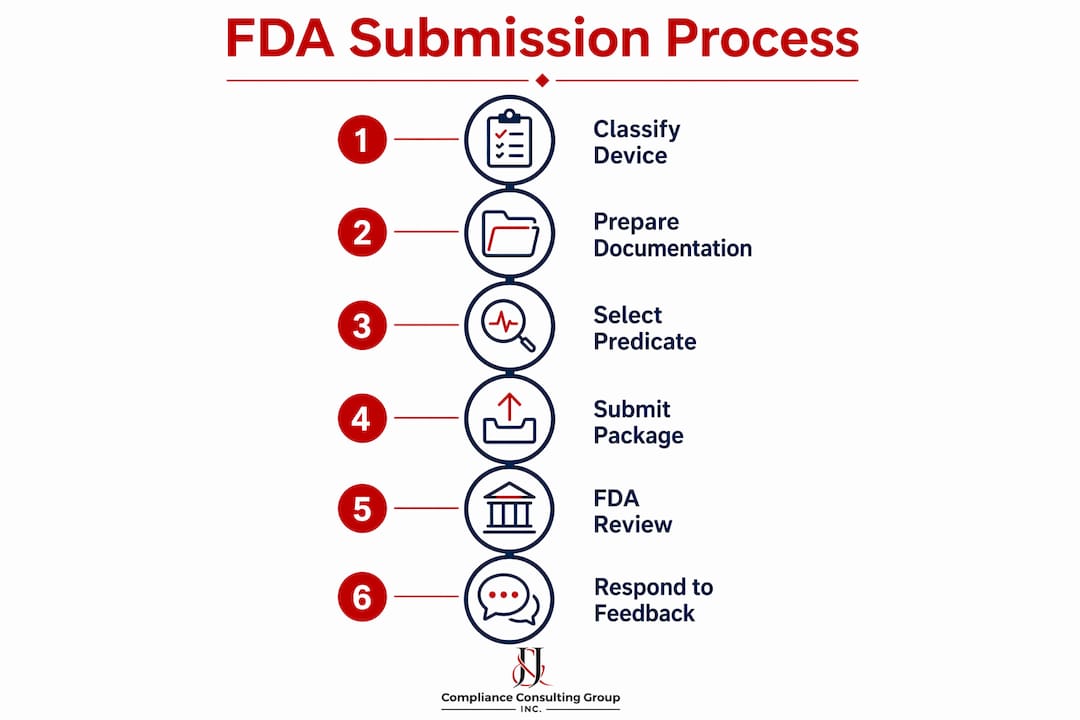
The 510(k) pathway is the most common route for Class II devices. It comes in three forms: Traditional, Special, and Abbreviated. A Traditional 510(k) demonstrates substantial equivalence to a legally marketed predicate device. A Special 510(k) is used for modifications to your own cleared device. An Abbreviated 510(k) relies on FDA guidance documents or special controls to demonstrate equivalence. Selecting the right predicate is the most critical strategic decision in this process. Poor predicate selection leads to testing gaps, extended review cycles, or outright rejection.
The De Novo pathway applies when no legally marketed predicate exists for a novel, low-to-moderate risk device. A successful De Novo classification creates a new device type and can itself serve as a predicate for future 510(k) submissions. Many device developers skip verifying device classification and exemptions, which leads to unnecessary or incorrect submission types.
- Class I: Most are exempt from 510(k); subject to general controls only
- Class II: Typically requires a 510(k); subject to special controls
- Class III: Requires PMA with clinical data; highest scrutiny
- De Novo: For novel low-to-moderate risk devices with no predicate
- Exempt devices: Verify exemption status before assuming no submission is needed
Pro Tip: Before selecting a predicate device, confirm its cleared intended use and technological characteristics in the FDA’s 510(k) database. A predicate that looks similar on the surface may carry performance standards that increase your testing burden significantly.
What does a complete FDA submission package require?
A complete medical device submission package includes device description, intended use, performance testing data, labeling, biocompatibility data, software documentation, and sterilization validation where applicable. Each element must be organized within the FDA’s eSTAR interactive PDF, which contains built-in logic and validation checks. This structure replaces the legacy free-form PDF format and reduces incomplete applications.

The eSTAR template’s complexity demands significant preparatory effort. Rushed or incomplete entries are a leading cause of technical screening rejections. The template guides submitters through each required section, but it does not write the content for you. Teams that underestimate the preparation time often face delays before the substantive review even begins.
Submissions are filed through the FDA’s CDRH Portal or the Electronic Submissions Gateway (ESG). User fees apply to most 510(k) and De Novo submissions, with small business discounts available. The table below compares the traditional PDF approach with the current eSTAR format.
| Feature | Traditional PDF submission | eSTAR structured submission |
|---|---|---|
| Format | Free-form PDF sections | Interactive PDF with built-in logic |
| Validation | Manual review only | Automated checks flag missing fields |
| Completeness risk | High; errors caught late | Lower; template guides entry |
| FDA acceptance | No longer accepted for 510(k) or De Novo | Required since 2023 (510k) and 2025 (De Novo) |
| Review efficiency | Slower; more back-and-forth | Faster initial screening |
Pro Tip: Use the Pre-Submission process to get formal FDA feedback on your predicate selection, testing plan, and software documentation before you file. A Pre-Sub meeting can prevent months of rework after submission.
What is the FDA review timeline for a 510(k) in 2026?
The FDA targets a 90-calendar day substantive review period for 510(k) submissions. That clock starts after the submission passes Acceptance Review and Technical Screening, not on the day you file. Understanding this distinction helps you set realistic internal timelines.
The review process follows a defined sequence:
- File submission via CDRH Portal or ESG before 4 PM ET on a business day to receive same-day receipt.
- Acceptance Review confirms the submission meets basic administrative requirements within 15 business days.
- Technical Screening checks for completeness; Refuse to Accept (RTA) criteria apply here.
- Substantive Review begins; the FDA reviewer evaluates safety and effectiveness data.
- Additional Information (AI) request may be issued if the reviewer needs clarification or more data.
- Submitter response must be filed within 180 days of an AI request or the submission is considered withdrawn.
- Final decision is issued as Substantially Equivalent (SE), Not Substantially Equivalent (NSE), or a request for additional data.
The FDA processes submissions uploaded before 4 PM ET on business days as received that same day. Missing that cutoff shifts your receipt date by one business day, which matters when you are managing a tight approval timeline.
Failing to respond to a deficiency letter within 180 days results in automatic withdrawal. That means you restart the entire process, including paying user fees again. Teams should build AI response workflows into their submission project plans from day one.
Under the 2026 QMSR, the FDA’s inspection program CP 7382.850 replaced the prior QSIT program. This new program focuses on quality management processes, internal audits, and traceability systems. Regulatory affairs teams preparing for FDA device inspections should align their quality systems with ISO 13485:2016 before any review begins.
How have QMSR and cybersecurity rules changed device submissions?
The QMSR took effect on february 2, 2026, replacing the legacy Quality System Regulation (QSR) and aligning FDA requirements with ISO 13485:2016. This change affects how manufacturers document their quality management systems, conduct internal audits, and demonstrate management review processes. Non-conformance in these areas is now a leading cause of compliance enforcement actions.
Cybersecurity requirements have added a separate documentation burden. The FDA requires a Software Bill of Materials (SBOM) under Section 524B of the FD&C Act for all cyber-connected medical devices. Missing this documentation is a common cause of submission deficiencies in 2026. Reviewers scrutinize cybersecurity submissions heavily, and incomplete SBOMs trigger AI requests that delay clearance.
Key regulatory changes manufacturers must address:
- QMSR alignment: Update your quality manual and procedures to reflect ISO 13485:2016 requirements, not just the legacy QSR framework
- Internal audits: Document audit schedules, findings, and corrective actions as FDA inspectors now review these records under CP 7382.850
- Management review: Maintain formal records of management review meetings, including inputs and outputs
- SBOM requirement: Prepare a complete Software Bill of Materials listing all software components, versions, and known vulnerabilities for connected devices
- Cybersecurity plan: Include a post-market monitoring plan for cybersecurity threats as part of your submission package
- Traceability systems: Demonstrate design history file traceability from requirements through verification and validation
Teams working toward ISO 13485 alignment will find that the QMSR transition is less disruptive when quality systems are already structured around process-based thinking. The manufacturers who treated QSR compliance as a checkbox exercise are now facing the steepest learning curve.
Key Takeaways
A complete, correctly formatted medical device submission requires accurate device classification, a well-chosen predicate, thorough documentation in eSTAR, and full alignment with the 2026 QMSR and cybersecurity mandates.
| Point | Details |
|---|---|
| Choose the right pathway | Device class determines whether you file a 510(k), De Novo, or PMA; verify classification before drafting. |
| Master the eSTAR format | The eSTAR interactive PDF is mandatory for 510(k) and De Novo; incomplete entries cause technical screening rejections. |
| Manage review timelines | The FDA targets 90 days for substantive review; respond to AI requests within 180 days or face withdrawal. |
| Align with QMSR | The 2026 QMSR requires ISO 13485:2016-aligned quality systems; internal audits and traceability records are now inspected. |
| Include cybersecurity documentation | A complete SBOM under FD&C Act Section 524B is mandatory for connected devices and heavily reviewed. |
What I’ve learned from watching submissions fail at the finish line
The most preventable submission failures I see share one trait: teams treat the regulatory package as a documentation exercise rather than a strategic argument. A 510(k) is not a form you fill out. It is a technical case you build, and every element, from predicate selection to biocompatibility rationale, either strengthens or weakens that case.
Predicate selection deserves more attention than most teams give it. Predicate device selection dictates the breadth and depth of comparison testing, which shapes your entire regulatory burden. I have seen companies choose a predicate based on product similarity alone, only to discover that the predicate’s cleared indications require performance testing the new device cannot pass. A Pre-Submission meeting with the FDA, used early and used well, prevents exactly this kind of costly pivot.
The eSTAR transition has also exposed a gap in how teams allocate preparation time. The template looks structured, but it requires substantive answers, not placeholders. Teams that rush the eSTAR entry phase often receive Refuse to Accept decisions that could have been avoided with an extra two weeks of internal review.
My strongest recommendation for 2026 is to treat QMSR compliance as a product development input, not a post-clearance task. Manufacturers who build ISO 13485:2016-aligned processes into their development workflow arrive at submission with documentation that is already inspection-ready. That is a real competitive advantage when the FDA’s inspection program is actively looking at audit trails and management review records.
— Mike
How Jjccgroup supports your medical device submission strategy
Preparing a complete, compliant FDA submission package requires more than filling out forms. It requires a clear regulatory strategy, accurate device classification, and documentation that holds up under FDA scrutiny.

Jjccgroup brings over 30 years of FDA regulatory experience to medical device companies at every stage of the submission process. From 510(k) submission consulting and eSTAR preparation to QMSR alignment and cybersecurity documentation, the team provides end-to-end support that reduces rework and shortens your path to clearance. Whether you are filing your first submission or managing a complex De Novo request, Jjccgroup’s FDA compliance services give your team the structure and expertise to move forward with confidence.
FAQ
What is a medical devices submission?
A medical devices submission is a formal regulatory filing to the FDA that demonstrates a device’s safety and effectiveness before it can be legally marketed in the United States. Common submission types include the 510(k), De Novo classification request, and Premarket Approval (PMA).
When is the eSTAR template required?
The eSTAR template is mandatory for all 510(k) submissions since october 1, 2023, and for De Novo classification requests since october 1, 2025, unless the FDA grants a specific exemption or waiver.
How long does FDA 510(k) review take?
The FDA targets a 90-calendar day substantive review period for 510(k) submissions, beginning after the submission clears Acceptance Review and Technical Screening. Responding to Additional Information requests within 180 days is required to avoid automatic withdrawal.
What does the 2026 QMSR require from manufacturers?
The QMSR, effective february 2, 2026, requires manufacturers to align their quality management systems with ISO 13485:2016, including documented internal audits, management reviews, and traceability systems. FDA inspections under program CP 7382.850 now focus directly on these process records.
What cybersecurity documentation does the FDA require for connected devices?
The FDA requires a Software Bill of Materials (SBOM) under Section 524B of the FD&C Act for all cyber-connected medical devices. Missing or incomplete cybersecurity documentation is one of the most common causes of submission deficiencies in 2026.
