





Reprocessing medical devices is not simply a matter of cleaning and repackaging. It is a regulated manufacturing activity with legal, clinical, and operational consequences that affect patient safety at every step. Understanding why reprocessing medical devices requires compliance is not optional for manufacturers or compliance officers — it defines whether your operation is lawful, your devices are safe, and your organization can withstand regulatory scrutiny. The economic and environmental benefits of reprocessing are real, but they do not reduce the regulatory burden. What follows breaks down exactly what is required, why, and how to get it right.
Table of Contents
- Key Takeaways
- The regulatory landscape for reprocessing medical devices
- Why compliance is mandatory in reprocessing
- Core compliance components and frameworks
- Challenges and common pitfalls in achieving compliance
- Practical steps for maintaining reprocessing compliance
- My perspective on compliance as a strategic asset
- How Jjccgroup can support your reprocessing compliance program
- FAQ
Key Takeaways
| Point | Details |
|---|---|
| Reprocessing equals manufacturing | Both FDA and EU MDR treat reprocessors as manufacturers, triggering full compliance obligations. |
| Labeling does not determine liability | FDA focuses on actual activities performed, not how entities categorize their own processes. |
| Traceability is non-negotiable | Complete lifecycle records are required for incident investigation, recalls, and post-market vigilance. |
| EU and US frameworks differ significantly | Compliance officers must address both FDA QMSR and EU MDR Article 17 if operating in multiple markets. |
| Compliance gaps carry serious consequences | Non-compliance can result in device recalls, infection outbreaks, and enforcement actions. |
The regulatory landscape for reprocessing medical devices
Medical device reprocessing encompasses far more than sterilization. It includes cleaning, disinfection, inspection, functional testing, refurbishment, and restoring a device to a condition suitable for patient use. When these activities result in significant changes to a device’s safety or performance profile, regulators on both sides of the Atlantic treat the entity responsible as the manufacturer of that device.
In the United States, the FDA draws a clear line between servicing and remanufacturing. Under 21 CFR 820.3(a), remanufacturing is defined as processing that significantly changes a finished device’s safety or effectiveness. Any entity whose activities meet that definition must comply with quality system regulations, registration requirements, and adverse event reporting. Servicing, by contrast, involves restoring a device to its original specification without altering its safety profile. The distinction matters enormously in practice, because crossing that threshold without recognizing it is one of the most common compliance failures in the industry.
In the European Union, EU MDR Article 17 removes much of the ambiguity. Any person who reprocesses a single-use device to make it suitable for further use within the EU is legally considered the manufacturer and must assume all manufacturer obligations. These obligations include:
- Conformity assessment and CE marking
- Clinical evaluation data demonstrating equivalent safety and performance
- Traceability systems covering every reprocessed unit
- Post-market surveillance and vigilance reporting
- Quality management system implementation
The two frameworks differ in scope and approach, but they share a foundational principle: reprocessing is manufacturing, and it must be treated as such.
Why compliance is mandatory in reprocessing
Patient safety is the clearest answer. Failure to appropriately reprocess reusable medical devices is consistently cited as a direct threat to patient health. Inadequate cleaning protocols have been linked to healthcare-associated infection outbreaks. Functional failures in reprocessed devices, from endoscopes to electrosurgical instruments, have caused patient harm that traced back directly to non-compliant reprocessing practices.
Regulatory compliance exists precisely to prevent these outcomes. The legal requirements are not arbitrary barriers. They reflect what the science of device validation, sterilization, and risk management has established as the minimum standard for acceptable patient risk. Here is what compliance in reprocessing legally demands:
- Traceability records that document every unit’s reprocessing history and enable targeted recalls when problems arise
- Performance testing that confirms the reprocessed device meets the original manufacturer’s specifications for function and safety
- Incident reporting to regulators whenever a reprocessed device contributes to a serious adverse event
- Quality management system documentation covering procedures, personnel training, and process controls
- Post-market surveillance that monitors real-world use data and triggers corrective action when safety signals emerge
When compliance fails, the consequences extend beyond regulatory penalties. Hospitals using non-compliant reprocessed devices face liability exposure. Reprocessors face recalls, Warning Letters, and in severe cases, injunctions halting operations entirely. The 2015 CRE outbreak linked to reprocessed duodenoscopes at multiple U.S. hospitals, which resulted in patient deaths, demonstrated what unchecked compliance gaps look like in practice.
Pro Tip: Do not wait for a regulatory inspection to assess your reprocessing program. Conduct internal audits against FDA and EU MDR requirements annually, and treat every near-miss as a signal that your quality system needs recalibration.
Core compliance components and frameworks
Compliance for reprocessed devices is built on four interconnected pillars: risk management, process validation, quality management systems, and post-market vigilance. Missing any one of them creates a gap that regulators will find.
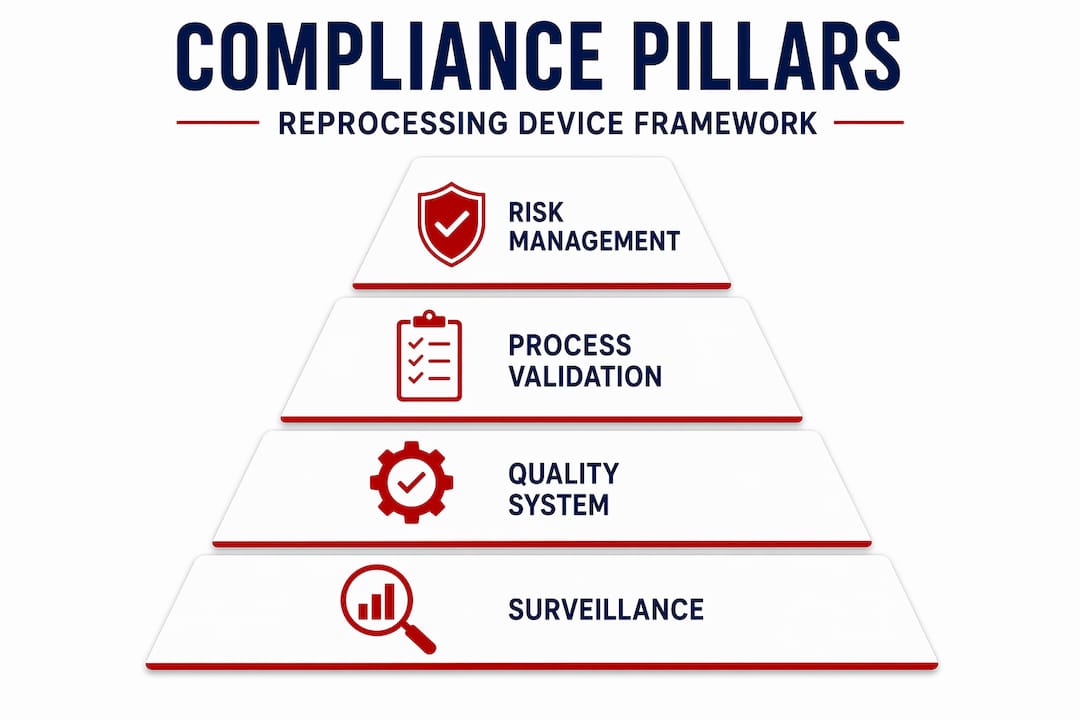
Risk management under EU MDR Article 17 requires reprocessors to conduct reverse engineering analysis to detect any changes in device construction that could affect performance. This is not a theoretical exercise. It means systematically comparing the reprocessed device’s physical and functional characteristics against the original manufacturer’s validated design, identifying any deviations, and documenting the risk assessment that supports continued use.
Process validation is equally demanding. Every cleaning procedure, sterilization cycle, and functional test must be validated for the specific device being reprocessed. Generic protocols are not acceptable. If you reprocess three different catheter types, you need validation data for each one.

The following table shows how key compliance requirements compare across the two major regulatory frameworks:
| Compliance element | FDA (QMSR / 21 CFR Part 820) | EU MDR Article 17 |
|---|---|---|
| Quality management system | ISO 13485 aligned QMSR, effective 2026 | ISO 13485 plus EU Common Specifications |
| Device registration | Required with FDA as manufacturer | CE marking and Notified Body involvement |
| Traceability | Required for recall readiness | Mandatory per Article 17 traceability rules |
| Post-market surveillance | MDR and adverse event reporting | Vigilance reporting and PMCF required |
| Risk management | ISO 14971 based approach | ISO 14971 plus clinical evaluation |
| Labeling obligations | Full labeling as manufacturer | Full manufacturer labeling requirements |
Post-market surveillance deserves special emphasis. Reprocessors must report incidents and maintain ongoing safety monitoring comparable to original device manufacturers. This is not a passive obligation. It requires active data collection, trend analysis, and documented response protocols.
Pro Tip: When building your quality management system for reprocessing, map each procedure directly to the regulatory requirement it satisfies. This creates an audit-ready traceability matrix that significantly reduces inspection preparation time.
Challenges and common pitfalls in achieving compliance
The most persistent compliance challenge is the mislabeling problem. Entities that call their operations “servicing” or “refurbishing” sometimes believe that terminology shields them from remanufacturing obligations. It does not. FDA’s enforcement focus is on the actual activities performed, not the label applied to them. If the activity results in a significant change to device safety or performance, it is remanufacturing regardless of what the organization calls it. For compliance officers, this means the regulatory pathway for medical device reprocessing must be assessed based on what you actually do, not how you describe it.
In the EU, fragmentation across member states adds another layer of complexity. National laws may prohibit or permit reprocessing under different conditions, and some states allow opt-outs from full manufacturer obligations under specific circumstances. Operating across multiple EU markets without understanding each country’s current position creates serious compliance exposure.
The top five compliance pitfalls that Jjccgroup sees repeatedly in practice:
- Assuming activity labels control regulatory status. What you do governs your obligations, not what you call it.
- Inadequate traceability systems. Missing or incomplete records make incident investigation and recalls nearly impossible.
- Generic validation protocols. Validation must be device-specific. One procedure does not cover multiple device types.
- Gaps in post-market surveillance. Collecting complaints is not the same as having an active safety monitoring program.
- Ignoring national law variability in the EU. Compliance with EU MDR alone does not guarantee compliance in every member state.
Addressing these pitfalls requires a structured compliance review against both the applicable regulatory framework and the specific activities your organization performs. The reprocessing safety guide published by Jjccgroup provides a practical starting point for that assessment.
Practical steps for maintaining reprocessing compliance
Getting compliance right requires disciplined process design, not just policy documentation. Start with the validation of your cleaning and sterilization procedures. Each process must be validated against device-specific parameters, including material compatibility, cycle time, temperature, and residual contamination testing. Validation is not a one-time activity. It requires revalidation when device specifications change, when equipment is replaced, or when process inputs shift.
A structured compliance maintenance program should include these numbered activities:
- Conduct device-specific risk assessments using ISO 14971 before beginning any new reprocessing program
- Validate all cleaning, disinfection, and sterilization cycles for each device type with documented acceptance criteria
- Establish a traceability system that links each reprocessed unit to its processing records, operator, equipment, and release testing data
- Implement a quality management system aligned with FDA QMSR and ISO 13485, covering training, corrective actions, and management review
- Activate post-market surveillance protocols including complaint handling, adverse event reporting, and trend analysis schedules
- Prepare audit-ready documentation packages covering procedures, validation reports, training records, and incident logs
- Review national regulations annually for every market in which you distribute reprocessed devices
The single-use device testing requirements are particularly relevant to risk analysis and validation planning. Simulated use testing data provides the clinical evidence regulators expect when equivalence to an original device must be demonstrated.
My perspective on compliance as a strategic asset
I have worked with reprocessors who treat compliance as a cost center. That mindset is the most expensive one in this industry. What I have seen, repeatedly, is that organizations which build compliance into their reprocessing operations from day one spend a fraction of what reactive organizations spend on remediation, recalls, and enforcement response.
The deeper truth is that closed-loop traceability is not just a regulatory requirement. It is the operational backbone of a reprocessing program that can scale, respond to problems quickly, and earn the trust of hospital customers who are increasingly sophisticated about supplier compliance. When a hospital asks you for evidence that your reprocessed devices meet original performance specifications, your answer to that question is your market position.
I also believe the industry underestimates how fast the regulatory landscape is shifting. FDA’s QMSR alignment with ISO 13485, effective 2026, is raising the floor for every reprocessor operating in the U.S. market. EU member states are tightening their national positions on single-use device reprocessing. The organizations that treat today’s standards as the ceiling will find themselves in remediation mode within three to five years. The ones that treat compliance as a living program will be ahead of the next wave before it arrives.
— Mike
How Jjccgroup can support your reprocessing compliance program
Managing compliance across FDA and EU MDR frameworks simultaneously is one of the most technically demanding challenges in medical device operations. Jjccgroup brings over 30 years of regulatory consulting experience to exactly that challenge.

Whether you are establishing a new reprocessing program, preparing for an FDA inspection, or working to align your quality management system with the updated QMSR requirements, Jjccgroup’s team provides the documentation strategy, process validation guidance, and regulatory submission support that compliance officers need. The firm’s work spans regulatory approval consulting and strategic compliance planning, covering both U.S. and international regulatory requirements. Clients describe the experience as transformative — not because compliance becomes simple, but because they finally have a partner who understands every dimension of it.
FAQ
What does it mean for a reprocessor to be considered a manufacturer?
Under EU MDR Article 17, any entity that reprocesses a single-use device for further use is legally considered the manufacturer and must fulfill all manufacturer obligations, including conformity assessment, traceability, and post-market surveillance.
How does FDA distinguish remanufacturing from servicing?
FDA defines remanufacturing as any processing that significantly changes a device’s safety or effectiveness under 21 CFR 820.3(a). Servicing restores a device to its original specification. The distinction determines which regulatory obligations apply.
What are the biggest risks of non-compliance in reprocessing?
Non-compliance can result in healthcare-associated infection outbreaks, device recalls, FDA Warning Letters, and legal liability for both reprocessors and the healthcare facilities that use non-compliant devices.
Does labeling a process as “servicing” reduce regulatory obligations?
No. FDA’s enforcement focus is on actual activities performed, not the label applied. If an activity significantly changes device safety or performance, it triggers remanufacturing requirements regardless of what the organization calls the process.
What is required for traceability in reprocessed device compliance?
Reprocessors must maintain records linking each unit to its complete processing history, operator data, equipment records, and release testing results to support incident investigation, recalls, and ongoing post-market vigilance.
Recommended
- Reusable Medical Device: A 4-Step Safety Guide – J&J Consulting Group- FDA Regulatory Compliance
- SaMD Consulting 101: The Ultimate 2025 Guide
- ISO 10993 Parts List: A Biocompatibility Overview – J&J Consulting Group- FDA Regulatory Compliance
- Single-Use Device Testing: What You Need to Know – J&J Consulting Group- FDA Regulatory Compliance
