



Compliance in food product development is the legal and operational requirement to meet safety, labeling, traceability, and hygiene standards before a product reaches consumers. Skip it, and you face recalls, regulatory fines, and permanent brand damage. Integrate it early, and you protect consumers, accelerate market entry, and build the kind of credibility that sustains long-term growth. The importance of compliance in food product development is not a checkbox at the end of your process. It is the architecture your entire development program must be built on.
Why food product development needs compliance from day one
The most expensive compliance mistake in food manufacturing is treating regulatory requirements as a final review step. Regulatory experts should be involved at the concept definition phase, guiding formulation and labeling decisions before a single batch is produced. That single shift prevents the reformulations and launch delays that derail timelines and inflate costs.
Food product standards govern far more than what goes on the label. They shape which ingredients you can legally use, how allergens must be declared, what nutrition claims are permissible, and how your manufacturing environment must be controlled. Discovering a prohibited ingredient or a non-compliant health claim after pilot production means scrapping work, restarting formulation, and losing weeks or months of development time.
Early regulatory constraints shape formulation decisions and prevent late-stage cost overruns. This means your quality and regulatory teams must sit alongside R&D from the first concept meeting, not arrive as auditors after the fact.
- Identify ingredient authorizations before formulation begins
- Validate allergen declarations against current regional requirements
- Confirm nutrition labeling compliance before packaging design is finalized
- Screen health claims through legal and regulatory review prior to marketing approval
- Map hazard controls to HACCP requirements at the ingredient selection stage
Pro Tip: When developing products for multiple markets, build a compliance matrix at the concept stage that maps each ingredient and claim against the regulatory requirements of every target region. This prevents the common problem of a product that clears FDA requirements but fails EU Novel Food rules.
How does traceability work as a compliance requirement?
Traceability is the documented ability to follow a food product through every stage of production, processing, and distribution. EU Regulation (EC) 178/2002 mandates traceability across the entire food chain, requiring operators to identify their suppliers and customers and make that information accessible to authorities on demand. In the United States, FSMA 204 requires electronic traceability records for high-risk food categories, capturing Critical Tracking Events and Key Data Elements, with full compliance required by 2028. Together, these regulations define a global standard that food manufacturers cannot ignore.

The practical value of traceability becomes clear during a recall. Batch and lot linking allows you to isolate the affected product precisely, rather than pulling entire product lines from shelves. That precision protects consumers faster and limits financial losses significantly.
| Traceability Requirement | EU (EC 178/2002) | U.S. (FSMA 204) |
|---|---|---|
| Scope | All food chain operators | High-risk food categories |
| Record format | Accessible to authorities | Electronic records required |
| Key requirement | Supplier and customer identification | Critical Tracking Events and Key Data Elements |
| Compliance deadline | Already in force | Full compliance by 2028 |
| Recall application | Targeted batch/lot isolation | Rapid recall via linked records |
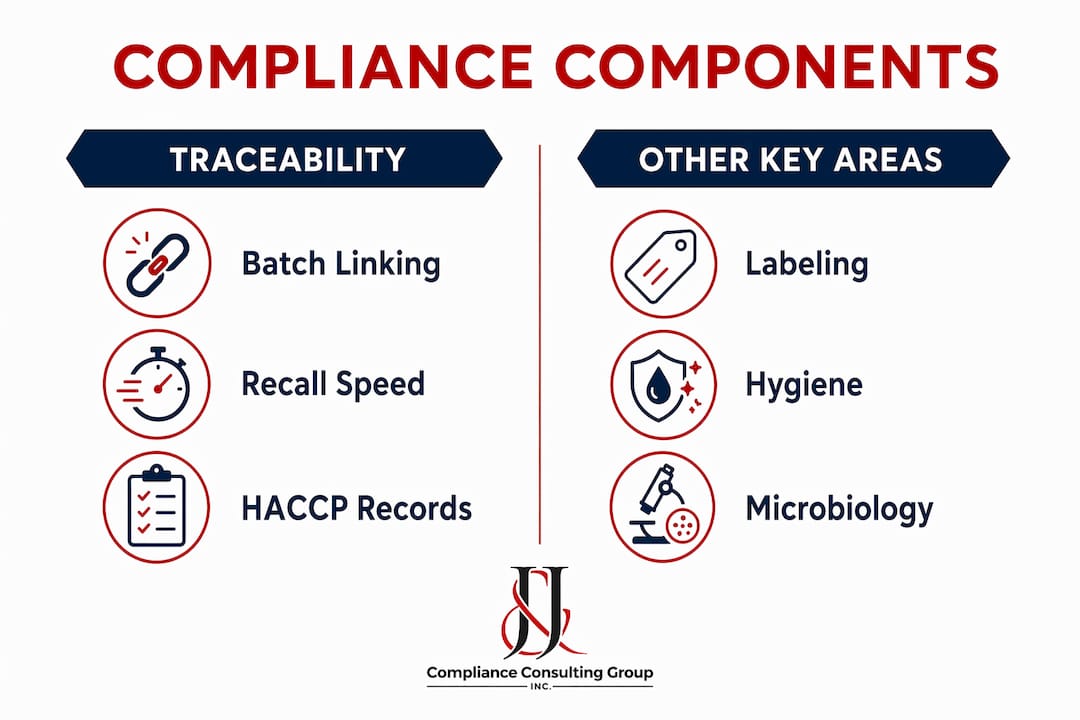
Traceability system speed is critical. EU authorities and buyers expect manufacturers to respond “without delay,” with effective systems capable of tracing products within hours. A slow or incomplete traceability response is not just an operational failure. It is a regulatory violation that triggers enforcement actions and financial penalties.
Traceability is also inseparable from HACCP, since both require documented records at critical control points and batch linking to confirm product safety. Regulatory inspections routinely test traceability by selecting a finished product and requiring the manufacturer to trace it upstream and downstream in real time.
Pro Tip: Run mock recalls at least twice a year. Select a random batch, start the clock, and measure how quickly your team can retrieve all linked records. Regulators expect a response within hours. If your team needs days, your traceability system needs immediate attention.
What are the key compliance components beyond traceability?
Traceability is one pillar of food safety regulations. Labeling, hygiene standards, and microbiological safety requirements form the others, and each carries its own legal obligations and enforcement risks.
Labeling compliance is where many manufacturers face the most visible failures. Food labeling requires mandatory allergen declarations, complete ingredient listings, accurate nutritional information, and legally approved health claims. Misbranding, whether from an omitted allergen or an unapproved claim, triggers regulatory sanctions and product recalls. Cross-checks between legal and quality departments before launch are not optional. They are the last line of defense against costly post-market corrections.
Hygiene standards carry equal weight, particularly for products of animal origin. Regulation (EC) No 853/2004 sets specific hygiene rules for animal-origin food products, supplementing general food safety requirements. Food operators must comply with detailed annex provisions covering everything from slaughter hygiene to cold chain management.
Microbiological safety is a compliance area that catches many developers off guard, especially when working with novel ingredients. Novel food ingredients introduce hidden microbiological risks that require comprehensive microbiology criteria and challenge studies before regulatory approval. A challenge study tests whether your product formulation can inhibit pathogen growth under realistic storage conditions. Skipping this step with a new ingredient is a direct path to a safety incident.
- Allergen declarations must be reviewed against the specific requirements of each target market, since the EU and U.S. allergen lists differ
- Nutritional claims must meet both compositional thresholds and approved claim language for the relevant jurisdiction
- Hygiene compliance for animal-origin products requires documented adherence to Regulation (EC) No 853/2004 annex provisions
- Novel ingredients require microbiological challenge studies as part of the regulatory submission process
- Global product development demands compliance portfolio management, since labeling and safety requirements vary significantly across regions
How do you build a compliance management system for food manufacturing?
A compliance management system is the structured program that translates regulatory requirements into daily operational practice. Regulators evaluate the existence and effectiveness of these systems when enforcement actions occur. A well-designed program directly influences the severity of penalties if a violation is found.
The foundation of any effective compliance program is what regulators call “tone at the top.” Senior leadership must visibly prioritize compliance, allocate resources to it, and hold teams accountable. Without that organizational commitment, policies become documents that no one reads and training becomes a formality that no one takes seriously.
Here is how to build a compliance management system that actually functions under regulatory scrutiny:
- Establish written policies and procedures that translate each applicable regulation into specific operational requirements, with clear ownership assigned to named roles.
- Deliver role-specific training so that production staff, quality managers, and regulatory affairs personnel each understand the compliance obligations relevant to their function.
- Implement ongoing monitoring through internal audits, process checks, and documentation reviews that identify gaps before regulators do.
- Create a consumer complaint process that captures, investigates, and resolves product safety concerns systematically, with records retained for regulatory review.
- Conduct independent audits at regular intervals. Internal teams develop blind spots. External auditors identify risks that internal reviews miss.
- Extend compliance oversight to suppliers and third parties. Your compliance program is only as strong as the weakest link in your supply chain. Supplier qualification and ongoing monitoring are non-negotiable.
Effective programs include tone at the top, structured policies, training, and independent auditing. The quality of your compliance management system directly shapes your legal exposure when something goes wrong. Manufacturers with documented, functioning programs consistently receive more favorable regulatory outcomes than those without.
For food product developers working across multiple categories, connecting your compliance management system to your food safety compliance requirements framework creates a single source of truth that supports both daily operations and regulatory inspections.
Key takeaways
Compliance in food product development is a strategic requirement that protects consumers, prevents costly reformulations, and determines your legal exposure when regulators investigate.
| Point | Details |
|---|---|
| Integrate compliance early | Involve regulatory experts at concept stage to prevent reformulations and launch delays. |
| Traceability is legally mandatory | EU Regulation (EC) 178/2002 and FSMA 204 require documented batch tracking accessible to authorities. |
| Labeling errors trigger recalls | Allergen declarations, nutrition claims, and ingredient listings must be cross-checked before launch. |
| Compliance systems reduce legal risk | Regulators assess the quality of your compliance program when determining enforcement penalties. |
| Novel ingredients need extra scrutiny | Microbiological challenge studies are required for new ingredients before regulatory approval. |
Why reactive compliance is the most expensive strategy in food development
After working with food and beverage manufacturers across multiple regulatory jurisdictions, the pattern I see most often is not ignorance of the rules. It is the decision to treat compliance as something you handle after the product is developed. That decision costs more than most teams realize until they are already in trouble.
I have seen manufacturers reach pilot production with a formulation built around an ingredient that was not authorized in their primary market. The reformulation cost was significant, but the real damage was the six-month delay that allowed a competitor to capture the shelf space they had been targeting. The compliance failure did not just cost money. It cost market position.
The manufacturers who consistently outperform their peers on time-to-market are the ones who treat regulatory intelligence as a product development input, not a post-development filter. They know which ingredients are authorized before they select them. They validate labeling claims before they design packaging. They run mock recalls before regulators ask for one.
Compliance in the food industry is also a competitive differentiator that most manufacturers underutilize. A documented, audited compliance management system signals to retail buyers, co-manufacturers, and international distributors that your products are low-risk partners. That signal opens doors that technical product quality alone cannot.
The practical advice I give every food product developer is this: your compliance program should be able to answer three questions at any moment. What is in this product and is every ingredient authorized? Where did every batch go and can you retrieve that information in hours? Does your label reflect exactly what is in the package, with every required declaration present and accurate? If you cannot answer all three with confidence, your compliance program has gaps that need attention before your next product launch.
— Mike
How Jjccgroup supports food product developers with compliance
Food product developers who want to build compliance into their process from the start, rather than fix it after the fact, need more than a checklist. They need regulatory expertise that covers formulation, labeling, traceability, and safety standards across the jurisdictions where their products will be sold.
Jjccgroup brings over 30 years of FDA regulatory experience to food and beverage manufacturers navigating exactly these challenges. From regulatory approval consulting to compliance management system design, Jjccgroup provides the structured guidance that turns regulatory requirements into a manageable, repeatable process. Whether you are launching a novel ingredient, entering a new market, or building out your traceability infrastructure, Jjccgroup’s team works alongside yours to reduce risk and accelerate your path to market. Explore Jjccgroup’s food and beverage consulting services to see how expert regulatory support translates into faster, safer product launches.
FAQ
Why does food product development need compliance?
Compliance in food product development protects consumers from unsafe products and protects manufacturers from recalls, fines, and legal penalties. Without it, products risk failing regulatory review, triggering enforcement actions, or causing consumer harm.
What is traceability in food manufacturing?
Traceability is the documented ability to track a food product from raw materials through production to the end customer, with records accessible to regulators on demand. EU Regulation (EC) 178/2002 and U.S. FSMA 204 both mandate traceability systems capable of supporting rapid, targeted recalls.
When should compliance be integrated into product development?
Compliance should be integrated at the concept definition stage, before formulation begins. Involving regulatory experts early prevents costly reformulations caused by unauthorized ingredients, non-compliant claims, or labeling errors discovered late in development.
What are the consequences of non-compliance in the food industry?
Non-compliance leads to product recalls, regulatory fines, misbranding sanctions, and reputational damage. Regulators also assess the quality of a manufacturer’s compliance management system when determining the severity of enforcement penalties.
What does a food compliance management system include?
An effective compliance management system includes written policies, role-specific training, ongoing monitoring, consumer complaint processes, independent audits, and supplier oversight. Regulators evaluate the existence and effectiveness of these programs during enforcement reviews.
Recommended
- Product Development Compliance: A Practical Guide – J&J Consulting Group- FDA Regulatory Compliance
- FDA Product Compliance: A Step-by-Step Guide – J&J Consulting Group- FDA Regulatory Compliance
- Pharmaceutical Development Compliance: Your Essential Guide – J&J Consulting Group- FDA Regulatory Compliance
- Dietary Supplement Compliance: Essential FDA Requirements for Brands
