




A compliance officer in the tobacco industry is a dedicated professional responsible for ensuring that companies meet all legal and regulatory obligations tied to tobacco product manufacturing, marketing, and sales. The role exists because the tobacco sector operates under one of the most demanding regulatory frameworks in American commerce, governed by the FDA, the Prevent All Cigarette Trafficking (PACT) Act, and a dense web of state and local laws. Without a qualified compliance officer, tobacco companies face penalties that can reach six figures monthly, product seizures, license revocations, and the loss of access to major shipping carriers. Understanding why tobacco companies need compliance officers starts with recognizing that regulatory failure is not a theoretical risk. It is a documented, recurring operational threat.
Why tobacco companies need compliance officers in 2026
The regulatory environment surrounding tobacco is not static. Federal oversight from the FDA covers product approval, marketing restrictions, ingredient reporting, and labeling requirements. The PACT Act adds a separate layer of obligations specific to online and mail-order tobacco sales, including age verification, carrier reporting, and monthly sales reporting to state tax authorities. State and local governments compound this complexity with their own licensing requirements, excise tax structures, and zoning restrictions that vary by jurisdiction.

The scale of vendor-level knowledge gaps makes the situation more urgent. 73.3% of tobacco vendors were unaware of specific tobacco control licensing regulations in a recent study. That figure represents a systemic vulnerability. When the people selling tobacco products do not understand the laws governing those sales, the liability flows directly back to the manufacturer or distributor.
Key regulatory challenges that make compliance officers indispensable include:
- FDA premarket authorization: New tobacco products require Premarket Tobacco Product Applications (PMTAs) before they can legally enter the market. Errors in this process delay product launches and invite enforcement action.
- PACT Act reporting: Sellers must file monthly reports with state tax administrators and collect applicable taxes. Missing a single filing cycle triggers penalties.
- Age verification at point of sale: Both in-store and online channels must verify purchaser age. The FDA mandates that no tobacco products be sold to anyone under 21.
- Carrier compliance: Shipping tobacco products requires adherence to carrier-specific rules that align with federal law. Violations result in carrier bans.
- State licensing: Each state where a tobacco company operates or ships products may require separate licenses, each with its own renewal schedule and compliance conditions.
Pro Tip: Build a jurisdiction matrix that maps every state where your company ships or sells tobacco products against its specific licensing, tax, and reporting requirements. Update it quarterly. This single document becomes the foundation of your compliance calendar.
How do compliance officers manage age verification and tax reporting?
Age verification and tax reporting are the two operational areas where tobacco compliance officers spend the most concentrated effort. Both carry direct legal exposure and both require integration across sales, logistics, and finance functions.
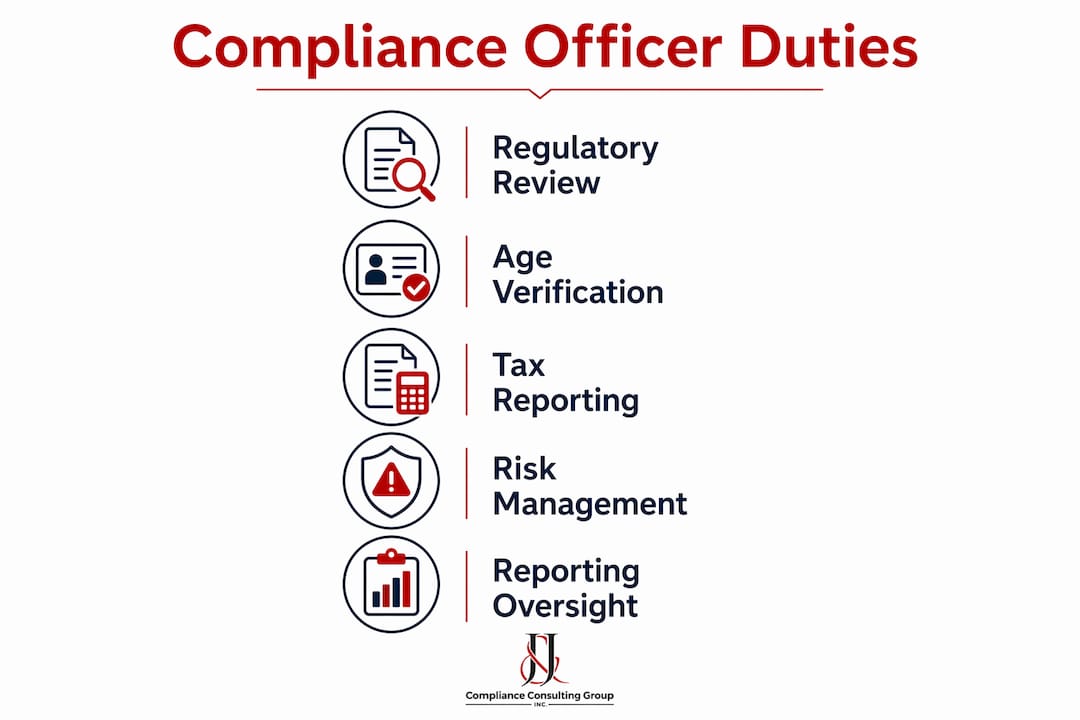
On the age verification side, the compliance officer’s job is to select, implement, and audit the systems that prevent underage sales. Age verification software is legally required for online tobacco sellers, and adult signature upon delivery is mandated to prevent youth access. Despite these requirements, the majority of online e-cigarette stores have failed to enforce age verification and signature-on-delivery requirements. This gap is exactly where a compliance officer’s oversight creates measurable risk reduction.
A structured approach to managing these two critical areas typically follows this sequence:
- Audit existing verification systems. Identify whether current ID scanners, third-party verification software, or point-of-sale integrations meet FDA and PACT Act standards. Tools like AgeID, Veratad, and similar platforms are commonly deployed for online channels.
- Establish vendor compliance protocols. Retailers and distributors must receive written guidance on age verification procedures. The compliance officer documents this training and retains records for audit purposes.
- Configure tax collection at the transaction level. Excise taxes on tobacco products differ by product type and jurisdiction. The compliance officer works with accounting systems to apply the correct rate at the point of sale.
- File monthly PACT Act reports. Each state that receives tobacco shipments requires a monthly sales report. The compliance officer owns this calendar and coordinates with finance to pull accurate data.
- Maintain audit-ready records. Ongoing documentation and corrective actions are the foundation of defensible compliance. Every verification log, tax filing, and vendor communication should be retained and organized.
Pro Tip: Treat your PACT Act reporting calendar as a hard operational deadline, not an administrative task. A missed monthly filing to a single state tax authority can trigger penalties that accumulate faster than most finance teams anticipate.
What risks do tobacco companies face without dedicated compliance officers?
The consequences of operating without dedicated compliance oversight in tobacco are concrete and severe. PACT Act penalties can reach thousands of dollars per shipment for first-time violations and escalate to six figures monthly for repeated offenses. That escalation is not gradual. Penalties accumulate exponentially across shipments, meaning a company processing high volumes of online orders can reach catastrophic fine levels within a single billing cycle.
Carrier access is equally at risk. Federal law prohibits major carriers from transporting tobacco products when PACT Act rules are violated. Losing access to UPS, FedEx, or USPS does not just create a logistics inconvenience. It effectively shuts down the direct-to-consumer channel for an online tobacco business.
The risks compound across several dimensions:
- License revocation: State licensing authorities conduct unannounced inspections. Licensing and compliance failures uncovered during these inspections can result in criminal charges and inventory seizure, not just administrative fines.
- Reputational damage: Enforcement actions are public record. A tobacco company cited for selling to minors or failing to collect excise taxes faces lasting reputational harm with retail partners and regulators.
- Operational shutdown: Repeated violations create a pattern that regulators use to justify escalated enforcement, including injunctions that halt operations entirely.
“Compliance should be embedded as a foundation, not treated as a tedious afterthought. The businesses that treat it as optional discover its importance only after the damage is done.” — The heavy burden of compliance in tobacco selling
The absence of a compliance officer does not eliminate these risks. It simply removes the person responsible for catching them before they become enforcement actions.
How do compliance officers proactively align tobacco companies with evolving regulations?
Reactive compliance, responding to violations after they occur, is the most expensive version of the function. Proactive compliance officers work ahead of enforcement by monitoring regulatory changes, training internal teams, and building systems that make adherence the default behavior rather than an exception.
Eric Estes, General Counsel at Xcaliber International, describes this as the ability to think like a regulator. His approach emphasizes deep industry immersion so that legal advice aligns with operational realities rather than existing in isolation from them. That philosophy translates directly into how compliance officers should function within tobacco companies.
Proactive compliance activities include:
- Regulatory horizon scanning: Monitoring FDA rulemaking, state legislative sessions, and PACT Act enforcement guidance to identify changes before they take effect.
- Vendor education programs: Given that compliance officers translate complex statutes into clear operational protocols, structured vendor training reduces the knowledge gaps that create liability.
- Digital licensing management: Tracking license renewal dates, filing deadlines, and inspection schedules through centralized software prevents the administrative failures that trigger enforcement.
- Internal audit cycles: Regular self-audits of age verification logs, tax filings, and carrier documentation identify gaps before regulators do.
| Reactive compliance | Proactive compliance |
|---|---|
| Responds to violations after detection | Identifies risks before enforcement action |
| Relies on legal defense after the fact | Builds defensible records in advance |
| Treats regulations as external constraints | Embeds regulatory requirements into operations |
| Higher long-term cost from penalties | Lower cost through prevention and preparation |
Treating compliance with strategic foresight keeps tobacco businesses ahead of enforcement cycles and positions them as credible partners with regulators rather than targets of scrutiny. That positioning has real commercial value, particularly when new product applications or licensing renewals require regulatory goodwill.
Pro Tip: Schedule a quarterly regulatory review meeting that includes compliance, legal, operations, and finance. Regulatory changes rarely affect only one department. Cross-functional awareness prevents the siloed responses that create compliance gaps.
Key takeaways
Tobacco companies that invest in dedicated compliance officers reduce legal exposure, protect operational continuity, and build the regulatory credibility needed to grow in a heavily scrutinized industry.
| Point | Details |
|---|---|
| Vendor knowledge gaps create liability | 73.3% of tobacco vendors lack awareness of licensing laws, making compliance officer oversight critical. |
| PACT Act penalties escalate fast | Violations can reach six figures monthly, threatening business viability for high-volume sellers. |
| Age verification requires active oversight | Most online tobacco sellers fail to enforce verification requirements without dedicated compliance management. |
| Proactive compliance reduces total cost | Early identification of regulatory risks costs far less than responding to enforcement actions. |
| Defensible records are non-negotiable | Audit-ready documentation of licenses, filings, and vendor training is the foundation of sustainable compliance. |
The compliance officer is the most undervalued role in tobacco
After working alongside tobacco companies navigating FDA submissions and PACT Act obligations, I have seen a consistent pattern. The companies that struggle most with regulatory exposure are not the ones that ignore compliance entirely. They are the ones that treat it as a part-time responsibility distributed across legal, finance, and operations without a single owner.
The tobacco regulatory environment in 2026 does not reward distributed accountability. The FDA, state tax authorities, and carrier compliance programs each have their own documentation requirements, filing deadlines, and enforcement mechanisms. A compliance officer who masters both legal frameworks and industry logistics is not a luxury. That person is the operational anchor that keeps every other function from creating inadvertent violations.
What I find most underappreciated is the reputational dimension. Tobacco companies that maintain clean compliance records gain real advantages in licensing renewals, retail partnerships, and regulatory negotiations. Regulators notice which companies come prepared and which ones scramble. That distinction compounds over time in ways that affect far more than just penalty exposure.
The role also requires a specific combination of skills that is genuinely rare. Legal knowledge alone is insufficient without operational fluency. Operational experience alone is insufficient without regulatory depth. The compliance officers who deliver the most value are the ones who can sit in a product development meeting, a carrier negotiation, and a state tax audit in the same week and add credibility in all three rooms.
— Mike
How Jjccgroup supports tobacco compliance programs
Tobacco companies facing the complexity of FDA oversight, PACT Act obligations, and multi-state licensing requirements need more than general legal counsel. They need regulatory expertise specific to the tobacco sector, built on direct experience with FDA submissions, compliance program design, and enforcement response.
Jjccgroup brings over 30 years of FDA regulatory consulting experience to tobacco manufacturers, distributors, and online retailers. From tobacco regulatory strategy consulting that builds defensible compliance programs from the ground up, to detailed FDA compliance services that address the full scope of federal and state requirements, Jjccgroup functions as the expert partner that compliance officers and executives rely on when the regulatory stakes are highest. If your organization needs a clearer path through tobacco compliance requirements, explore the tobacco compliance consulting guide to see where expert support delivers the most impact.
FAQ
What does a compliance officer do in a tobacco company?
A tobacco compliance officer manages the company’s adherence to FDA regulations, PACT Act requirements, state licensing obligations, age verification protocols, and excise tax reporting. The role translates regulatory requirements into operational procedures that every department follows.
What are the penalties for PACT Act violations?
Civil penalties for first-time PACT Act violations can reach several thousand dollars per incident, and repeated violations escalate to six figures monthly. Companies that violate PACT Act rules also risk losing access to major shipping carriers, which can shut down direct-to-consumer operations.
Why is age verification so difficult for online tobacco sellers?
Most online tobacco sellers fail to consistently enforce age verification and adult signature delivery requirements, even when they have self-imposed policies in place. A compliance officer provides the oversight structure, technology selection, and audit processes that make consistent enforcement achievable.
How does the PACT Act affect tobacco shipping?
The PACT Act requires online and mail-order tobacco sellers to verify purchaser age, collect applicable state taxes, and file monthly sales reports with state tax administrators. Non-compliant sellers lose the right to use major carriers for tobacco shipments.
When should a tobacco company hire a compliance officer?
A tobacco company should establish a dedicated compliance function before entering new markets, launching online sales channels, or expanding its product portfolio. Waiting until after an enforcement action is the most expensive way to recognize the role’s value.
Recommended
- The Ultimate Guide to Tobacco Compliance – J&J Consulting Group- FDA Regulatory Compliance
- Tobacco Consulting 101: Your Guide to FDA Compliance – J&J Consulting Group- FDA Regulatory Compliance
- Tobacco Consulting: Your Guide to FDA Compliance
- Tobacco Consulting 101: A Guide to FDA Compliance – J&J Consulting Group- FDA Regulatory Compliance
