





An FDA consent decree is a court-approved, judicially enforceable legal order requiring a company to remediate serious regulatory violations under ongoing judicial oversight. Unlike a warning letter or a Form 483 observation, a consent decree carries the full weight of a court order. Noncompliance is not a contractual breach. It is contempt of court. For regulatory professionals in pharmaceutical, medical device, and food manufacturing, understanding the legal mechanics of a consent decree is the foundation of any credible enforcement response strategy.
What is an FDA consent decree and how does it work?
A consent decree is a court-supervised settlement that resolves an FDA enforcement action without a full trial. The company and the Department of Justice, acting on behalf of the FDA, negotiate the terms, and a federal judge enters the agreement as a binding order. Critically, most decrees include a “neither admit nor deny” clause, which allows companies to resolve cases without formal admissions of wrongdoing. This protects against collateral civil claims while still mandating full corrective action.
The decree’s obligations are enforceable by a judge, and any violation can trigger contempt proceedings. That distinction separates a consent decree from every other FDA enforcement tool. A warning letter requests voluntary action. A consent decree commands it. Violations carry the risk of fines, operational shutdowns, and in serious cases, criminal prosecution.
The most common context for consent decrees is Good Manufacturing Practice (GMP) noncompliance in drug manufacturing, medical device production, and food processing. Companies operating under GMP compliance requirements who repeatedly fail to correct systemic quality failures are the primary candidates for this level of enforcement. The FDA does not reach for a consent decree as a first response. It is the end of a long escalation path.
What triggers an FDA consent decree?
The FDA’s enforcement escalation follows a defined sequence, and a consent decree represents the final stage of that progression. Understanding each step helps compliance officers recognize when their organization is approaching the threshold.
- FDA inspection and Form 483 observations. Investigators document observations of potential violations during facility inspections. Companies have 15 business days to submit a written response. Inadequate or absent responses signal to the FDA that voluntary correction is unlikely.
- Warning letter issuance. The FDA issues a Warning Letter when inspectional findings are serious and the company’s response is insufficient. Warning letters are public, carry reputational consequences, and demand a specific corrective action plan with timelines.
- Continued noncompliance. Repeated or egregious GMP violations after a Warning Letter demonstrate that voluntary compliance has failed. This is the primary trigger for escalation to judicial enforcement.
- Department of Justice referral. The FDA refers the case to the DOJ, which files a complaint for injunction in federal court. The company then negotiates the consent decree terms with DOJ attorneys and FDA counsel.
- Federal court entry. A federal judge signs the decree, making it a court order. From this point, the company operates under judicial supervision.
A real example illustrates the pattern clearly. Guardian Pharmacy Services received an FDA consent decree in 2019 following inspections that identified serious violations in drug compounding practices. The decree followed the standard escalation path: inspection, inadequate response, and ultimately court-ordered remediation.
Pro Tip: If your facility has received two or more Warning Letters addressing the same systemic issue, treat the next inspection as a pre-decree audit. Engage regulatory counsel and begin building litigation-grade documentation immediately.
How does a consent decree compare to other FDA enforcement tools?
Regulatory professionals frequently conflate consent decrees with consent agreements, warning letters, and import alerts. Each carries a different legal weight and demands a different compliance response.
| Enforcement tool | Legal status | Enforceability | Typical consequence |
|---|---|---|---|
| Form 483 observation | Inspectional finding | Voluntary response | Written response required |
| Warning letter | Administrative action | Voluntary compliance | Public record, import scrutiny |
| Consent agreement | Private contract | Contract law | Civil breach remedies |
| Import alert | Administrative order | Regulatory detention | Product held at port of entry |
| Consent decree | Federal court order | Judicial contempt power | Fines, shutdowns, criminal referral |
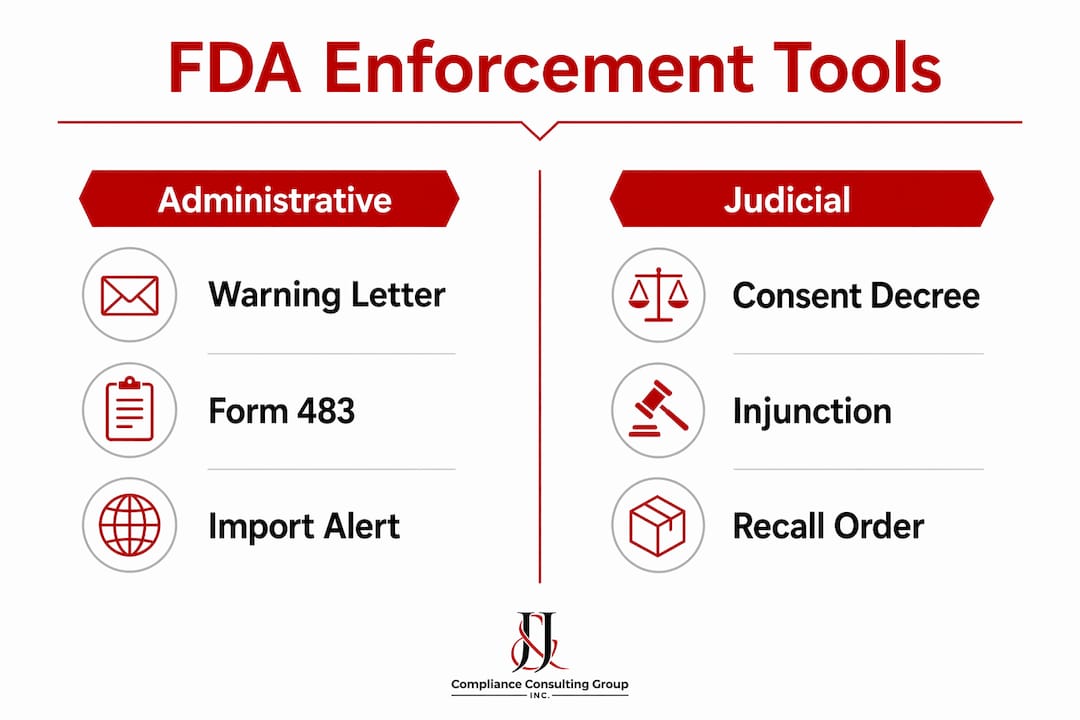
The distinction between a consent agreement and a consent decree is particularly important. A consent agreement is a private contract between the company and the FDA. Breach triggers contract remedies. A consent decree is a court order. Violations are treated as defiance of a federal judge, allowing the court to impose sanctions immediately without a separate lawsuit.
Key practical differences for compliance management include:
- Monitoring intensity. Consent decrees require independent third-party monitors approved by the FDA. Consent agreements typically rely on self-reporting.
- Documentation standard. Decree compliance requires litigation-grade records. Warning letter responses require professional quality but not court-ready documentation.
- Operational restrictions. Decrees frequently include product shipment holds or manufacturing suspensions. Warning letters do not carry automatic operational restrictions.
Understanding these distinctions shapes how you allocate resources, engage legal counsel, and structure your quality management system response.
What are the typical components of an FDA consent decree?
Every consent decree is negotiated individually, but the core structural elements are consistent across pharmaceutical, medical device, and food enforcement actions. Compliance officers should expect the following obligations.
Corrective action plans with defined timelines. The decree specifies exactly what the company must fix, in what sequence, and by what date. These milestones are not aspirational. Missing a court-mandated deadline is a compliance failure with legal consequences.
Independent third-party monitoring. Consent decrees require external audits and ongoing reporting by independent experts approved by the FDA. These monitors assess whether corrective actions are genuine and sustained, not cosmetic. Their reports go directly to the FDA and the court.
CAPA and root cause analysis reporting. Companies must demonstrate that they have identified the root causes of violations and implemented corrective and preventive actions. Effective CAPA program execution is not optional under a decree. It is a measurable deliverable with reporting cadence specified in the order.

Operational restrictions. Many decrees include immediate restrictions such as halted product shipments, mandatory recalls, or suspended manufacturing lines. These restrictions lift only when the company demonstrates specific remediation milestones to the monitor and the FDA.
Duration and exit criteria. Most consent decrees remain in effect for approximately five years, though the timeline varies based on violation severity and remediation progress. The decree is lifted only after the company demonstrates sustained compliance across multiple audit cycles. Sustained means years of consistent performance, not a single clean inspection.
Pro Tip: Map every obligation in the decree to a named internal owner with a documented escalation path. Courts and monitors look for evidence that the company treats decree milestones as operational priorities, not compliance exercises.
What compliance strategies work when managing a consent decree?
Managing a consent decree requires a fundamentally different governance model than routine FDA compliance. The standard quality management system is necessary but not sufficient. Here is what effective execution looks like in practice.
-
Align your quality system precisely to decree language. Consent decree compliance execution requires exact alignment of GMP systems with court-mandated milestones and reporting cadence. External monitors measure progress against the decree’s exact terms, not against industry best practices or your internal quality standards. Every procedure, record, and corrective action must map directly to a specific decree obligation.
-
Treat the work as systemic, not transactional. Organizations frequently underestimate the systemic nature of issues revealed by consent decrees, which leads to repeated noncompliance after the order is entered. Fixing the specific violation that triggered the decree is insufficient. FDA monitors test controls across processes and sites comprehensively. If the root cause is a quality culture problem, isolated procedure updates will not satisfy the court.
-
Build litigation-grade documentation from day one. Courts and FDA monitors scrutinize documentation to verify compliance precisely per the decree. This means document control with version history, decision traceability for every quality event, and clear escalation records when issues arise. A quality event with no documented escalation path looks like concealment to a federal monitor.
-
Prepare for financial and operational pressure. Failure to comply can result in severe financial penalties and operational shutdowns. Companies under active decrees have faced tens of millions of dollars in fines and extended manufacturing suspensions. Budget for the full cost of remediation, including monitor fees, legal counsel, and the internal resources required to sustain compliance over multiple years.
-
Engage FDA enforcement consulting expertise early. Companies that attempt to manage decree obligations with internal quality teams alone consistently underperform against companies that bring in experienced regulatory counsel and compliance consultants from the start. The regulatory strategy, monitor relationship management, and court reporting require specialized expertise that most internal teams do not maintain.
Key takeaways
An FDA consent decree is a federal court order, and every compliance decision made under one carries judicial consequences that extend far beyond routine regulatory risk.
| Point | Details |
|---|---|
| Legal weight is absolute | A consent decree is a court order, not a voluntary commitment. Violations trigger contempt proceedings, not just regulatory notices. |
| Escalation follows a pattern | Decrees follow repeated failures to address Form 483s and Warning Letters. Early corrective action prevents judicial escalation. |
| Obligations are specific and measurable | Corrective action plans, third-party monitoring, and CAPA reporting are court-mandated deliverables with defined timelines. |
| Duration averages five years | Most decrees remain active for approximately five years, requiring sustained compliance across multiple independent audit cycles. |
| Systemic fixes are required | Isolated procedural corrections fail under decree scrutiny. Monitors test controls across all processes and sites. |
What I’ve learned from watching companies navigate consent decrees
After working alongside pharmaceutical and medical device manufacturers through some of the most demanding enforcement periods of their history, one pattern stands out above all others. The companies that exit consent decrees on schedule share a single characteristic: they stopped treating compliance as a legal obligation and started treating it as an operational discipline.
The companies that struggle are the ones that assign decree management to the legal department and the quality team in parallel, with no unified governance structure. The legal team protects the company. The quality team fixes the processes. Neither group is accountable for the integrated performance the court actually measures. That structural gap is where decrees get extended.
There is also a psychological dimension that rarely gets discussed. Consent decrees carry reputational weight that affects employee morale, customer relationships, and investor confidence. Leadership teams that acknowledge this openly and frame the decree as a defined remediation program, with clear milestones and a visible exit path, consistently build stronger internal compliance cultures than those that treat the decree as a confidential legal matter.
My honest recommendation: engage specialized regulatory compliance consulting from the moment a consent decree is entered, not after the first monitor report comes back unsatisfactory. The cost of early expert engagement is a fraction of the cost of a decree extension or contempt proceeding. And the value of having someone in the room who has done this before, who knows how monitors think and what courts expect, is genuinely difficult to overstate.
The decree is not the end of the story. For companies willing to do the systemic work, it is the beginning of a quality infrastructure that outlasts the order and strengthens the business for years after.
— Mike
How Jjccgroup supports companies under FDA consent decrees

Jjccgroup brings over 30 years of FDA regulatory expertise to companies managing the full scope of consent decree obligations. From compliance gap assessments and CAPA effectiveness validation to audit readiness coaching and independent monitor preparation, Jjccgroup provides the structured support that turns court-mandated requirements into sustainable quality systems. Their consultants understand how FDA monitors evaluate progress and how to present corrective actions in the precise format courts and regulators expect. For manufacturers in pharmaceutical, medical device, and food industries facing active enforcement, explore Jjccgroup’s FDA compliance services to understand how expert guidance accelerates your path to decree resolution.
FAQ
What is an FDA consent decree?
An FDA consent decree is a federal court order requiring a company to correct serious regulatory violations, typically related to GMP noncompliance, under judicial supervision. It is negotiated between the company and the Department of Justice on behalf of the FDA and entered by a federal judge.
How long does an FDA consent decree last?
Most FDA consent decrees remain in effect for approximately five years, though the actual duration depends on the severity of violations and the company’s remediation progress. The decree lifts only after the company demonstrates sustained compliance across multiple independent audit cycles.
What happens if a company violates a consent decree?
Violating a consent decree is treated as contempt of a federal court order, which can result in immediate fines, operational shutdowns, and in serious cases, criminal prosecution. The judicial enforcement mechanism makes noncompliance significantly more consequential than failing to respond to a warning letter.
How does a consent decree differ from a warning letter?
A warning letter is an administrative action requesting voluntary corrective action, while a consent decree is a court order mandating specific remediation with enforceable deadlines. Noncompliance with a warning letter carries regulatory consequences. Noncompliance with a consent decree carries judicial ones.
Can a company negotiate the terms of a consent decree?
Yes. Consent decree terms are negotiated between the company’s legal counsel and the Department of Justice before a federal judge enters the order. Companies can influence the scope of corrective actions, timelines, and monitoring requirements during negotiations, making early engagement of experienced regulatory and legal counsel critical.
Recommended
- FDA Compliance Services Explained: Complete Guide for Manufacturers
- FDA Enforcement Consulting: A Practical Guide – J&J Consulting Group- FDA Regulatory Compliance
- FDA Regulatory Compliance Consulting: A Guide – J&J Consulting Group- FDA Regulatory Compliance
- Dietary Supplement Compliance: Essential FDA Requirements for Brands
