




FDA establishment registration is the official process by which owners and operators of regulated facilities formally identify their locations to the FDA before manufacturing, processing, or distributing regulated products in the United States. This requirement applies across medical devices, pharmaceuticals, dietary supplements, tobacco, and food and beverage operations. Registration is not product approval. It does not confirm that your products are safe or cleared for market. Understanding FDA establishment registration explained in full means recognizing it as a distinct legal obligation that runs parallel to, but separate from, any premarket submission or product listing process.
What does FDA establishment registration actually require?
Establishment registration identifies the facility and the specific activities performed there, such as manufacturing, processing, sterilization, repacking, relabeling, and specification development. The FDA uses this data to know who is operating, where they are located, and what regulated activities they perform. Registration does not evaluate product safety. It creates a traceable record of every facility in the regulated supply chain.

The requirement applies to physical locations, not corporate entities. A company with three manufacturing sites must register each site separately. Corporate headquarters cannot serve as a blanket registration for all operations. Each registered facility receives a unique FDA registration number that identifies it in the agency’s database.
The industries most directly affected include:
- Medical device manufacturers, distributors, and importers operating in the U.S. market
- Pharmaceutical manufacturers and repackagers handling prescription and OTC drug products
- Food facility operators involved in manufacturing, processing, packing, or holding food for human or animal consumption
- Tobacco product manufacturers and importers subject to FDA Center for Tobacco Products oversight
- Dietary supplement manufacturers operating under current Good Manufacturing Practice regulations
Pro Tip: Farms, retail food establishments, and certain nonprofit food operations are exempt from food facility registration. Verify your exemption status before assuming registration is not required.
How does the FDA registration process work, and what are the 2026 deadlines and fees?
The FDA registration process differs by product category, and missing the correct window creates immediate compliance risk. New facilities must register within 30 days of beginning regulated operations. After that, renewal timing depends on your industry.
Medical device registration
Medical device establishments must register annually and pay a registration fee of $11,423 for FY2026. The submission window opens october 1 and closes december 31 each year. Registration is completed through the FDA Unified Registration and Listing System, known as FURLS. Payment is processed through the Device Facility User Fee system, or DFUF. Missing the december 31 deadline puts your facility at risk of suspension and blocks legal U.S. distribution.
Tobacco establishment registration
Tobacco product manufacturers must re-register annually by december 31. Product listings must be updated twice per year, by june 30 and december 31, if any product changes occur. Tobacco registrations are managed through the Tobacco Registration and Listing Module Next Generation, known as TRLM NG. There is no registration fee for tobacco establishments, but the biannual listing obligation adds an ongoing compliance burden.
Food facility registration
Food facility registrations are renewed biennially in even-numbered years between october 1 and december 31. The FDA currently charges no fee for food facility registration. Facilities use the FDA’s online portal to submit and renew registrations. The food facility registration process also requires designation of a U.S. Agent for foreign facilities importing food into the United States.
The table below summarizes the key registration requirements by industry:
| Industry | Registration frequency | Deadline | FY2026 fee |
|---|---|---|---|
| Medical devices | Annual | December 31 | $11,423 |
| Tobacco products | Annual | December 31 | $0 |
| Food facilities | Biennial (even years) | December 31 | $0 |
| Pharmaceuticals | Annual | Varies by product type | Varies |
Pro Tip: Set calendar reminders for october 1 each year. That date opens the registration window for medical devices and food facilities simultaneously, and early submission reduces the risk of payment processing errors close to the deadline.
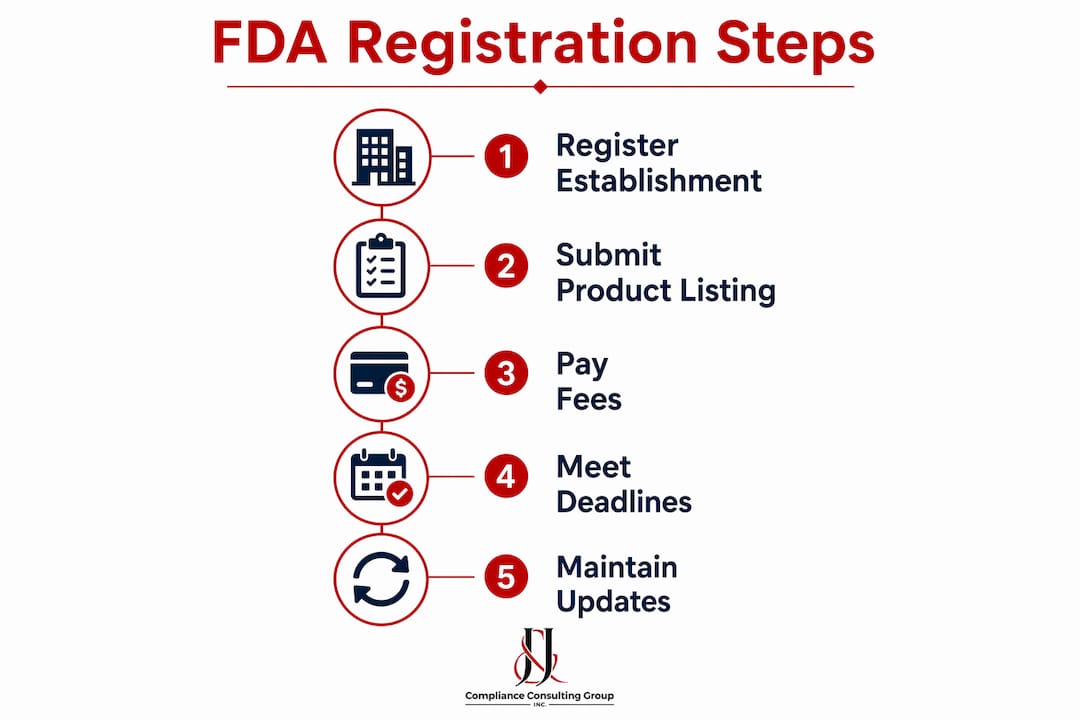
The step-by-step registration process for most facilities follows this sequence:
- Create an account in the relevant FDA system (FURLS for devices, TRLM NG for tobacco, or the FDA Industry Systems portal for food).
- Enter facility information including physical address, owner or operator details, and regulated activities performed.
- Designate a U.S. Agent if the facility is located outside the United States.
- Submit the registration and pay applicable fees through the designated payment system.
- Receive your FDA registration number and retain it for product listings, labeling, and import documentation.
- Renew registration within the applicable annual or biennial window to maintain active status.
Registration vs. product listing vs. FDA approval: what is the difference?
Establishment registration is frequently confused with product approval, but the two serve entirely different legal purposes. Registration identifies who you are and where you operate. It says nothing about whether your products are safe, effective, or cleared for market.
Product listing is a separate requirement. It declares which specific products are associated with a registered establishment. For medical device companies, device listing must be submitted through FURLS alongside or after registration. For tobacco manufacturers, product listings are submitted through TRLM NG on a biannual schedule.
FDA product approvals and clearances, including 510(k) clearance and Premarket Approval (PMA), are safety and efficacy evaluations. They require clinical data, performance testing, and formal FDA review. Registration does not substitute for these submissions.
| Process | Purpose | Timing | Evaluated by FDA? |
|---|---|---|---|
| Establishment registration | Identifies facility and operations | Before or within 30 days of starting | No |
| Product listing | Declares products at a registered facility | Concurrent with or after registration | No |
| 510(k) clearance | Demonstrates substantial equivalence | Before marketing most Class II devices | Yes |
| Premarket Approval (PMA) | Proves safety and efficacy | Before marketing Class III devices | Yes |
These three processes are legally distinct but operationally linked. A facility cannot submit a valid product listing without an active registration. A product cannot legally enter the U.S. market without both an active registration and, where required, the appropriate premarket clearance or approval.
What are the most common FDA registration compliance pitfalls?
Missing renewal deadlines is the most common and most avoidable compliance failure. The FDA does not send warning notices before suspending a registration. Suspension takes effect automatically when a facility fails to renew on time, and registration suspension is one of the FDA’s strongest enforcement tools. It immediately halts a facility’s ability to legally distribute products in the United States until the issue is resolved.
Other frequent pitfalls include:
- Failing to register each physical location separately. Each distinct facility requires its own registration and unique FDA registration number. A warehouse and a manufacturing plant at different addresses are two separate registrations, even under the same corporate ownership.
- Skipping U.S. Agent designation for foreign facilities. Foreign establishments must designate a U.S. Agent during registration. This person or entity acts as the FDA’s official point of contact. Failing to designate one renders the registration incomplete.
- Assuming no changes means no action required. Registration renewal is an active obligation. A facility that has not changed its operations, address, or ownership still must renew within the applicable window. Inaction equals non-compliance.
- Confusing registration systems. FURLS, DFUF, and TRLM NG are separate systems with separate account requirements. Submitting through the wrong portal does not satisfy the registration obligation.
Pro Tip: If your company operates multiple facilities across different product categories, consider working with a regulatory compliance consultant who manages multi-system filings. The administrative complexity compounds quickly across sites and product types.
Maintaining accurate registration data is also an ongoing obligation. If your facility’s address, ownership, or regulated activities change, you must update the registration promptly. Outdated information creates discrepancies that can trigger FDA scrutiny during inspections or import reviews.
Key Takeaways
FDA establishment registration is a mandatory, facility-specific identification process that must be renewed annually or biennially depending on product category, and failure to comply results in immediate enforcement action without prior warning.
| Point | Details |
|---|---|
| Registration identifies facilities, not products | Each physical location must register separately and receive its own FDA registration number. |
| Deadlines vary by industry | Medical devices and tobacco renew annually by december 31; food facilities renew biennially in even years. |
| FY2026 medical device fee is $11,423 | Food and tobacco registrations carry no FDA fee, but all require active renewal to stay compliant. |
| Registration is separate from product approval | 510(k) clearance and PMA are distinct submissions that evaluate safety and efficacy, not facility identity. |
| Non-compliance triggers immediate enforcement | Missed renewals result in registration suspension, blocking all legal U.S. product distribution. |
What I’ve learned after years of watching companies get this wrong
Registration is the kind of requirement that feels administrative until it isn’t. I’ve seen well-run companies with strong product portfolios face shipment detentions at the border because someone assumed the registration renewed automatically. It does not. The FDA’s enforcement posture on registration lapsed facilities is not lenient, and the agency does not offer grace periods as a standard practice.
The most persistent misconception I encounter is that registration and product approval are interchangeable milestones. They are not. A facility can be fully registered and still have no cleared products. A product can be 510(k) cleared and still be blocked from distribution if the manufacturing facility’s registration has lapsed. Both obligations must be active simultaneously for legal U.S. market access.
Foreign manufacturers consistently underestimate the U.S. Agent requirement. This is not a formality. The U.S. Agent is the FDA’s primary contact for inspections, communications, and enforcement actions. Designating an unqualified or unresponsive agent creates real operational risk. I recommend working with a qualified FDA regulatory consulting firm that can serve this function with accountability.
The tobacco sector has a layer of complexity that catches manufacturers off guard. The biannual product listing requirement means that even after registration is current, companies must track product changes and submit updates by june 30 and december 31. Missing a listing update is a separate violation from a missed registration renewal. For tobacco companies, I recommend reviewing tobacco compliance consulting resources that address both obligations together.
Registration management is not glamorous work. But it is foundational. Every inspection, every import entry, and every product listing ties back to an active, accurate establishment registration. Getting it right consistently is what separates companies that scale without interruption from those that face avoidable enforcement actions.
— Mike
How Jjccgroup supports your FDA registration compliance
Regulatory registration obligations do not pause, and the cost of a missed deadline is far greater than the cost of expert support. Jjccgroup brings over 30 years of experience helping pharmaceutical, medical device, dietary supplement, tobacco, and food companies meet their FDA registration requirements accurately and on time.
From initial regulatory approval consulting to annual renewal management, U.S. Agent designation, and multi-facility coordination, Jjccgroup handles the full scope of registration obligations. Their team also supports device listing, tobacco product listing updates, and fee navigation across FURLS, DFUF, and TRLM NG. For companies that need a trusted partner to manage the complexity of FDA compliance across multiple sites and product categories, Jjccgroup delivers the depth and consistency that regulated industries require.
FAQ
What is FDA establishment registration?
FDA establishment registration is the process by which facilities involved in manufacturing, processing, packing, or distributing regulated products formally identify themselves to the FDA. It is required before beginning regulated operations and must be renewed annually or biennially depending on the product category.
Who is required to register with the FDA?
Medical device manufacturers, food facility operators, tobacco product manufacturers, pharmaceutical companies, and dietary supplement manufacturers are all required to register their facilities with the FDA. Each physical location must be registered separately.
How much does FDA establishment registration cost in 2026?
The FY2026 medical device registration fee is $11,423 per establishment. Food facility registration and tobacco establishment registration currently carry no FDA fee.
What happens if a facility misses its FDA registration renewal deadline?
Missing the renewal deadline results in registration suspension, which immediately prohibits the facility from legally distributing products in the United States. The FDA does not issue advance warnings before suspending a registration.
Is FDA establishment registration the same as product approval?
No. Registration identifies the facility and its regulated activities. Product approvals such as 510(k) clearance or PMA evaluate the safety and efficacy of specific products and require separate submissions to the FDA.
