


An FDA warning letter is defined as a formal enforcement communication issued by the U.S. Food and Drug Administration to notify a company of significant regulatory violations requiring immediate corrective action. The FDA warning letter explained in full means understanding that this document carries serious legal weight, differs fundamentally from a preliminary Form 483 observation, and demands a structured written response within 15 business days. The FDA issued 470 warning letters in 2025, each carrying the potential to disrupt operations, damage retailer relationships, and trigger follow-up inspections. For compliance officers and business leaders in pharmaceutical, supplement, and medical device sectors, knowing how to respond is not optional. It is the difference between a contained enforcement action and a prolonged regulatory crisis.
What is an FDA warning letter and how does it differ from a Form 483?
An FDA warning letter is a formal, public enforcement notice. A Form 483 documents inspectional observations made during a facility inspection and represents the FDA investigator’s preliminary findings, not the agency’s final position. The distinction matters because a Form 483 gives you an early opportunity to correct issues before they escalate. A warning letter means the FDA has reviewed those observations, found your response inadequate or your violations serious, and is now putting you on official notice.
The escalation from Form 483 to warning letter signals a shift in regulatory posture. The warning letter is posted publicly on the FDA’s website, which means retailers, investors, and business partners can see it. That public visibility creates reputational risk that a Form 483 does not. Ignoring a Form 483 response is a common path to receiving a warning letter. Ignoring a warning letter itself risks injunctions, product seizures, and consent decrees.

| Feature | FDA Form 483 | FDA Warning Letter |
|---|---|---|
| Issued by | FDA investigator | FDA district office or center |
| Public record | No | Yes |
| Response required | Voluntary but strongly advised | Required within 15 business days |
| Enforcement weight | Preliminary observation | Formal enforcement action |
| Typical trigger | End of facility inspection | Unresolved or serious violations |
Key consequences of a warning letter include:
- Suspension or delay of pending product approvals
- Increased scrutiny during future FDA inspections
- Loss of retailer or distributor contracts
- Investor concern and potential financing complications
- Mandatory public disclosure in some regulated sectors
How should companies structure an effective FDA warning letter response?
The response must mirror the numbered observations in the warning letter exactly. Each observation requires acknowledgment, a root cause analysis, immediate corrective actions with specific completion dates, and a CAPA plan that prevents recurrence. Skipping any of these elements signals to the FDA that your organization does not fully understand the violation or lacks the systems to fix it.
A well-structured response follows this sequence for each cited observation:
- Acknowledge the observation. State clearly that you understand the FDA’s finding. Do not minimize or deflect.
- Provide a root cause analysis. Identify the specific system, process, or documentation failure. Regulatory experts stress that root cause analysis must go beyond blaming “human error” or “operator mistakes.” Systemic causes require systemic fixes.
- Describe immediate corrective actions. List specific steps already taken, with dates. Attach supporting documentation such as updated SOPs, training records, or batch records.
- Present your CAPA plan. Include milestones, responsible parties, and verification methods. The FDA expects to see how you will confirm the fix is working.
- Address prevention. Explain how your quality system will detect and prevent similar violations across other product lines or facilities.
- Attach substantive evidence. Bare assertions carry no weight. Attach revised procedures, test results, and audit findings as exhibits.
Pro Tip: The 15-day response deadline is for submitting a credible plan, not for completing all corrective actions. If you need more time for certain items, state realistic timelines explicitly. Proactively requesting an extension with the FDA is accommodated far more readily than submitting an incomplete or vague response.
Common mistakes that extend enforcement timelines include:
- Submitting generic responses that do not address specific observations
- Failing to attach documentary evidence
- Overpromising correction timelines you cannot meet
- Responding without legal counsel review
- Treating the response as a legal defense rather than a compliance commitment
Legal counsel advises that ignoring warning letters greatly increases the risk of enforcement escalation to injunctions or product seizures. Involve regulatory counsel and your quality team from day one.
What is the typical timeline and business impact after receiving an FDA warning letter?
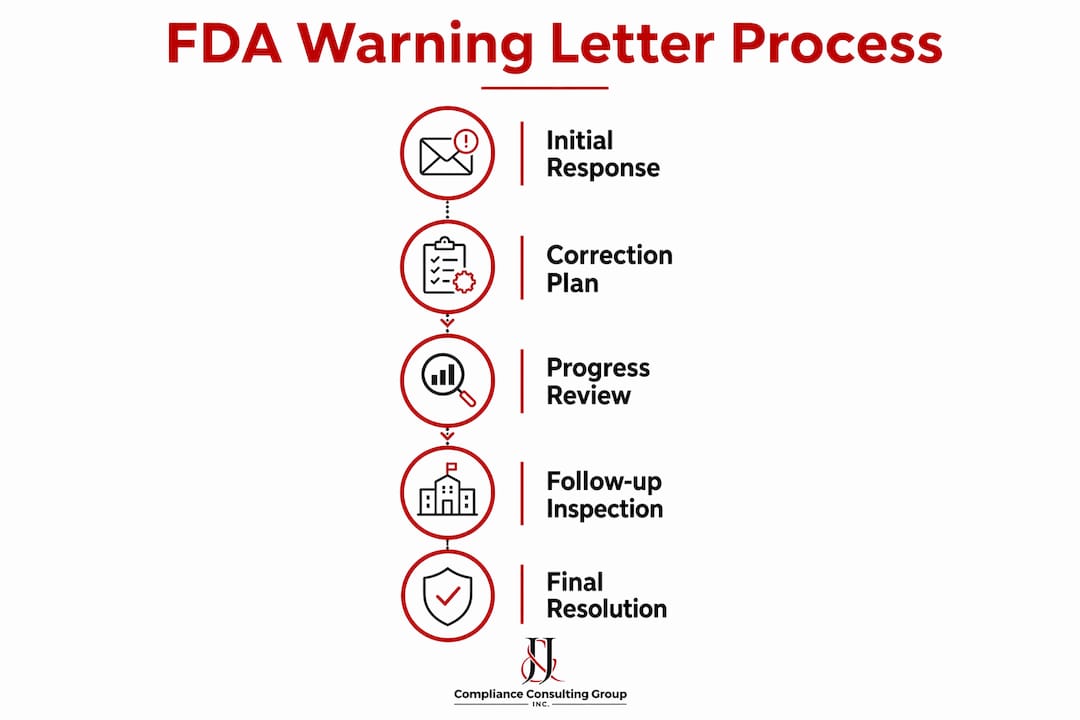
The recovery period following a warning letter typically spans 12–18 months, including follow-up inspections and ongoing reporting requirements. That timeline reflects the reality that the FDA does not close a warning letter based on your written response alone. Verification by a follow-up FDA inspection is the true close of the enforcement action. Your response starts the clock, but sustained corrective action closes it.
| Phase | Timeframe | Key Activity |
|---|---|---|
| Initial response | 0–15 business days | Submit written response with CAPA plan |
| Active remediation | 1–6 months | Implement corrections, update SOPs, train staff |
| Follow-up reporting | 6–12 months | Submit progress updates to FDA as committed |
| Verification inspection | 12–18 months | FDA re-inspects to confirm sustained compliance |
| Warning letter closure | After inspection | FDA issues close-out letter if satisfied |
The business impact extends well beyond the compliance team. Retailers and distributors often place holds on purchasing decisions when a warning letter appears publicly. Investors in publicly traded companies may require disclosure. For pharmaceutical companies, pending drug applications can be placed on hold until the warning letter is resolved. Managing external communications proactively, with factual and measured statements, protects relationships during the remediation period.
During active remediation, your team must document every corrective action with dates, responsible parties, and verification evidence. Successful remediation requires cross-functional accountability and documentation of sustained changes, not just one-time fixes. Quality, operations, regulatory affairs, and legal must all contribute.
What are common causes of FDA warning letters in supplement and pharmaceutical industries?
Current Good Manufacturing Practice (cGMP) violations are the most frequent trigger for FDA warning letters across both pharmaceutical and dietary supplement companies. Inadequate documentation, poor lot traceability, and failure to validate manufacturing processes appear repeatedly in warning letter causes related to data integrity and GMP documentation. These are systemic deficiencies, not isolated errors, and the FDA treats them accordingly.
For dietary supplement companies, unauthorized disease claims on product labels, websites, and social media are a leading cause of enforcement. Marketing disease claims on websites and social media frequently trigger warning letters when companies imply their products treat, cure, or prevent diseases without FDA approval. The Dietary Supplement Health and Education Act (DSHEA) permits structure/function claims but prohibits disease claims without prior FDA authorization.
The FDA’s scrutiny of digital content is broader than most compliance officers expect. Old and legacy marketing content is treated as active claims and can be cited in warning letters. Product names, testimonials, blog posts, and third-party retailer descriptions all fall within the FDA’s review scope. A supplement company that cleaned up its label years ago but left old website copy untouched remains exposed.
Common causes across both industries include:
- cGMP violations in manufacturing, testing, or packaging
- Inadequate or missing batch records and laboratory documentation
- Failure to investigate out-of-specification results
- Unauthorized disease claims on labels, websites, or social media
- Lack of validated cleaning or sterilization procedures
- Supplier qualification failures and inadequate raw material testing
Pro Tip: For supplement compliance, conduct a full digital content audit at least annually. Review your website, Amazon listings, social media profiles, and any third-party retailer pages that reference your products. The FDA does not distinguish between content you posted last week and content posted five years ago.
What best practices can help businesses avoid FDA warning letters?
Proactive inspection readiness is the single most effective way to reduce warning letter risk. FDA mock inspections simulate the real inspection experience, expose documentation gaps before an investigator does, and build staff confidence in responding to investigator questions. Companies that conduct regular mock audits consistently perform better during actual FDA inspections.
Effective documentation and SOP management form the backbone of any defensible compliance program. Every process must have a current, approved SOP. Every deviation must be documented and investigated. Every CAPA must be verified as effective. The FDA does not accept verbal assurances. Written, dated, and signed records are the only currency that matters during an inspection or enforcement action.
Best practices for reducing warning letter risk include:
- Conduct annual mock FDA inspections with external experts
- Maintain a living document control system with version-controlled SOPs
- Build a marketing compliance review process that covers all digital channels
- Establish a cross-functional compliance committee with executive accountability
- Engage regulatory counsel before launching new products or marketing campaigns
- Monitor FDA warning letters in your industry sector to identify emerging enforcement trends
- Develop a pre-written response framework so your team is not starting from scratch if a letter arrives
For companies operating in biotech and pharmaceutical sectors, tax and financial compliance considerations often intersect with regulatory remediation costs, making cross-functional planning between finance and regulatory affairs a practical necessity during enforcement actions.
Building a compliance culture means treating every Form 483 observation as a warning letter in waiting. The companies that resolve enforcement actions fastest are those that already have documented systems, trained staff, and clear accountability structures in place before the FDA arrives.
Key Takeaways
An FDA warning letter requires a structured, evidence-backed response within 15 business days, and full resolution typically takes 12–18 months including a verification inspection.
| Point | Details |
|---|---|
| Warning letter vs. Form 483 | A warning letter is a public enforcement action; a Form 483 is a preliminary observation with no public record. |
| Response deadline | Submit a credible CAPA plan within 15 business days; request an extension proactively if needed. |
| Root cause depth | Identify systemic failures, not individual errors, to satisfy FDA expectations for corrective action. |
| Recovery timeline | Expect 12–18 months of active remediation, reporting, and a follow-up verification inspection. |
| Prevention priority | Annual mock inspections and digital content audits are the most effective tools for avoiding enforcement. |
What I’ve learned after years of warning letter response work
The companies that recover fastest from FDA warning letters share one trait: they treat the letter as a diagnostic report, not an attack. That shift in perspective changes everything about how the response gets written and how the remediation gets executed.
The most common mistake I see is the instinct to minimize. Teams write responses that technically address each observation but avoid admitting the underlying system was broken. The FDA reads those responses carefully. Vague language and passive constructions signal that the organization has not done the hard work of understanding what actually failed.
Root cause analysis is where most responses fall short. Blaming a single employee or citing a one-time training lapse rarely satisfies the FDA, and it rarely reflects reality. When documentation failures appear across multiple batches or multiple products, the root cause is a system problem. The response must say so, and the CAPA must fix the system.
The 15-day window feels short, but it is workable if you have a cross-functional team ready to move. Quality, regulatory affairs, operations, and legal need to be in the same room within 24 hours of receipt. The response that gets written by one person in isolation is almost always weaker than the one built collaboratively with full organizational context.
My strongest advice: do not wait for a warning letter to build your response capability. Develop your CAPA framework, train your team on FDA response expectations, and run a mock inspection every year. The companies that do this work in advance close enforcement actions in 12 months. The ones that start from scratch after receiving a letter often take twice as long.
— Mike
How Jjccgroup supports your FDA warning letter response
Receiving an FDA warning letter does not have to mean months of uncertainty. Jjccgroup brings over 30 years of regulatory consulting experience to help pharmaceutical, supplement, medical device, and food and beverage companies build responses that satisfy FDA expectations and close enforcement actions efficiently.
Jjccgroup’s team supports root cause analysis, CAPA development, response drafting, and direct FDA communication strategy. Their FDA compliance services cover the full enforcement cycle, from the initial 15-day response through verification inspection readiness. For companies that want to get ahead of risk, Jjccgroup’s regulatory approval consulting builds the compliance infrastructure that prevents warning letters from arriving in the first place. Contact Jjccgroup to put experienced regulatory counsel behind your next response.
FAQ
What is an FDA warning letter?
An FDA warning letter is a formal enforcement notice issued by the FDA to a company that has committed significant regulatory violations. It requires a written response within 15 business days and is posted publicly on the FDA’s website.
How is a warning letter different from a Form 483?
A Form 483 documents preliminary inspectional observations and is not public. A warning letter is a formal enforcement action with public visibility and mandatory response requirements.
How long does it take to resolve an FDA warning letter?
Resolution typically takes 12–18 months, including active remediation, progress reporting, and a follow-up FDA verification inspection to confirm sustained compliance.
What are the most common causes of FDA warning letters for supplement companies?
The most frequent causes include cGMP violations, inadequate documentation, and unauthorized disease claims on labels, websites, and social media that imply the product treats or prevents a disease.
Can a company dispute findings in an FDA warning letter?
Yes. A company may respectfully disagree with specific observations in its written response, but must provide documented evidence to support that position. Disagreement without evidence does not satisfy the FDA’s response expectations.
