


Dietary supplement CGMP compliance is defined by FDA’s 21 CFR Part 111, the mandatory federal regulation that governs how every dietary supplement sold in the United States must be manufactured, packaged, labeled, and stored. The U.S. supplement industry includes 15,000 manufacturers and over 80,000 products, generating $69 billion annually. That scale means FDA scrutiny is constant and citations are common. Because supplements require no pre-market FDA approval, the entire compliance burden falls on manufacturers to prove safety and labeling accuracy after products reach the market. This guide covers what 21 CFR Part 111 requires, how to prepare your facility and team, and how to avoid the violations that trigger Warning Letters.
What are the core CGMP requirements for dietary supplement manufacturing?
21 CFR Part 111 is mandatory for every dietary supplement marketed in the United States, and FDA does not issue a CGMP certification. Compliance is demonstrated through internal records, not a certificate on the wall. FDA CGMP regulations focus on manufacturing process consistency, not on whether a supplement is effective. The goal is to confirm that identity, purity, strength, and composition match label claims for every batch produced.
The core requirements under 21 CFR Part 111 cover the full production lifecycle:
- Ingredient identity testing: Manufacturers must test each ingredient’s identity using validated methods. Relying solely on a supplier’s Certificate of Analysis is insufficient and frequently cited by FDA. For botanical ingredients, DNA barcoding is one accepted technique.
- Specifications: Written specifications must exist for every raw material, in-process material, and finished product. These define acceptable limits for identity, purity, strength, and composition.
- Supplier qualification: Vendors must be evaluated and approved before their materials enter production. Qualification records must be maintained.
- Master manufacturing records (MMRs) and batch production records (BPRs): MMRs and BPRs are required documentation that prove production consistency and traceability. Missing or incomplete batch records are among the most common inspection violations.
- Quality control unit: A designated quality control unit must review and approve or reject all components, in-process materials, and finished batches. This unit operates independently from production.
- Finished product testing: Each batch must be tested against specifications before release. Results must be documented and retained.
- Packaging and labeling controls: Labels must be reviewed for accuracy before application. Packaging must protect product integrity.
- Sanitation standards: Facilities and equipment must follow written sanitation procedures. Cleaning logs must be maintained.
- Complaint handling: Written procedures for complaint review and investigation are required. Many small manufacturers lack these, creating direct regulatory exposure.
- Adverse event reporting: Serious adverse events must be reported to FDA within 15 business days. Serious events include hospitalization, disability, and death. Failure to report can result in criminal referral.
Pro Tip: Build your complaint handling system before you need it. A written procedure that documents receipt, investigation, and resolution of every complaint is a compliance requirement, not an optional best practice.
How to prepare your facility and personnel for FDA inspections

FDA inspections of supplement facilities are unannounced. Nearly 50% of inspected facilities receive citations for CGMP violations. Preparation is not a one-time event. It is an ongoing operational discipline.
Follow these steps to build inspection-ready operations:
- Document all personnel training. Manufacturing staff must be qualified through education, experience, or formal training, and that training must be documented. Lack of training records is one of the most frequently cited inspection findings. Keep individual training logs current and accessible.
- Establish written sanitation procedures. Facilities must maintain documented equipment cleaning and verification logs. Inspectors check these logs to confirm contamination prevention. Assign responsibility for each cleaning task and verify completion in writing.
- Qualify and maintain all production equipment. Equipment qualification records must show that instruments perform within validated parameters. Schedule preventive maintenance and document every service event.
- Implement a formal internal audit program. Conduct audits at least annually against 21 CFR Part 111 requirements. Use audit findings to generate corrective actions, and track those actions to closure.
- Organize records for immediate access. During an inspection, FDA investigators request records on the spot. Disorganized or missing records signal systemic problems. Maintain a centralized, indexed document control system.
- Prepare staff for investigator interactions. Train employees on what to say and what not to say during an inspection. Designate a primary contact who accompanies the investigator throughout the visit.
Pro Tip: Run a mock FDA inspection at least once per year. Assign an internal team member or third-party consultant to act as the investigator. The gaps you find internally are far less costly than the ones FDA finds first. Review your FDA inspection readiness checklist before scheduling that mock audit.
How to document, verify, and maintain compliance throughout the product lifecycle
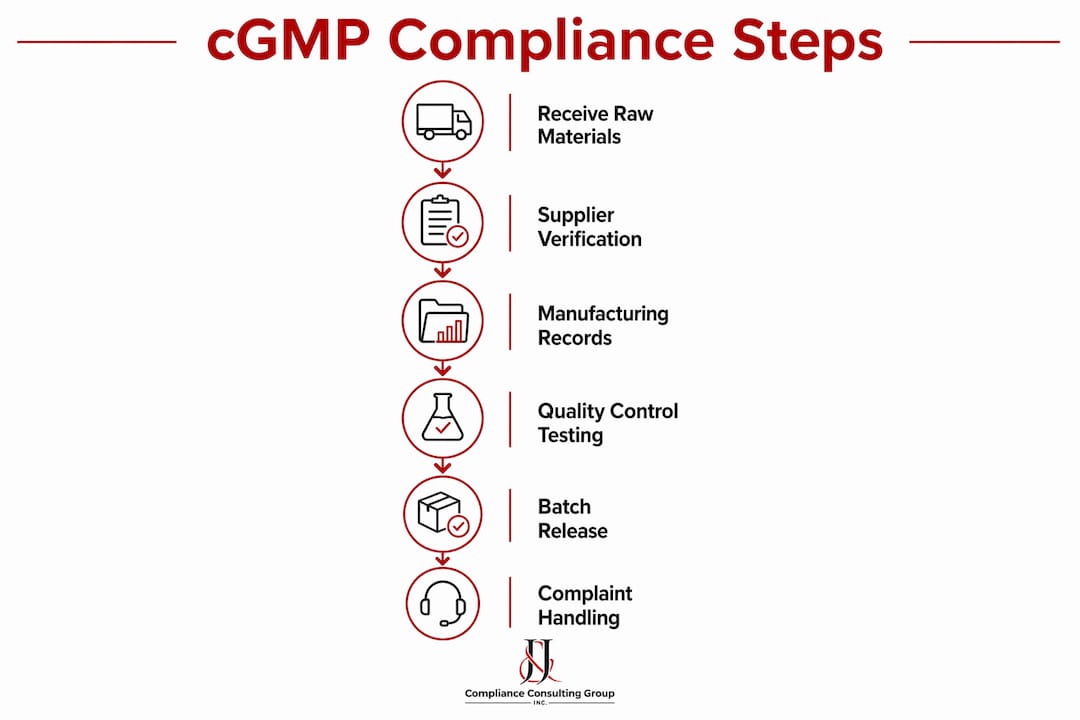
A compliant supplement operation runs on documented evidence. The process below covers the full lifecycle from raw material receipt through finished product release.
Raw material receipt and supplier verification
Receive each ingredient shipment with a documented review against your approved supplier list. Verify the Certificate of Analysis against your internal specifications. Then conduct independent identity testing using validated analytical methods. Do not release any ingredient to production until identity testing is complete and documented.
Master manufacturing records and batch production records
Create an MMR for every product formulation. The MMR defines the formula, manufacturing steps, equipment, in-process controls, and specifications. For each production run, generate a BPR that records actual quantities used, equipment used, in-process test results, and operator sign-offs. The BPR must be reviewed and approved by the quality control unit before batch release.
The table below summarizes the key documentation requirements at each lifecycle stage:
| Lifecycle Stage | Required Document | Key Content |
|---|---|---|
| Raw material receipt | Ingredient receipt record | Supplier, lot number, identity test result |
| Production | Batch production record | Formula, quantities, in-process controls, operator sign-offs |
| Quality control testing | Laboratory test record | Test method, results, pass/fail determination |
| Batch release | Quality control approval | QC unit signature, release date, disposition |
| Complaint handling | Complaint investigation record | Complaint details, investigation findings, resolution |
| Adverse event reporting | Serious adverse event report | Event description, reporter, FDA submission date |
Quality control testing and batch release
Test every finished batch against your written specifications before release. Document the test method, analyst, date, and result. The quality control unit reviews the completed BPR and all test results, then issues a written release or rejection decision. No batch ships without that documented approval.
Complaint investigation and adverse event reporting
Log every consumer complaint in a written system. Investigate each complaint against your specifications and production records. If a complaint involves a serious adverse event, file the required report with FDA within 15 business days. Retain all complaint and investigation records for at least one year beyond the product’s shelf life or two years from the date of manufacture, whichever is longer.
Pro Tip: Retain all manufacturing and testing records for the full required period in a secure, retrievable format. FDA may request records from prior production years during an inspection, and gaps in retention are treated as violations.
Common compliance pitfalls and how to avoid them
FDA citations follow predictable patterns. Knowing the most common violations lets you close gaps before an investigator finds them.
- Missing or incomplete specifications: Every raw material and finished product must have written specifications. Facilities that rely on verbal standards or informal practices are cited consistently.
- Inadequate ingredient identity testing: Accepting supplier Certificates of Analysis as the sole identity verification is a direct violation. Independent testing with validated methods is required.
- Incomplete batch records: Missing signatures, undated entries, and blank fields in BPRs are immediate red flags. Every step in the BPR must be completed and signed at the time it occurs.
- No written complaint procedures: Small manufacturers frequently lack formal complaint systems. A written procedure that covers receipt, investigation, and resolution is a regulatory requirement under 21 CFR Part 111.
- Assuming contract manufacturer compliance covers your brand: This is one of the most costly misunderstandings in the industry.
“Non-compliance by a contract manufacturer renders the brand’s product non-compliant under FDA law. Brands must include enforceable CGMP obligations and audit rights in every contract manufacturing agreement. Performing your own periodic audits of contract facilities is not optional. It is a legal responsibility.”
- Inadequate personnel training records: Training must be documented at the individual level. A general training policy without individual completion records does not satisfy 21 CFR Part 111.
- Delayed or missing adverse event reports: Serious adverse events require FDA notification within 15 business days. Late or absent reports escalate regulatory risk significantly.
If your facility receives a Form 483 observation or a Warning Letter, a structured FDA 483 response with documented corrective actions is the required next step.
What I’ve learned about sustaining CGMP compliance long-term
After working with dietary supplement manufacturers across a wide range of sizes and product categories, the pattern is consistent. Companies that treat CGMP compliance as a documentation exercise fail inspections. Companies that embed compliance into daily operations pass them.
The single most underestimated risk I see is contract manufacturing. Brands assume their contract manufacturer handles everything. They sign a contract, receive finished goods, and move on. When FDA inspects and finds violations at the contract facility, the brand is equally liable. I always recommend that brands include specific, enforceable CGMP clauses in every contract and conduct annual audits of their contract manufacturers. That audit right must be written into the agreement before production starts.
The second pattern I see consistently is reactive recordkeeping. Teams complete production steps and fill in records later, from memory. That practice creates discrepancies that inspectors catch immediately. Real-time documentation is not a preference. It is the standard FDA expects and the one that holds up under scrutiny.
Third-party audits are worth the investment. An external auditor sees gaps that internal teams normalize over time. I recommend scheduling a third-party audit at least 12 months before any anticipated FDA inspection cycle, then using the findings to drive a corrective action plan with firm deadlines. The dietary supplement compliance requirements are specific enough that a qualified auditor can benchmark your program against 21 CFR Part 111 with precision.
Compliance culture starts at the top. When leadership treats quality as a cost center rather than a business requirement, documentation lapses, training falls behind, and audit findings pile up. The manufacturers with the strongest compliance records are the ones where the quality control unit has real authority and real resources.
— Mike
How Jjccgroup supports dietary supplement CGMP compliance
Jjccgroup brings over 30 years of FDA regulatory experience to dietary supplement manufacturers who need more than a checklist.

Jjccgroup’s consulting services cover CGMP audit readiness, compliance program development, and preparation for unannounced FDA inspections. The team supports manufacturers through Form 483 responses, Warning Letter replies, and corrective action planning. For brands working with contract manufacturers, Jjccgroup helps draft enforceable compliance clauses and conducts supplier audits. Whether you are building a compliance program from the ground up or closing gaps before an inspection, Jjccgroup’s FDA compliance services provide the regulatory depth and practical support your operation needs to meet 21 CFR Part 111 requirements with confidence.
Key takeaways
Full dietary supplement CGMP compliance requires documented systems for ingredient testing, batch records, quality control, complaint handling, and personnel training that satisfy 21 CFR Part 111 at every production stage.
| Point | Details |
|---|---|
| 21 CFR Part 111 is mandatory | Every U.S. dietary supplement manufacturer must comply; FDA issues no CGMP certification. |
| Independent ingredient testing is required | Supplier Certificates of Analysis alone do not satisfy FDA identity testing requirements. |
| Batch records must be complete and real-time | Missing or backdated BPR entries are among the most cited inspection violations. |
| Contract manufacturers do not absorb your liability | Brands must audit contract facilities and include enforceable CGMP clauses in agreements. |
| Serious adverse events require 15-business-day reporting | Late or missing reports to FDA can escalate to criminal referral. |
FAQ
What is the supplement CGMP requirement under FDA rules?
The supplement CGMP requirement is 21 CFR Part 111, which mandates that all dietary supplements marketed in the United States be manufactured under documented quality controls covering identity, purity, strength, and composition. Compliance is verified through FDA inspections, not a certification process.
Why does dietary supplement CGMP apply to all manufacturers?
CGMP applies to all dietary supplement manufacturers because the Dietary Supplement Health and Education Act (DSHEA) places full responsibility for product safety and labeling accuracy on the manufacturer, since FDA does not conduct pre-market approval for supplements. Every facility that manufactures, packages, labels, or holds dietary supplements is subject to 21 CFR Part 111.
What records does FDA inspect during a CGMP audit?
FDA inspectors typically review master manufacturing records, batch production records, ingredient identity test results, equipment cleaning logs, personnel training records, complaint investigation files, and adverse event reports. Missing or incomplete records in any of these categories result in Form 483 observations.
Does a contract manufacturer’s CGMP compliance protect the brand?
No. Non-compliance by a contract manufacturer renders the brand’s product non-compliant under FDA law. Brands must include enforceable CGMP obligations and audit rights in their contracts and conduct independent audits of contract facilities.
How often should a dietary supplement facility conduct internal CGMP audits?
Internal CGMP audits should be conducted at least annually, with findings documented and corrective actions tracked to closure. Facilities with a history of FDA citations or rapid production growth benefit from audits every six months.
