


Generally Recognized as Safe (GRAS) is a legal designation that exempts certain substances from the premarket food additive approval process under the Federal Food, Drug, and Cosmetic Act’s 1958 Food Additives Amendment. The designation rests on a specific legal standard: qualified experts must agree, based on publicly available evidence, that a substance is safe under its intended conditions of use. FDA does not approve or certify GRAS substances in the traditional regulatory sense. For regulatory professionals and manufacturers, understanding how GRAS works, what it requires, and where it can fail is the foundation of sound food safety compliance strategy.
What are the legal and regulatory criteria for GRAS designation under FDA rules?
GRAS status is defined under 21 CFR 170.30, which sets out the evidentiary and procedural requirements a substance must meet to qualify. The safety standard is “reasonable certainty of no harm” under the substance’s intended conditions of use. That standard is functionally equivalent to the safety threshold applied to formally reviewed food additives. The difference is procedural, not substantive.
Two types of evidence can support a GRAS determination:
- Scientific procedures: Peer-reviewed studies, published research, and expert evaluations demonstrating safety. This pathway applies to most modern ingredients and requires the same quality of evidence FDA would expect in a formal food additive petition.
- Common use in food prior to 1958: A substance with a documented history of safe consumption before january 1, 1958 may qualify on that basis alone, without additional scientific studies.
A critical requirement applies to both pathways: safety evidence must be publicly available and recognized by qualified experts in the relevant scientific field. Proprietary or hidden data cannot support a valid GRAS determination. This public availability requirement is what separates GRAS from trade-secret-protected food additive petitions.
“The safety of a substance under the conditions of its intended use must be recognized by experts qualified by scientific training and experience to evaluate the safety of substances directly or indirectly added to food.”
21 CFR 170.30(a)
Commonly recognized GRAS substances include vinegar, corn syrup, and baking soda. These examples illustrate both pathways: long histories of safe use and broad scientific consensus. For manufacturers introducing newer ingredients, the scientific procedures pathway is the standard route.
How do manufacturers establish GRAS status?

Manufacturers have two distinct pathways to establish GRAS status. Understanding the practical differences between them shapes both the timeline and the regulatory risk profile of any product.
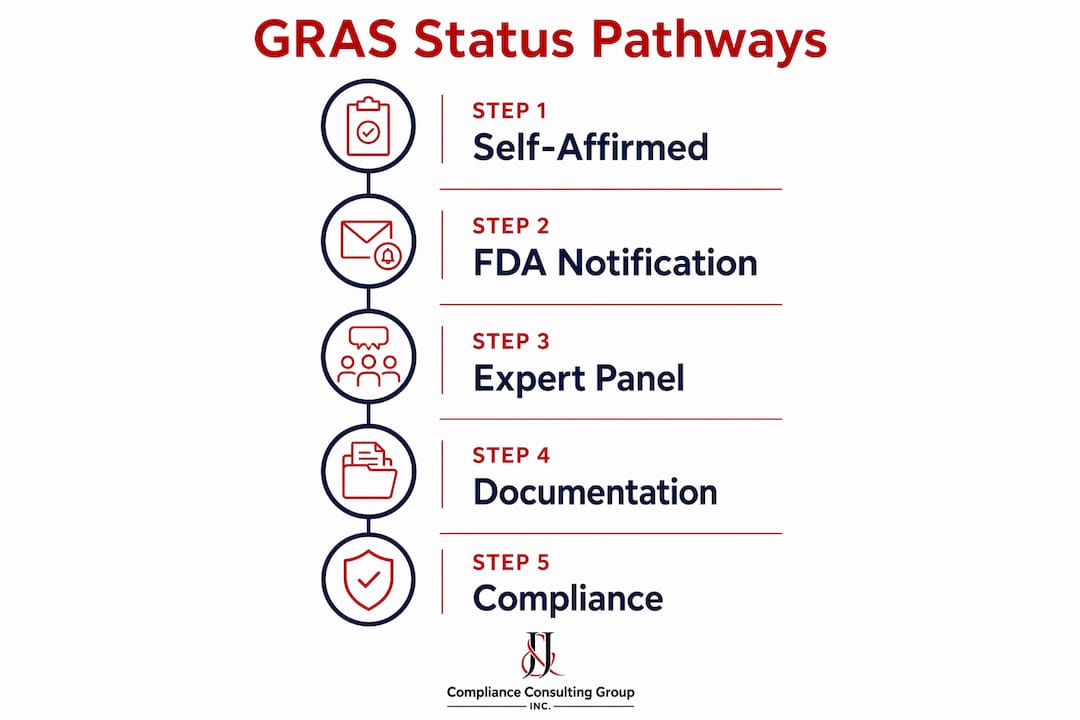
Self-affirmed GRAS
Self-affirmed GRAS means the manufacturer independently conducts and documents an expert safety consensus without submitting anything to FDA. The company convenes a panel of qualified scientists, reviews all relevant published data, and concludes that the substance meets the “reasonable certainty of no harm” standard. No FDA filing is required. No FDA acknowledgment is issued.
This pathway is faster and keeps proprietary formulation details out of the public record. The trade-off is significant: the manufacturer bears full legal responsibility for the determination. If FDA later questions the safety basis, the company has no “no questions” letter to point to.
FDA voluntary GRAS notification program
The FDA voluntary notification program allows manufacturers to submit a GRAS dossier to FDA for review. Submissions use Form FDA 3667 for electronic filing and typically involve clarification exchanges between the manufacturer and FDA reviewers. If FDA finds the submission adequate, it issues a “no questions” letter.
That letter is not FDA approval. It is not a certification of safety. Regulatory experts confirm that a “no questions” letter simply means FDA reviewed the dossier and had no further questions at that time. FDA retains full authority to revisit the substance if new safety data emerges.
The numbered steps below reflect the typical notification process:
- Compile the full safety dossier, including all published studies, expert panel qualifications, and intended use specifications.
- Complete Form FDA 3667 and submit electronically through FDA’s GRAS notification portal.
- Respond to any clarification requests from FDA reviewers during the review period.
- Receive FDA’s response, which may be a “no questions” letter, a letter stating FDA has ceased evaluation, or a request for additional data.
- File the response and maintain the complete dossier as part of ongoing compliance documentation.
Pro Tip: Even if you pursue self-affirmed GRAS, document your expert panel’s qualifications, the studies reviewed, and the reasoning behind the safety conclusion as thoroughly as you would for an FDA submission. That documentation is your primary defense if FDA ever challenges the determination.
A common misconception is that FDA notification confers a higher legal status than self-affirmed GRAS. It does not. Both pathways produce the same legal outcome: a manufacturer’s conclusion that the substance is GRAS. The notification pathway adds a layer of transparency and FDA familiarity with the substance, which carries practical value during inspections and enforcement inquiries.
What are the limitations and enforcement risks of GRAS status?
GRAS status is not a blanket authorization. GRAS determinations are specific to the substance, its intended use, and the concentration at which it is used. A substance that is GRAS as a flavoring agent at low concentrations is not automatically GRAS as a preservative at higher concentrations. Changing the use condition requires a new safety assessment.
The use-specific nature of GRAS creates real compliance risk for manufacturers who expand product lines or reformulate without reassessing their GRAS basis. The key limitations include:
- No automatic extension across uses: A GRAS conclusion for one application does not cover other applications, even for the same substance.
- Concentration sensitivity: Safety conclusions are tied to specific use levels. Exceeding those levels without a new assessment creates regulatory exposure.
- Population-specific considerations: A substance safe for the general adult population may require additional evaluation for vulnerable populations such as infants, pregnant individuals, or people with specific health conditions.
- Evolving science: New toxicological data or epidemiological findings can undermine a previously sound GRAS determination.
FDA’s enforcement authority over GRAS substances is real and active. FDA maintains public GRAS inventories and retains authority to act against products through warning letters, product seizures, and injunctions if a substance does not meet safety standards. FDA can also produce scientific memoranda and apply administrative or legal remedies when GRAS claims fail to hold up under scrutiny.
“A weak or insufficiently supported GRAS determination poses significant liability. FDA can swiftly enforce product removals when the scientific basis for a GRAS conclusion does not withstand review.”
Legal practitioners in FDA regulatory practice
Poorly documented GRAS determinations carry the highest enforcement risk. A manufacturer who relied on unpublished internal studies, failed to convene genuinely qualified experts, or did not account for all intended uses has a GRAS determination that will not survive regulatory scrutiny. The consequences range from voluntary recalls to injunctive action.
How does GRAS status fit into your compliance strategy?
GRAS compliance is not a one-time event. It is an ongoing obligation that requires active management as science evolves, product uses change, and FDA enforcement priorities shift.
Pro Tip: Schedule a formal GRAS re-evaluation every three to five years, or immediately when new toxicological data is published for your substance. Waiting for FDA to raise a concern is not a compliance strategy.
The following practices define a sound GRAS compliance program:
- Maintain a complete, current dossier. Every study reviewed, every expert consulted, and every intended use covered must be documented and retrievable. Gaps in documentation are gaps in your legal defense.
- Monitor the FDA GRAS notices inventory. FDA publishes all GRAS notifications and responses. Tracking this inventory helps you identify emerging safety concerns for substances similar to yours and signals how FDA is interpreting the evidence base in your category.
- Align GRAS documentation with labeling. The intended uses described in your GRAS determination must match what appears on your product label. Discrepancies create regulatory exposure.
- Reassess when use conditions change. Reformulation, new delivery formats, or new target populations all trigger a reassessment obligation.
- Integrate GRAS review into your broader FDA compliance program. GRAS does not exist in isolation. It intersects with food labeling regulations, current Good Manufacturing Practices (cGMPs), and facility registration requirements.
The table below summarizes the key compliance actions and their regulatory purpose:
| Compliance action | Regulatory purpose |
|---|---|
| Maintain complete safety dossier | Provides legal defense if FDA challenges the GRAS basis |
| Periodic re-evaluation | Accounts for new scientific data and evolving safety standards |
| Monitor FDA GRAS inventory | Identifies emerging concerns and FDA interpretive trends |
| Align labeling with GRAS scope | Prevents discrepancies between intended use and marketed claims |
| Reassess on reformulation | Confirms GRAS basis covers new use conditions or concentrations |
Transparency in safety data is the gold standard for GRAS determinations that withstand regulatory scrutiny. Manufacturers who rely on publicly available, peer-reviewed evidence and convene genuinely qualified expert panels build GRAS determinations that hold up under FDA review and in litigation. Those who cut corners on documentation or expert qualifications create liability that can surface years after a product launches.
Key Takeaways
GRAS status is a manufacturer’s legal conclusion, not FDA approval, and it requires rigorous, publicly available scientific evidence tied to specific use conditions.
| Point | Details |
|---|---|
| GRAS is not FDA approval | A “no questions” letter confirms FDA review, not safety certification or permanent endorsement. |
| Two pathways exist | Self-affirmed GRAS and FDA voluntary notification both produce the same legal outcome but carry different risk profiles. |
| Use-specific scope | A GRAS determination covers only the substance, use, and concentration assessed. New conditions require new assessments. |
| Documentation is your defense | Complete, current dossiers with qualified expert panels are the primary protection against enforcement action. |
| Ongoing re-evaluation is required | New scientific data or changed use conditions obligate manufacturers to reassess their GRAS basis. |
Why the GRAS misconception is the most dangerous compliance gap I see
The single most persistent problem I encounter with manufacturers navigating GRAS is the belief that FDA notification equals FDA approval. Teams invest significant resources in preparing a GRAS dossier, receive a “no questions” letter, and then treat that letter as a permanent green light. It is not. GRAS is a manufacturer’s determination, and the legal responsibility never transfers to FDA regardless of which pathway you use.
What concerns me more is the self-affirmed GRAS space. The absence of any FDA filing creates a false sense of security. I have reviewed determinations where the “expert panel” consisted of internal scientists with direct financial interest in the product’s success. That is not independent expert consensus. That is a liability waiting to materialize.
The regulatory environment around GRAS is tightening. FDA’s enforcement posture has grown more active, and the public availability requirement for safety data means that weak determinations are increasingly visible to advocacy groups and plaintiffs’ attorneys, not just regulators. Manufacturers who treat GRAS as a checkbox rather than a living compliance obligation are taking on risk they may not fully appreciate until a warning letter arrives.
My advice is straightforward: treat your GRAS dossier with the same rigor you would apply to a formal food additive petition. Convene genuinely independent experts. Use only published, peer-reviewed data. Document every decision. And review the determination every time your product, its use, or the underlying science changes.
— Mike
Jjccgroup’s support for GRAS compliance and FDA strategy
Preparing a defensible GRAS determination requires more than assembling studies. It requires a structured process, qualified expert coordination, and documentation that will hold up under FDA scrutiny.

Jjccgroup brings over 30 years of FDA regulatory experience to GRAS notification preparation and food safety compliance strategy. The team works with food and beverage manufacturers, dietary supplement brands, and other regulated companies to build GRAS dossiers grounded in rigorous science and aligned with current FDA expectations. From initial safety evidence review through expert panel coordination and FDA submission support, Jjccgroup provides the regulatory approval consulting that manufacturers need to protect their products and their market position. Contact Jjccgroup to discuss your GRAS compliance needs.
FAQ
What does GRAS mean under FDA regulations?
GRAS stands for Generally Recognized as Safe. It is a legal designation that exempts a substance from the premarket food additive approval process when qualified experts agree it is safe under its intended conditions of use.
Is a GRAS “no questions” letter the same as FDA approval?
No. A “no questions” letter means FDA reviewed the submission and had no further questions at that time. It is not an endorsement, a certification, or a permanent approval of the substance’s safety.
What is the difference between self-affirmed GRAS and FDA notification?
Self-affirmed GRAS is a manufacturer’s internal safety conclusion with no FDA filing required. FDA voluntary notification involves submitting a formal dossier for FDA review. Both pathways produce the same legal outcome, but notification adds a layer of FDA familiarity with the substance.
Can a GRAS determination cover all uses of a substance?
No. GRAS determinations are use-specific. A conclusion covering one application, concentration, or population does not automatically extend to other uses. Each new condition of use requires its own safety assessment.
What happens if FDA challenges a GRAS determination?
FDA can issue warning letters, initiate product seizures, or seek injunctions if a substance does not meet safety standards. Weak or poorly documented determinations carry the highest risk of enforcement action and potential market removal.
