


FDA import food safety requirements are the mandatory regulations that every importer must follow to ensure food entering U.S. commerce meets the same safety standards as domestically produced products. These rules, established primarily under the Food Safety Modernization Act (FSMA), cover prior notice submissions, Foreign Supplier Verification Program (FSVP) obligations, facility registration, and labeling compliance. Getting any one of these wrong can result in shipment refusal, detention, and costs that fall entirely on the importer. Understanding the full scope of these requirements is the first step toward building a supply chain that moves without interruption.
What are the key FDA import food safety requirements?
FDA food import rules rest on four legal pillars: prior notice, facility registration, FSVP, and product safety and labeling compliance. Each one is a separate obligation. Satisfying one does not substitute for another.

Prior notice
Prior Notice requires importers to submit an electronic notification to FDA before any food shipment arrives at a U.S. port. The time windows are exact and non-negotiable:
- By water: Submit at least 8 hours before arrival.
- By air or land from Mexico: Submit at least 4 hours before arrival.
- By land from Canada: Submit at least 2 hours before arrival.
- Maximum advance window: No earlier than 15 days before arrival.
Each submission must include the product description, manufacturer, country of origin, shipper, importer of record, and anticipated port of arrival. Missing or incorrect information triggers an automatic hold.
Pro Tip: Set internal calendar alerts tied to your freight forwarder’s estimated arrival time. A 30-minute error on a water shipment can cost you days of detention fees.
Facility registration
Every foreign food facility that manufactures, processes, packs, or holds food for U.S. consumption must register with FDA. Registration must be renewed every two years during the October–December registration window. Importers should request and retain proof of current registration from each supplier before any shipment departs.
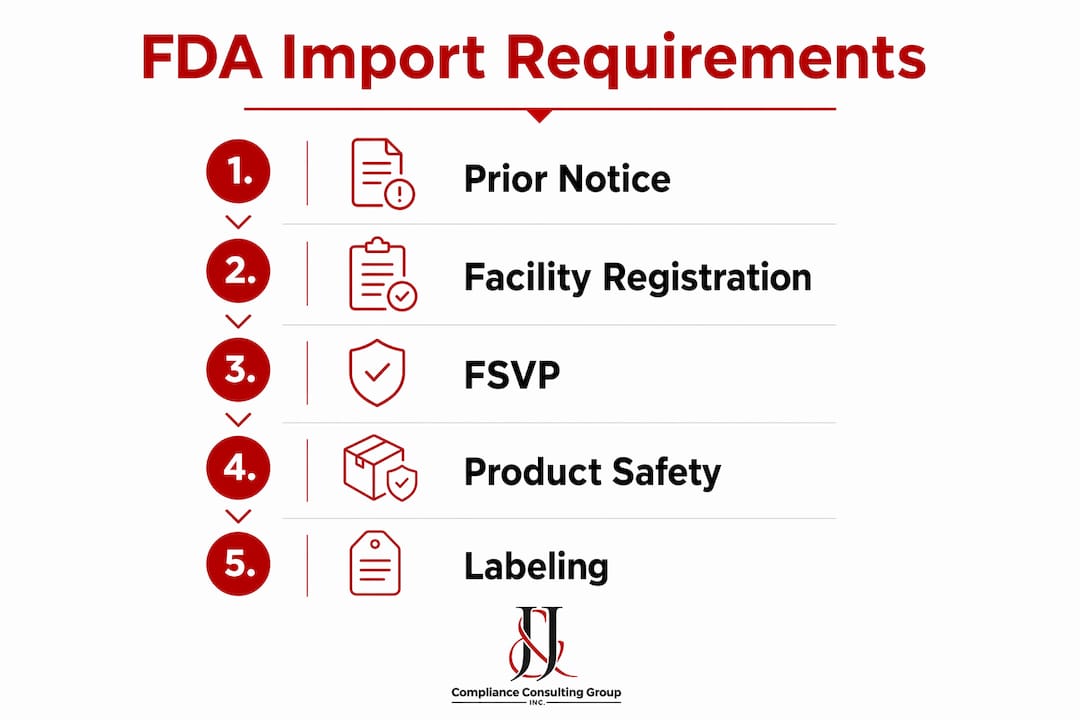
Foreign Supplier Verification Program
FSVP mandates that U.S. importers verify their foreign suppliers meet U.S. safety standards through documented hazard analysis and ongoing risk-based monitoring. This is not a one-time registration check. FSVP requires continuous supplier evaluation, corrective action records, and periodic re-analysis of hazards. The FSMA final rule on FSVP is now fully effective, and FDA audits are actively targeting importer records.
FSVP and Prior Notice are separate, non-substitutable legal requirements. Importers must maintain compliance with both simultaneously. Assuming that registering a supplier satisfies FSVP obligations is one of the most common and costly mistakes in food import operations.
How do FDA and USDA import regulations differ?
Not all food imports fall under FDA jurisdiction. Knowing which agency governs your product is a compliance prerequisite, not an optional detail.
| Category | FDA | USDA/FSIS |
|---|---|---|
| Jurisdiction | Most foods, beverages, dietary supplements, seafood | Meat, poultry, egg products, catfish |
| Inspection rate | Risk-based, random sampling | Mandatory 100% physical inspection |
| Country approval | Product-level compliance required | Country-level equivalence required |
| Port restrictions | Any FDA-designated port | Only USDA-designated ports |
| Documentation | Prior Notice, FSVP records | Additional FSIS certificates, equivalence docs |
USDA’s Food Safety and Inspection Service (FSIS) conducts mandatory 100% physical inspections of all regulated meat, poultry, egg, and catfish imports. That is a fundamentally stricter regime than FDA’s risk-based random inspections. The difference matters operationally: a shipment of processed chicken requires FSIS clearance at a designated port, while a shipment of canned fish falls under FDA rules at a broader range of entry points.
USDA FSIS equivalence applies at the country and product category level, not product by product. A country not on FSIS’s approved equivalence list cannot export regulated meat or poultry to the U.S. at all, regardless of individual product quality. Importers sourcing from multiple countries must verify each country’s equivalence status before building their supply chain around those products.
What operational pitfalls do importers face with FDA requirements?
The gap between knowing the rules and executing them correctly is where most import problems originate. FDA enforcement in 2026 has grown more targeted, and the consequences of errors are immediate.
The Prior Notice timing trap is the most common source of avoidable shipment refusals. No grace period exists for late or early submissions. A filing that arrives outside the required window causes mandatory holding, with the importer responsible for all storage and destruction costs. Freight delays, time zone errors, and last-minute vessel changes all create timing risk that importers must actively manage.
Common operational pitfalls include:
- Treating FSVP as a one-time task. FSVP requires documented, current hazard analysis and ongoing supplier performance evaluation. A supplier audit conducted two years ago does not satisfy today’s obligation.
- Incomplete hazard analysis. Importers must identify biological, chemical, and physical hazards specific to each product and supplier. Generic templates without product-specific data will not hold up in an FDA audit.
- Labeling oversights. FDA enforces detailed ingredient, allergen, and nutrition panel requirements. A shipment can be detained for misbranding even when the food itself is safe.
- Ignoring Import Alerts. FDA places repeat violators on Import Alert lists, which trigger automatic detention of future shipments without physical examination.
FDA is increasingly using Import Alerts and targeted inspections around contaminants like Salmonella, pesticides, and heavy metals. Importers with weak compliance histories are the first to face detention in 2026. A clean compliance record is now a competitive asset, not just a legal obligation.
Pro Tip: Maintain a compliance binder for each supplier that includes current facility registration proof, the most recent FSVP hazard analysis, corrective action records, and Prior Notice submission logs. FDA auditors expect to see this documentation on demand.
How can importers reduce shipment delays and stay compliant?
Proactive compliance systems consistently outperform reactive ones. The importers who move product fastest are those who treat FDA requirements as an operational discipline, not a last-minute checklist.
-
Apply for the Voluntary Qualified Importer Program (VQIP). VQIP offers expedited entry to importers with demonstrated strong supply chain controls and a long-term FDA compliance history. Acceptance into VQIP signals to FDA that your operation meets a high standard, which reduces inspection frequency and speeds clearance.
-
Build a living FSVP program. Static documents do not satisfy FSVP. Your FSVP compliance program should include scheduled supplier audits, defined corrective action triggers, and annual hazard re-analysis. Assign a named FSVP responsible individual for each product line.
-
Automate Prior Notice submissions. Use FDA’s Prior Notice System Interface (PNSI) or a compliant third-party system to submit notices accurately and on time. Automation reduces human error and creates an auditable submission record.
-
Audit labels before shipment. Every label must carry a truthful ingredient list, major food allergen declarations, and a compliant nutrition facts panel. Run label reviews against current FDA requirements before production, not after the shipment is loaded.
-
Build traceability into your supply chain. FDA’s Food Traceability Rule, part of FSMA, requires detailed records for high-risk foods. Maintaining lot-level traceability records protects you during recalls and demonstrates good-faith compliance to auditors.
Importers who integrate these practices early in their supply chain decisions avoid the reactive scramble that leads to detention fees, destroyed product, and damaged supplier relationships. Food safety compliance is most cost-effective when it is built into procurement and logistics from the start.
Key Takeaways
FDA import food safety compliance requires simultaneous adherence to Prior Notice, FSVP, facility registration, and labeling rules, with USDA/FSIS adding a separate, stricter layer for meat, poultry, and egg products.
| Point | Details |
|---|---|
| Prior Notice timing is exact | Submit within required windows: 8 hours by water, 4 by air or Mexico land, 2 by Canada land. |
| FSVP is ongoing, not one-time | Maintain current hazard analysis and supplier performance records for every product line. |
| FDA and USDA have separate jurisdiction | Identify your product’s governing agency before building your supply chain. |
| Import Alerts escalate fast | A weak compliance history triggers automatic detention of future shipments. |
| VQIP rewards strong compliance | Demonstrated supply chain controls qualify importers for expedited FDA entry. |
What I’ve learned after years of watching importers get this wrong
The most expensive mistake I see importers make is treating FDA compliance as a documentation exercise rather than a risk management discipline. They collect the right forms, file Prior Notice on time, and register their suppliers. Then a contaminant issue surfaces at a supplier facility, and they have no corrective action records, no re-analysis protocol, and no documented response plan. FDA does not distinguish between importers who did not know the rules and those who knew them but did not follow through.
The regulatory environment in 2026 is more demanding than it was even three years ago. FDA’s use of Import Alerts has grown, and the agency’s focus on Salmonella, pesticides, and heavy metals means that contaminant-related detentions are no longer rare events. Importers who built their compliance programs around the minimum requirements are now finding those programs inadequate.
The shift I recommend is straightforward: treat your FSVP program as a living quality system, not a filing cabinet. Schedule supplier audits on a fixed calendar. Set automatic triggers for corrective actions when supplier test results fall outside acceptable ranges. Apply for VQIP as a long-term goal, because the internal discipline required to qualify for it is exactly the discipline that prevents detentions.
Compliance built early into supply chain decisions costs a fraction of what reactive enforcement response costs. The importers I have seen succeed long-term are those who view their FDA regulatory consulting relationships as strategic partnerships, not emergency services.
— Mike
How Jjccgroup supports FDA food import compliance
Jjccgroup brings over 30 years of FDA regulatory experience to food importers who need more than general guidance. The team works directly with importers to develop FSVP programs, manage Prior Notice submissions, and address USDA equivalence requirements for meat and poultry supply chains.
Jjccgroup’s food and beverage consulting services cover the full compliance cycle, from supplier hazard analysis and facility registration verification to label reviews and Import Alert response. For importers preparing for FDA audits or working to qualify for VQIP, Jjccgroup’s FDA compliance services provide the structured support that turns compliance obligations into a repeatable, auditable process. The goal is fewer delays, lower enforcement risk, and a supply chain that meets FDA standards without disruption.
FAQ
What is the Prior Notice time window for food imports?
FDA requires Prior Notice at least 8 hours before arrival by water, 4 hours by air or land from Mexico, and 2 hours by land from Canada. Submissions cannot be made more than 15 days before arrival.
Does FSVP replace the need for Prior Notice?
No. FSVP and Prior Notice are separate legal requirements under FSMA. Importers must comply with both independently; satisfying one does not fulfill the other.
Which foods does USDA regulate at the border, not FDA?
USDA’s Food Safety and Inspection Service regulates meat, poultry, egg products, and catfish imports. These products require 100% physical inspection and must come from countries with FSIS-recognized equivalence status.
What happens if a Prior Notice submission is late or incorrect?
FDA refuses admission of the shipment, and the importer bears all storage and destruction costs. No grace period applies, and the hold remains until FDA completes its review.
What is VQIP and who qualifies for it?
The Voluntary Qualified Importer Program offers expedited FDA entry to importers with a strong, documented compliance history and proven supply chain controls. Qualification requires a track record of FSVP compliance and no significant enforcement history.
