


ISO 14971:2019 is the international standard defining a mandatory, systematic lifecycle approach to identify, evaluate, control, and monitor risks in medical devices. Medical device risk management under ISO 14971 applies across the full device lifecycle, from initial concept through post-market surveillance, covering software, in vitro diagnostics, and hardware alike. The FDA and Notified Bodies both reference this standard as a benchmark for regulatory submissions and audit readiness. A mature risk management system reduces recalls, accelerates regulatory reviews, and lowers warranty costs. For regulatory affairs professionals and quality assurance managers, understanding this standard is not optional. It is the foundation of every compliant product safety program.
What is the ISO 14971 risk management process?
ISO 14971:2019 is the current international standard for medical device safety management. It applies a systematic, lifecycle-integrated process that works alongside ISO 13485 quality management systems. The standard does not treat risk as a one-time design activity. It requires continuous engagement from product concept through decommissioning.
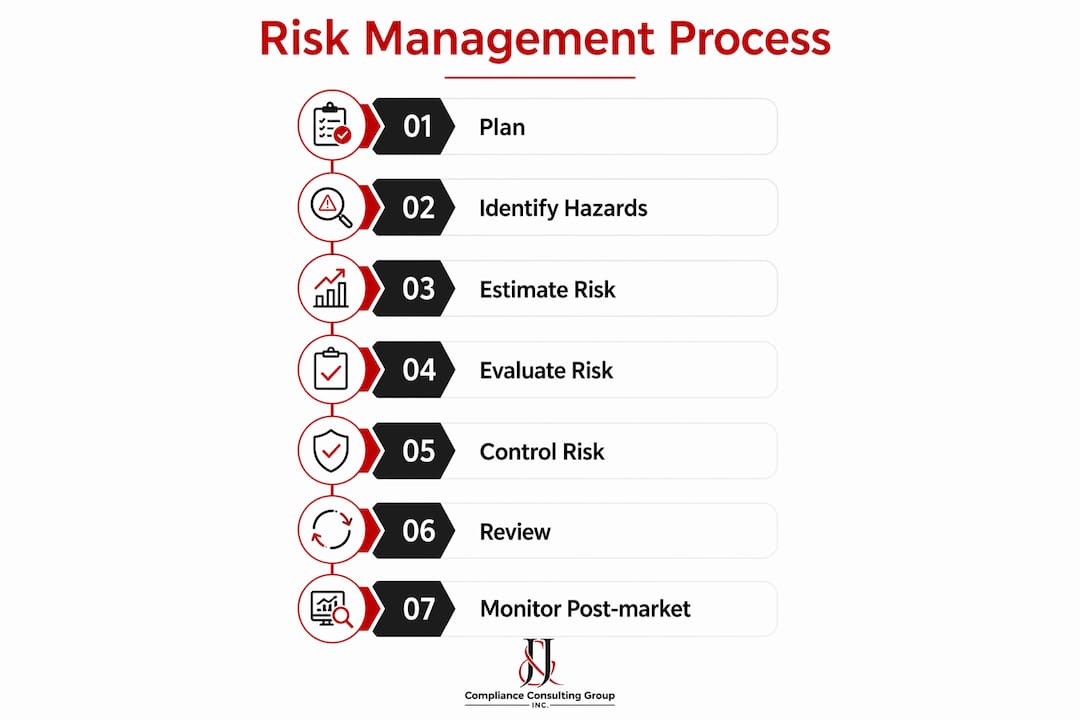
The process follows seven defined stages:
- Risk management plan. Define the scope, responsibilities, risk acceptability criteria, and review activities before any analysis begins.
- Risk analysis. Identify all hazards and hazardous situations associated with intended use and foreseeable misuse.
- Risk evaluation. Compare estimated risks against your acceptability criteria to determine which require control.
- Risk control. Apply measures using a defined hierarchy: inherent safety by design, protective measures, then information for safety.
- Benefit-risk analysis. Evaluate whether the clinical benefits of the device outweigh the residual risks after controls are applied.
- Risk management report. Summarize the entire process, confirm criteria were met, and document the overall residual risk conclusion.
- Post-production information. Collect and review field data to identify new hazards or changes in risk estimates.
Traceability of all hazards through the risk management file is a critical focus of regulators. Every hazard must link to its hazardous situation, estimated risk, control measure, and verified outcome.
Pro Tip: The risk management file is not a single document. It is a structured collection of records spanning the entire lifecycle. Auditors expect to trace any hazard from identification to verified control without gaps.
| Stage | Primary Output |
|---|---|
| Risk management plan | Documented scope, criteria, and responsibilities |
| Risk analysis | Hazard and hazardous situation register |
| Risk evaluation | Risk acceptability decisions |
| Risk control | Verified control measures and residual risk estimates |
| Benefit-risk analysis | Documented clinical benefit vs. residual risk conclusion |
| Risk management report | Summary confirming all criteria met |
| Post-production information | Updated file based on field and surveillance data |
What prerequisites does effective ISO 14971 implementation require?
Effective ISO 14971 compliance starts before any hazard identification begins. Three prerequisites determine whether your program will hold up under regulatory scrutiny.
- Integration with ISO 13485. Risk management activities must connect directly to your quality management system. Design controls, corrective and preventive actions, and supplier management all feed into the risk management file. Disconnected systems create traceability gaps that auditors find quickly. Jjccgroup’s work integrating ISO 13485 quality systems with risk management programs consistently reduces those gaps.
- Defined acceptability criteria. Your risk management plan must state, in advance, what constitutes acceptable risk. Criteria set after analysis is complete are not defensible. Regulators treat post-hoc criteria as a sign of an immature system.
- Assigned responsibilities. The plan must name who performs each activity, who reviews outputs, and who has authority to approve the risk management report. Vague ownership leads to inconsistent execution.
ISO 14971:2019 does not prescribe specific risk analysis methods. This is a point many teams misunderstand. Failure Mode and Effects Analysis (FMEA) is a useful tool, but treating it as the required method is a common mistake. The standard requires systematic hazard identification. The tool you use should match the complexity of your device.
ISO/TR 24971:2020 serves as the official companion document for interpreting complex clauses, including cybersecurity risks and software hazards. For connected devices or combination products, this guidance document is not optional reading.
Pro Tip: Select your risk analysis tools based on device complexity, not habit. A simple single-use device may need only a structured hazard checklist. A software-driven diagnostic platform warrants fault tree analysis alongside FMEA.
How do you conduct risk analysis, evaluation, and control under ISO 14971?
Executing the core risk management activities requires discipline and a clear sequence. Skipping steps or merging stages creates documentation that fails under audit.
Systematic hazard identification
Start with a thorough description of intended use, including the intended patient population, body contact, energy sources, and environment of use. Then identify foreseeable misuse scenarios. Regulators expect you to consider what users will actually do with the device, not just what the instructions say. Common hazard categories include mechanical energy, biological contamination, software failure, and incorrect output.
Risk estimation and evaluation
Estimate each risk by combining severity of harm and probability of occurrence. Your risk management plan must define the scales and the acceptability matrix before this step. Risks that fall above your acceptability threshold require control. Risks that fall below still require documentation confirming the decision was deliberate.

Applying risk controls in the correct hierarchy
ISO 14971 mandates a specific control hierarchy:
- Inherent safety by design (eliminate the hazard at the source)
- Protective measures in the device or manufacturing process
- Information for safety (warnings, labeling, training materials)
Jumping directly to labeling when a design solution exists is a common audit finding. After applying controls, verify their effectiveness and re-estimate the residual risk. Document both steps.
Benefit-risk analysis
Benefit-risk analysis must be evidence-based, documenting the nature and magnitude of remaining harm alongside specific clinical benefits. A defensible analysis quantifies residual risks and clinical benefits using objective data sources. Clinical expertise provides context, not sole justification. Regulators reject analyses that rely on subjective opinion alone. If your overall residual risk is not acceptable by your criteria, the benefit-risk analysis must explicitly show that clinical benefit outweighs that risk using published clinical data, post-market evidence, or comparative device performance.
How do you maintain risk management after product launch?
Risk management is a continuous discipline, not a static check-the-box activity completed at design freeze. Post-production information collection is a formal requirement under ISO 14971:2019, and regulators treat gaps in this area as a sign of systemic failure.
Post-launch risk management activities include:
- Reviewing complaint data and adverse event reports for new hazards or increased probability estimates
- Monitoring post-market clinical follow-up data and published literature for emerging safety signals
- Evaluating production nonconformances for links to identified hazards
- Updating the risk management file when new information changes any risk estimate or control effectiveness conclusion
- Triggering a formal review of the risk management report when significant changes occur
Manufacturers who integrate risk management as a continuous cycle, demonstrating traceability and updated controls, significantly reduce compliance risks. A system that cannot show how field data connects back to the risk management file will not satisfy FDA or Notified Body expectations during inspection.
The state-of-the-art requirement demands that manufacturers justify risk controls as current and exceeding minimum compliance thresholds. This means your post-market review must also assess whether new technologies or methods have emerged that would change what counts as an adequate control. Jjccgroup’s FDA inspection readiness support addresses exactly this gap, helping teams demonstrate continuous surveillance in audit-ready documentation.
Common audit findings in this area include: no formal procedure for reviewing post-market data against the risk management file, risk management reports that were never updated after launch, and missing traceability between complaint trends and hazard re-evaluation.
Key Takeaways
ISO 14971:2019 compliance requires a lifecycle-integrated risk management system that connects hazard identification, verified controls, evidence-based benefit-risk analysis, and continuous post-market surveillance into a single traceable record.
| Point | Details |
|---|---|
| Lifecycle scope | ISO 14971 applies from product concept through post-market, not just at design freeze. |
| Traceability is mandatory | Every hazard must link to its control measure and verified outcome in the risk management file. |
| Tool selection matters | Choose risk analysis tools based on device complexity, not convention; FMEA is not the only valid method. |
| Benefit-risk analysis requires data | Objective clinical evidence must support any conclusion that residual risk is outweighed by benefit. |
| Post-market updates are required | Field data, complaints, and literature must feed back into the risk management file after launch. |
Where most ISO 14971 programs actually break down
After working through dozens of risk management file reviews, the failure point is almost never the hazard identification. Teams are generally good at listing hazards. The breakdown happens in two places: benefit-risk analysis and post-production integration.
Manufacturers often struggle with formal, data-driven benefit-risk analysis. I have seen files where the benefit-risk section is a single paragraph stating that the clinical team believes the device is safe. That will not pass a Notified Body review in 2026. Regulators want to see the specific residual risks quantified, the specific clinical benefits cited from published data or clinical study reports, and a clear logical connection between the two. Subjective clinical opinion can support the analysis. It cannot be the analysis.
The second failure point is treating the risk management report as a document you finalize and file away. The standard requires you to update it when post-market data changes your risk picture. I have seen teams with excellent design-phase documentation and zero evidence that field complaints were ever reviewed against the hazard register. That gap is exactly what auditors look for.
The challenge in applying ISO 14971 lies in balancing technical feasibility with state-of-the-art safety expectations. My practical advice: build your post-market review into your existing complaint handling and CAPA procedures from day one. Do not create a separate process. Connect the systems so that every complaint triggers a check against the risk management file. That connection is what separates a mature system from a compliant-on-paper one.
— Mike
How Jjccgroup supports your ISO 14971 compliance program
Regulatory affairs teams that manage ISO 14971 compliance alongside active product pipelines face real resource constraints. Jjccgroup brings over 30 years of regulatory consulting experience to exactly this challenge, helping medical device manufacturers build risk management programs that satisfy FDA and Notified Body expectations from the first submission through post-market surveillance.

Jjccgroup’s consulting support covers risk management plan development, hazard analysis documentation, benefit-risk analysis frameworks, and audit-ready risk management file organization. The team also integrates ISO 14971 requirements directly into ISO 13485 quality systems, eliminating the traceability gaps that generate the most common audit findings. For manufacturers preparing regulatory submissions or facing upcoming inspections, Jjccgroup’s FDA compliance services provide the structured support needed to move from documentation gaps to defensible, inspection-ready programs. You can also explore Jjccgroup’s dedicated ISO 14971 consulting guide for a full overview of available support.
FAQ
What does ISO 14971:2019 require from medical device manufacturers?
ISO 14971:2019 requires manufacturers to establish a documented, lifecycle-integrated risk management system covering hazard identification, risk evaluation, risk control, benefit-risk analysis, and post-production monitoring. The risk management file must demonstrate full traceability from each hazard through its verified control measure.
Is FMEA required under ISO 14971?
ISO 14971 does not require FMEA specifically. The standard requires systematic hazard identification using methods appropriate to the device’s complexity, and ISO/TR 24971:2020 provides guidance on selecting suitable tools.
How often should the risk management file be updated?
The risk management file requires updating whenever post-production data, including complaints, adverse events, or literature, reveals a new hazard or changes an existing risk estimate. There is no fixed calendar interval; the trigger is new information.
What makes a benefit-risk analysis acceptable to regulators?
A defensible benefit-risk analysis quantifies residual risks and clinical benefits using objective data sources such as clinical study reports or published literature. Regulators reject analyses based solely on subjective clinical opinion.
How does ISO 14971 connect to ISO 13485?
ISO 13485 quality management system requirements directly support ISO 14971 implementation through design controls, CAPA processes, and supplier management. A disconnected quality system creates traceability gaps that regulators identify during audits.
