





Medical device adverse event reporting is the mandatory regulatory process by which manufacturers, importers, and user facilities notify the FDA about device-related deaths, serious injuries, and certain malfunctions. Governed by 21 CFR Part 803, this system, formally called Medical Device Reporting (MDR), feeds directly into the FDA’s MAUDE database and functions as a nationwide early warning system for device safety. Compliance officers and device manufacturers who treat MDR as a checkbox exercise rather than a safety infrastructure risk both patient harm and significant regulatory exposure. This guide covers who must report, what triggers a report, how to submit correctly, and how global frameworks like the EU MDR and SAHPRA compare.
What is medical device adverse event reporting and who must comply?
The FDA’s MDR system under 21 CFR Part 803 assigns reporting obligations to three distinct entity types: manufacturers, importers, and user facilities. Each carries a different scope of responsibility, and conflating them is one of the most common compliance errors in the field.
Manufacturers carry the broadest obligations. They must report:
- Deaths or serious injuries where their device may have caused or contributed to the outcome
- Malfunctions where recurrence could cause or contribute to a death or serious injury
- Events requiring submission within 30 calendar days or, in urgent cases, 5 working days
Importers share similar obligations to manufacturers for deaths and serious injuries, but their malfunction reporting requirements differ. They report to both the FDA and the device manufacturer.
User facilities (hospitals, nursing homes, ambulatory surgical centers) operate under a narrower scope. User facilities report deaths to both the FDA and the manufacturer within 10 working days, and serious injuries to the manufacturer only. If the manufacturer is unknown, the report goes directly to the FDA. Critically, user facilities have no malfunction reporting obligation.
Healthcare professionals and consumers may submit voluntary reports through MedWatch, the FDA’s safety reporting portal. These reports contribute to MAUDE data but do not carry the same mandatory weight as reports from regulated entities. Understanding which category your organization falls into determines your entire reporting architecture.
What are the required timelines for submitting adverse event reports?
Timelines in MDR compliance are non-negotiable, and the compliance clock starts earlier than most organizations expect.
The standard deadline for manufacturers and importers is 30 calendar days after becoming aware of a reportable event. This window includes weekends and holidays, with no grace period for incomplete investigations. Expedited reports, required when a device failure poses an immediate risk of serious harm, must be submitted within 5 working days. User facilities must submit their reports within 10 working days of becoming aware.
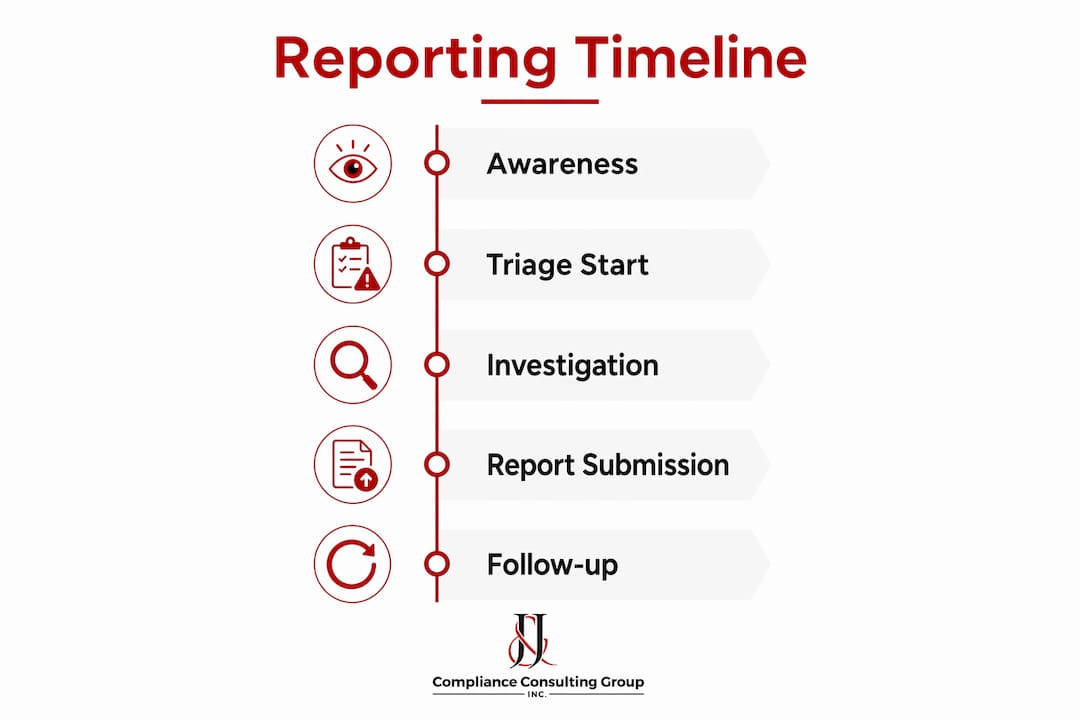
The phrase “becoming aware” is the critical trigger. The compliance clock starts when any employee with reporting responsibility receives information suggesting a reportable event may have occurred. It does not start when the investigation concludes. This distinction catches many organizations off guard, particularly those that wait for root cause analysis before initiating the reporting process.
The submission method matters as well. Electronic submission via FDA eMDR has been mandatory for manufacturers and importers since 2015. Paper submissions are permitted only in narrow exceptions, such as a verified technical failure of the eMDR system. Organizations should maintain eMDR account credentials and test submission workflows before they are needed under deadline pressure.
- Identify the awareness date. Document the exact date and time an employee with reporting responsibility first received information about the potential event.
- Classify the event. Determine whether the event involves a death, serious injury, or reportable malfunction based on the definitions in 21 CFR Part 803.
- Assign the report type. Decide between a 30-day standard report or a 5-day expedited report based on urgency criteria.
- Prepare the eMDR submission. Gather all required data elements and submit through the FDA eMDR electronic system before the deadline.
- File supplemental reports as needed. If new information emerges after initial submission, supplemental reports are required within 30 calendar days of obtaining that information.
Pro Tip: Begin your triage process the moment awareness is established. Do not wait for the investigation completion to start the reporting clock. A preliminary report submitted on time with an ongoing investigation noted is far preferable to a late report with complete findings.
How to complete an adverse event report: data elements and coding
Report quality directly determines how useful your submission is to both the FDA and your own post-market surveillance program. Incomplete or vaguely coded reports create downstream problems during inspections and signal detection reviews.
Every MDR submission requires specific mandatory data elements: device identifiers (including UDI where applicable), a clear event description, patient outcome, and the reporter’s contact information. The event narrative is particularly important. A strong narrative describes what happened, what the device was doing at the time, what the patient outcome was, and what the initial assessment of the cause is. Vague narratives like “device failed during use” provide almost no value for safety signal detection.

FDA MDR adverse event codes are organized into seven hierarchical categories, mapped to both IMDRF and the National Cancer Institute Thesaurus (NCIt). These categories cover device problems, component issues, cause investigation findings, and health effects. Selecting the most specific applicable code, rather than a broad parent code, significantly improves the regulatory utility of your report.
| Report element | What to include |
|---|---|
| Device identification | UDI, model number, lot/serial number, manufacturer name |
| Event description | Chronological account of what occurred, device status, clinical context |
| Patient outcome | Death, serious injury, no injury, unknown. Use FDA-defined outcome codes |
| Cause assessment | Preliminary findings, investigation status, device problem code |
| Supplemental data | Root cause analysis results, corrective actions, updated patient outcome |
Standardized coding supports safety signal detection across the MAUDE database, meaning your coding discipline contributes to industry-wide post-market surveillance. This is not just administrative compliance. It is a direct contribution to the evidence base that regulators use to identify systemic device problems.
Pro Tip: Audit your MDR code selections quarterly against your complaint data. If your team consistently selects the same three or four codes regardless of event type, that is a signal of under-classification, not a clean safety record.
How do global device safety reporting frameworks compare?
Medical device companies operating across multiple markets must satisfy distinct reporting obligations in each jurisdiction. Assuming that FDA MDR compliance covers your global obligations is a structural compliance gap.
The FDA MDR framework centers on deaths, serious injuries, and reportable malfunctions, with the MAUDE database as the public repository. The EU MDR framework, governed by Articles 87 through 92 of Regulation 2017/745, uses different terminology: incidents, serious incidents, and serious public health threats. EU MDR also requires manufacturers to report field safety corrective actions (FSCAs) and emphasizes rapid reporting based on awareness and predefined severity criteria. The EU approach is designed to reduce latency in safety information reaching competent authorities.
South Africa’s SAHPRA published Version 4 of its medical device adverse event reporting guideline in 2024, introducing a structured decision-tree to help licensees determine reportability. SAHPRA’s framework provides classification examples and timelines that differ meaningfully from both FDA and EU requirements.
| Regulatory framework | Reportable events | Key timeline | Submission system |
|---|---|---|---|
| FDA MDR (21 CFR Part 803) | Deaths, serious injuries, certain malfunctions | 30 days standard, 5 days expedited | FDA eMDR |
| EU MDR (Regulation 2017/745) | Incidents, serious incidents, public health threats | Immediate to 15 days depending on severity | EUDAMED (phased rollout) |
| SAHPRA (South Africa) | Adverse events per decision-tree classification | Varies by severity class | SAHPRA online portal |
The practical implication for compliance officers managing multi-jurisdictional programs is clear: each country’s reportability criteria must be evaluated independently. A malfunction that does not meet FDA’s reportability threshold may still trigger an EU MDR serious incident report. Building country-specific decision trees into your post-market surveillance procedures is not optional for global manufacturers.
What are the most common adverse event reporting failures?
Common MDR compliance failures cluster around a few predictable patterns, and most are preventable with the right internal processes.
- Misidentifying the reporting trigger. Teams that wait for investigation completion before starting the reporting clock routinely miss deadlines. The trigger is awareness, not conclusion.
- Underreporting due to causality ambiguity. MAUDE data does not establish causation, and the FDA does not require you to prove causation before reporting. Uncertainty about whether the device caused the event is not a valid reason to withhold a report.
- User error misclassification. Labeling an event as user error to avoid malfunction reporting is a high-risk strategy. Ambiguity between device malfunction and use error requires documented, defensible analysis, not a reflexive classification.
- Documentation gaps. Incomplete complaint files, missing awareness dates, and undocumented triage decisions create significant inspection risk.
- Failure to file supplemental reports. When new information emerges after initial submission, many organizations fail to submit the required supplemental report within 30 days.
“The most defensible MDR program is one where every decision, from initial triage to final submission, is documented with a clear rationale. Regulators do not expect perfection. They expect a traceable, good-faith process.”
Pro Tip: Build a responsibility matrix that names specific individuals accountable for each step of the MDR process: awareness documentation, event classification, report preparation, and submission. Shared responsibility without named owners produces consistent gaps.
Key takeaways
Effective medical device adverse event reporting requires awareness-triggered triage, jurisdiction-specific criteria, and coded submissions that serve both compliance and post-market safety signal detection.
| Point | Details |
|---|---|
| Awareness triggers the clock | The 30-day or 5-day reporting deadline starts when an employee becomes aware, not when the investigation concludes. |
| Entity type determines scope | Manufacturers, importers, and user facilities each carry distinct reporting obligations under 21 CFR Part 803. |
| Code quality drives safety value | Selecting specific FDA MDR adverse event codes improves MAUDE data utility and supports industry-wide signal detection. |
| Global frameworks differ materially | EU MDR and SAHPRA use different terms, timelines, and thresholds that require independent evaluation per market. |
| Supplemental reports are mandatory | New information after initial submission requires a supplemental MDR within 30 calendar days of obtaining it. |
Why MDR programs succeed or fail on organizational culture
After working with medical device manufacturers across multiple regulatory environments, I have seen a consistent pattern: the companies with the strongest MDR programs are not necessarily the ones with the most sophisticated software or the largest compliance teams. They are the ones where frontline staff, from sales representatives to service technicians, understand that reporting a potential adverse event is a protected and expected action.
The technical requirements of MDR are learnable. The regulatory submission process has clear rules, and the eMDR system is functional. What is harder to build is the organizational reflex to escalate a complaint immediately rather than investigate quietly and report later. I have seen that delay cost companies not just regulatory penalties, but the early detection of device problems that could have been corrected before they affected more patients.
Coding discipline is another area where I consistently see underinvestment. Teams spend significant effort on the event narrative and almost none on selecting the right MDR adverse event codes. That is backwards. The narrative matters for individual report quality, but the codes are what make your data comparable across thousands of reports in MAUDE. If your coding is inconsistent, your post-market surveillance program is working with degraded data.
For manufacturers operating in multiple markets, the harmonization challenge is real. I would not recommend building a single global MDR procedure and hoping it satisfies every jurisdiction. The differences between FDA MDR, EU MDR, and SAHPRA are specific enough that a jurisdiction-agnostic approach will produce gaps somewhere. The better model is a core procedure with jurisdiction-specific annexes, reviewed by people who know each market’s requirements directly.
— Mike
How Jjccgroup supports your adverse event reporting compliance

Jjccgroup brings over 30 years of regulatory consulting experience to medical device manufacturers and compliance officers who need more than generic guidance. Whether you are building an MDR program from scratch, preparing for an FDA inspection, or aligning your post-market surveillance procedures with EU MDR and SAHPRA requirements, Jjccgroup provides the procedural documentation, workflow design, and training support to get your program inspection-ready.
The team’s expertise spans FDA eMDR submissions, global vigilance alignment, and quality management system integration. Jjccgroup’s consulting approach is built around reducing regulatory risk while giving your team the confidence to make defensible reporting decisions under deadline pressure. Explore Jjccgroup’s regulatory compliance consulting services to see how tailored support can strengthen your adverse event reporting program.
FAQ
What is medical device adverse event reporting?
Medical device adverse event reporting is the mandatory process under 21 CFR Part 803 by which manufacturers, importers, and user facilities notify the FDA of device-related deaths, serious injuries, and certain malfunctions. Reports populate the FDA’s MAUDE database and support post-market safety surveillance.
When does the MDR reporting clock start?
The reporting clock starts when an employee with reporting responsibility becomes aware of information suggesting a reportable event may have occurred. It does not start at investigation completion, which means triage must begin immediately upon awareness.
Do user facilities need to report device malfunctions?
No. User facilities report deaths to the FDA and manufacturer within 10 working days, and serious injuries to the manufacturer only. Malfunction reporting is not required of user facilities under 21 CFR Part 803.
How does FDA MDR differ from EU MDR vigilance reporting?
FDA MDR focuses on deaths, serious injuries, and certain malfunctions with a standard 30-day submission window. EU MDR uses the terms “incident” and “serious incident” with timelines ranging from immediate to 15 days depending on severity, and also requires reporting of field safety corrective actions.
What happens if new information emerges after an MDR is submitted?
A supplemental report is required within 30 calendar days of obtaining new information related to a previously submitted MDR. Supplemental reports should include updated investigation findings, root cause analysis results, and any changes to the patient outcome assessment.
