


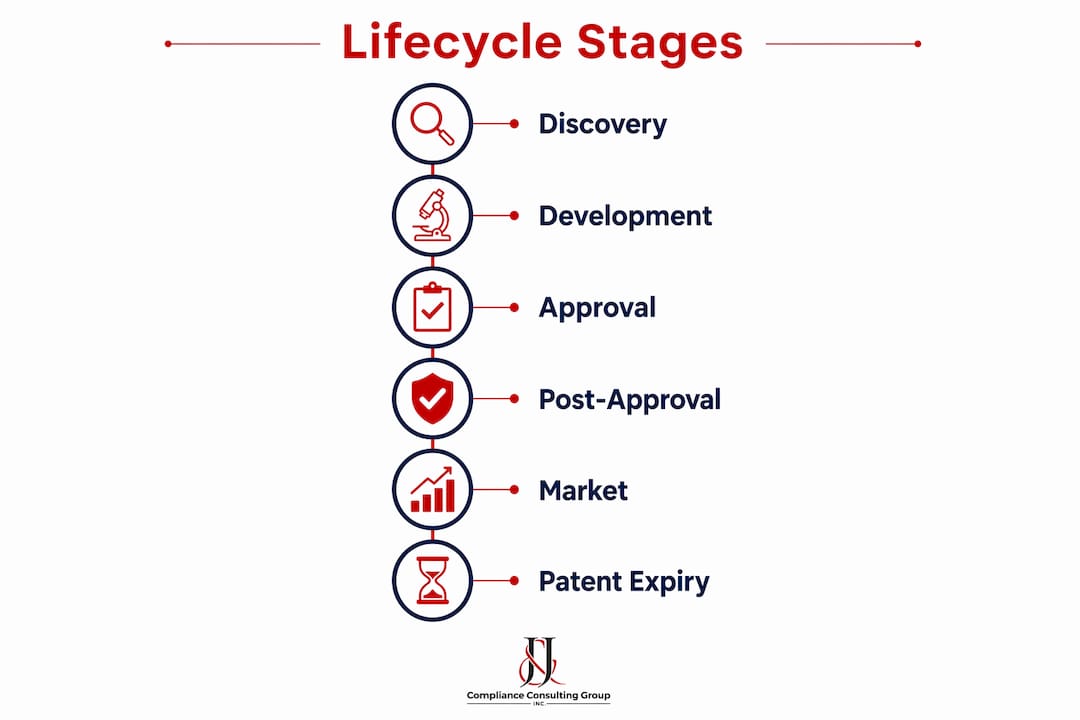
Pharmaceutical lifecycle management (PLCM) is defined as a comprehensive framework managing a drug from discovery through patent expiry and beyond, covering formulation, manufacturing, regulatory commitments, and commercial continuity. The framework spans six distinct stages: discovery, development, approval, launch, post-marketing, and patent expiry. For compliance officers and regulatory professionals, understanding what is lifecycle management pharma means understanding how every decision made at launch shapes your regulatory burden a decade later. Regulatory guidance like ICH Q12 has fundamentally changed how teams plan, document, and execute post-approval changes. This guide covers the core stages, key tools, and practical strategies that define effective lifecycle management in pharma today.
What is lifecycle management in pharma, and why does it matter?
PLCM is not a single activity. It is a cross-functional discipline that governs every phase of a drug’s commercial and regulatory existence. The importance of lifecycle management becomes clear when you consider that decisions made during development directly affect how easily you can make post-approval changes years later.
The six pharma product lifecycle stages each carry distinct regulatory obligations. Discovery and development focus on building the scientific and quality foundation. Approval requires assembling a complete regulatory dossier. Launch triggers post-marketing commitments. The post-marketing phase demands ongoing stability data, pharmacovigilance, and change management. Patent expiry forces companies to defend market position against generics while managing a mature product’s regulatory file.

Regulatory agencies including the USFDA, EMA, and WHO have all recognized that static, approval-only models fail to reflect how products actually evolve. ICH Q12 was developed specifically to address this gap. It gives pharmaceutical teams a structured way to plan, categorize, and communicate changes throughout a product’s life without triggering unnecessary regulatory review at every step.
Pro Tip: Map your product’s regulatory commitments by lifecycle stage at the time of approval. Teams that do this early spend significantly less time firefighting post-approval change requests later.
What are the main stages and components of pharmaceutical lifecycle management?
Lifecycle management in drug development relies on three core ICH Q12 tools: Established Conditions (ECs), Post-Approval Change Management Protocols (PACMPs), and the PLCM document itself. Each tool serves a specific function in reducing regulatory burden while maintaining quality oversight.
Established Conditions are the approved parameters and attributes that define a product’s identity and quality. Any change to an EC triggers a regulatory reporting obligation. Identifying ECs correctly at the time of approval is one of the most consequential decisions a regulatory team makes.
PACMPs are pre-agreed protocols that define the scope, criteria, and reporting category for anticipated future changes. When a PACMP is in place, a manufacturer can implement a qualifying change with a lower-level regulatory submission, provided the change falls within the pre-agreed scope. PACMPs must be scoped in advance; applying them to major unpredictable changes leads to regulatory rejection.
The PLCM document functions as the central repository connecting ECs, reporting categories, PACMPs, and post-approval CMC commitments. It is not a static filing artifact. It is a living operational document that should be updated as the product evolves.
ICH Q12 also establishes a three-tier risk categorization for post-approval changes:
| Change Category | Regulatory Action Required | Example |
|---|---|---|
| Minimal | Annual report or no notification | Minor analytical method update |
| Moderate | Prior notification or CBE-30 | Manufacturing site addition |
| Major | Prior approval supplement | New dosage form or indication |
Pro Tip: Assign a dedicated owner to the PLCM document from day one of approval. Treat it as a living compliance record, not an archive. Teams that update it continuously are far better prepared for regulatory inspections.
How does ICH Q12 transform lifecycle management practices in pharma?
ICH Q12 is the international guideline that harmonizes post-approval change management across USFDA, EMA, and WHO jurisdictions. Its adoption marks a shift from reactive, change-by-change regulatory submissions to proactive, risk-based lifecycle planning.
The guideline’s core contribution is enabling pharmaceutical quality systems to manage changes proportionate to their risk. Minimal changes require no prior notification. Major changes still require prior approval. The middle tier, moderate changes, can be handled through streamlined submissions when a PACMP is in place. This structure reduces the administrative load on both manufacturers and regulators.
Regional implementation differs in important ways. The USFDA fully endorses PACMPs and has integrated them into its post-approval change framework. The EMA requires detailed documentation and applies centralized variation classification. WHO encourages PACMP use but requires alignment with national regulatory authority requirements. Understanding these regional regulatory differences is not optional for teams managing global product portfolios.
Key benefits ICH Q12 delivers for compliance officers and regulatory teams:
- Reduces the number of prior-approval supplements required for routine manufacturing changes
- Enables pre-agreed regulatory pathways through PACMPs before changes are needed
- Aligns QA, regulatory affairs, and CMC teams around a shared change management framework
- Supports faster post-approval change implementation with consistent quality oversight
- Improves inspection readiness by centralizing lifecycle commitments in the PLCM document
Pro Tip: When preparing a PACMP, engage the relevant regulatory agency early. A well-scoped PACMP negotiated before you need it is far more valuable than one submitted reactively under time pressure.
What strategic approaches extend pharmaceutical product lifecycles and maximize value?
Lifecycle extension strategies are the commercial and regulatory tools companies use to sustain product value as patents expire and generic competition enters the market. The most effective strategies are planned in parallel with original development, not after exclusivity loss.
Experts consistently find that delaying product improvements until after patent expiry results in lost market share. Patients and prescribers switch to generics before an improved formulation reaches the market. The companies that protect long-term revenue are those that begin planning improvements during Phase III or earlier.
The main lifecycle extension strategies each carry distinct regulatory and commercial implications:
| Strategy | Description | Regulatory Consideration |
|---|---|---|
| Evergreening | Patent extensions via new formulations or delivery systems | Requires new IP filings and often a supplemental NDA |
| Flanking | Launching a related product to protect market position | May require separate regulatory dossier |
| Rx-to-OTC switch | Moving a prescription product to over-the-counter status | Requires FDA switch application and labeling changes |
| Reformulation | Improving bioavailability, tolerability, or dosing convenience | Triggers EC changes and reporting obligations |
| Repositioning | Targeting a new indication or patient population | Requires clinical data and new regulatory submissions |
| Line extension | Adding new strengths, dosage forms, or routes of administration | Typically requires a supplemental application |
Timing is the critical variable. Regulatory submissions for lifecycle extensions take time. A reformulation that begins development two years before patent expiry will rarely reach the market before generics do. The most effective lever for long-term value is ongoing product improvement planned well ahead of exclusivity loss. Regulatory teams should be involved in lifecycle extension planning from the moment a product enters Phase II.
How can pharma companies operationalize lifecycle management tools?
Operationalizing lifecycle management means treating the PLCM document, EC register, and PACMPs as active management tools, not compliance artifacts. The PLCM document consolidates EC identification, reporting categories, PACMPs, and post-approval CMC commitments into a single reference that the entire cross-functional team can use.
Integration with the Pharmaceutical Quality System (PQS) per ICH Q10 is the foundation of effective operationalization. The PLCM document should connect directly to the change control system. When a proposed change enters the change control process, the team should immediately reference the PLCM document to determine the EC impact and the applicable reporting category. This prevents the most common pitfall: discovering mid-change that a modification affects an EC and requires prior approval.
Common mistakes that undermine lifecycle management in practice:
- Treating the PLCM document as a one-time submission artifact rather than a living record
- Failing to update EC registers after approved changes
- Scoping PACMPs too broadly, which leads to regulatory rejection when specific changes fall outside the agreed criteria
- Siloing lifecycle planning within regulatory affairs, excluding QA and CMC teams
- Missing the connection between risk-based change classification and inspection readiness
Cross-functional governance is not optional. Regulatory affairs, QA, CMC, and commercial teams must share ownership of the PLCM document and the change management process. Companies that assign lifecycle management solely to regulatory affairs consistently struggle with misaligned timelines and missed reporting deadlines.
Pro Tip: Schedule a quarterly PLCM document review with representatives from regulatory affairs, QA, and CMC. Use it to reconcile approved changes, update EC registers, and flag anticipated changes that may need a PACMP.
Key Takeaways
Effective pharmaceutical lifecycle management requires integrating ICH Q12 tools, proactive extension planning, and cross-functional governance from the earliest stages of drug development.
| Point | Details |
|---|---|
| Define ECs at approval | Correctly identifying Established Conditions at approval determines your post-approval regulatory burden. |
| Use the PLCM document actively | Treat the PLCM document as a living operational record, not a static submission artifact. |
| Plan extensions in parallel | Begin lifecycle extension planning during Phase II or III to reach the market before patent expiry. |
| Apply ICH Q12 risk tiers | Categorize changes as minimal, moderate, or major to align regulatory submissions with actual risk. |
| Govern cross-functionally | Assign shared ownership of lifecycle tools across regulatory affairs, QA, and CMC teams. |
Why lifecycle management is more than a compliance checkbox
I have worked with pharmaceutical teams at every stage of product maturity, and the pattern I see most often is this: companies treat lifecycle management as a regulatory obligation rather than a commercial strategy. They build the PLCM document to satisfy an agency requirement, then file it away. Years later, when a manufacturing change or a reformulation becomes urgent, they are starting from scratch.
The teams that get this right think about lifecycle management the way a product manager thinks about a roadmap. They know what changes are coming, when they need to happen, and what regulatory pathway each one requires. They have PACMPs in place before they need them. They have updated their EC register every time a change was approved. When an inspector arrives, they can pull a current PLCM document that reflects the product’s actual state.
The other insight I keep returning to is the timing problem with lifecycle extensions. Regulatory professionals often know that a reformulation or an Rx-to-OTC switch would add commercial value, but they wait for a signal from the commercial team before acting. By the time the business case is approved and development begins, the window has closed. The companies that protect market share past patent expiry are the ones where regulatory and commercial planning happen simultaneously, not sequentially.
Lifecycle management in pharma is ultimately about maintaining control of your product’s future. The tools exist. ICH Q12 provides the framework. The PLCM document provides the structure. What separates high-performing teams is the discipline to use those tools continuously, not just at approval.
— Mike
Jjccgroup’s approach to pharmaceutical lifecycle strategy
Pharmaceutical lifecycle management requires both technical depth and regulatory experience. Jjccgroup brings over 30 years of FDA compliance expertise to help pharmaceutical companies build lifecycle strategies that hold up under agency scrutiny.

Whether your team needs support structuring a PLCM document, scoping PACMPs for anticipated manufacturing changes, or planning a lifecycle extension strategy aligned with ICH Q12, Jjccgroup provides the consulting depth to get it right. Our regulatory approval consulting services are built specifically for pharmaceutical manufacturers navigating post-approval complexity. We also support pharmaceutical regulatory consulting engagements that cover the full product lifecycle, from development through patent expiry. Contact Jjccgroup to build a lifecycle management program that protects your product’s quality and commercial position.
FAQ
What is pharmaceutical lifecycle management?
Pharmaceutical lifecycle management is a framework that governs a drug from discovery through patent expiry, covering regulatory submissions, manufacturing changes, quality systems, and commercial continuity. It integrates tools like ICH Q12 Established Conditions and PACMPs to manage post-approval changes efficiently.
What does ICH Q12 do for lifecycle management?
ICH Q12 provides a risk-based system for categorizing post-approval changes as minimal, moderate, or major, reducing unnecessary regulatory submissions. It introduces tools including Established Conditions, PACMPs, and the PLCM document to support proactive lifecycle planning across USFDA, EMA, and WHO jurisdictions.
What is a PLCM document?
The PLCM document is a centralized regulatory record that consolidates Established Conditions, reporting categories, PACMPs, and post-approval CMC commitments for a specific product. Proper maintenance of this document improves inspection readiness and keeps cross-functional teams aligned on lifecycle obligations.
When should lifecycle extension planning begin?
Lifecycle extension planning should begin during Phase II or Phase III clinical development, not after patent expiry approaches. Waiting until exclusivity loss is imminent leaves insufficient time for regulatory submissions and market entry before generics arrive.
How do ECs affect post-approval change management?
Established Conditions are the approved parameters that define a product’s quality and identity. Any change to an EC triggers a regulatory reporting obligation, so correctly identifying ECs at the time of approval directly determines the complexity and cost of future post-approval changes.
