


Medical device software validation is defined as the documented process of confirming that software performs its intended function safely, reliably, and in compliance with regulatory requirements. Regulatory professionals and quality assurance teams in medical device companies must follow structured medical device software validation steps to satisfy the FDA’s General Principles of Software Validation, the IEC 62304 software lifecycle standard, and the GAMP 5 risk-based framework. Skipping or shortcutting any step creates audit exposure, delays product release, and, most critically, puts patients at risk. This guide walks through each phase of the software validation process with the specificity your compliance program requires.
What are the essential medical device software validation steps?
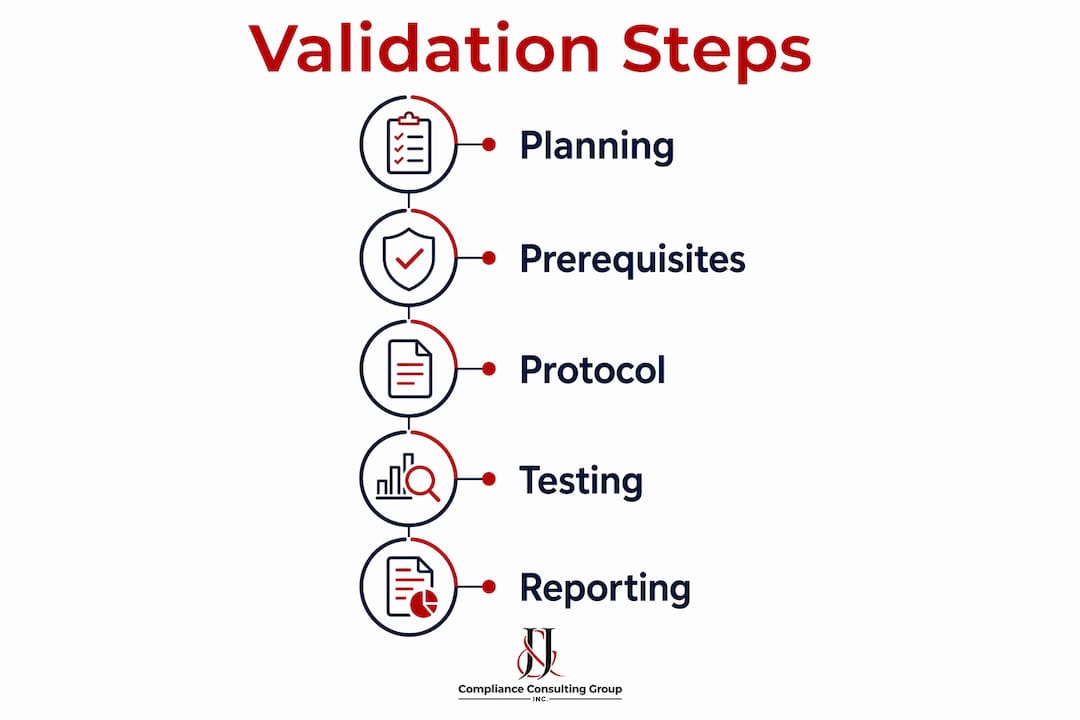
Medical device software validation follows a five-step workflow: planning, system prerequisites, protocol development, test execution, and final reporting. Each step builds on the previous one, and regulators expect documented evidence at every stage.
Step 1: Validation planning
The validation plan defines scope, acceptance criteria, team responsibilities, and the regulatory standards that apply. A well-constructed Validation Master Plan (VMP) tells reviewers exactly what will be tested, who owns each activity, and what constitutes a passing result. Without a VMP, teams frequently discover mid-project that critical requirements were never assigned to a test case.

Step 2: System prerequisites
Before writing a single test script, you need a Software Requirements Specification (SRS) and a completed risk analysis. The User Requirement Specification (URS) is foundational here. If a requirement cannot be tested, it cannot be validated. Risk analysis at this stage, typically following ISO 14971, determines which software functions carry the highest patient safety impact and therefore require the most rigorous testing.
Step 3: Protocol development
Test protocols translate requirements into executable test cases and validation scripts. Each test case must map directly to a requirement in the SRS. Protocols should specify the exact input, expected output, pass/fail criteria, and the tester’s role. Vague protocols produce vague results and give auditors reason to question the entire validation package.
Step 4: Test execution
Test execution is where the validation process becomes evidence. Teams run each test case, record results in real time, and document any deviations immediately. Electronic documentation tools that capture timestamps and electronic signatures replace paper-based records and reduce transcription errors. Every deviation requires a documented disposition before the team can proceed.
Pro Tip: Never execute tests against a software build that has not been formally baselined in your configuration management system. Testing an uncontrolled build invalidates your entire execution record.
Step 5: Final validation report
The final report summarizes all test outcomes, documents known anomalies, and records formal approval signatures. It confirms that the software meets its intended use under the conditions defined in the validation plan. Regulators treat this report as the primary evidence of compliance, so it must be complete, traceable, and signed before software release.
| Validation step | Primary deliverable | Key standard reference |
|---|---|---|
| Validation planning | Validation Master Plan (VMP) | GAMP 5, FDA General Principles |
| System prerequisites | SRS, URS, risk analysis | ISO 14971, IEC 62304 |
| Protocol development | Test cases and scripts | IEC 62304 Section 5.7 |
| Test execution | Executed protocols, deviation records | 21 CFR Part 11 |
| Final validation report | Signed summary report | GAMP 5, FDA General Principles |
What regulatory standards and frameworks guide the software validation process?
Four frameworks define the regulatory compliance requirements for medical device software validation. Understanding how they interact is what separates teams that pass audits from teams that scramble to explain gaps.
- FDA General Principles of Software Validation: This 2002 guidance document remains the primary FDA reference for validation procedures for devices. It establishes that validation must demonstrate fitness for intended use, not simply generate documentation volume.
- 21 CFR Part 11: This regulation governs electronic records and electronic signatures. Any validation documentation stored or signed electronically must meet Part 11 requirements for audit trails, access controls, and record integrity.
- IEC 62304: This international standard defines the software development lifecycle for medical device software. It classifies software into three safety classes (A, B, and C) and requires progressively more rigorous testing as the safety class increases. Verification methods under IEC 62304 include code review, static analysis, and formal mathematical methods depending on the assigned safety class.
- GAMP 5: The Good Automated Manufacturing Practice 5 framework applies a risk-based approach to validation. It categorizes software from infrastructure (Category 1) through custom applications (Category 5) and scales validation effort to match the risk profile of each category.
- FDA Computer Software Assurance (CSA): The CSA guidance, finalized after years of industry consultation, promotes risk-focused validation that concentrates testing effort on high-risk features. It explicitly discourages excessive documentation for low-risk functionality, freeing teams to apply rigor where patient safety demands it.
Audit trails, change control records, and electronic records are not optional under any of these frameworks. They are the evidence that regulators examine first during an inspection.
How to execute effective testing and documentation in software validation?
Effective medical software testing requires multiple levels of verification, each targeting a different layer of the software architecture.
- Unit testing verifies individual software modules in isolation. It catches coding errors before they propagate into integrated builds.
- Integration testing confirms that modules interact correctly when combined. This level is where interface failures and data-passing errors typically surface.
- System testing validates the complete software product against the SRS under conditions that simulate real-world use.
- User site testing (also called user acceptance testing or UAT) confirms that the software performs as intended in the actual operating environment, with the actual hardware and user population.
IEC 62304 requires all four testing levels with documented acceptance criteria at each stage. That requirement exists because defects found at the system level cost significantly more to fix than defects caught at the unit level.
White-box testing examines internal code logic and is typically used during unit and integration phases. Black-box testing evaluates software behavior from the user’s perspective without knowledge of the underlying code. Most validation programs use both methodologies, with coverage metrics documented to show that testing was thorough.
Traceability matrices linking user requirements to test cases are the backbone of audit-ready documentation. Without a traceability matrix, there is no systematic way to confirm that every requirement has been tested. Regulators treat a missing traceability matrix as a gap in the validation package, not a minor omission.
Pro Tip: Build your traceability matrix before writing test protocols, not after. Starting with requirements and working forward to test cases prevents the common mistake of writing tests that cover what is easy to test rather than what is required.
Anomalies discovered during test execution must be logged, assessed for patient safety impact, and formally dispositioned. Closing an anomaly without a documented risk assessment is one of the most common findings during FDA inspections. Change control processes must capture every software modification after validation, with a formal assessment of whether revalidation is required.
What are common challenges and best practices in medical device software validation?
The most persistent challenge in validation is the belief that more documentation equals better compliance. Regulators focus on evidence of fitness for intended use, not on the thickness of a binder. Validation packages are most valuable when they clearly demonstrate system control, reliability, and regulatory compliance. A 500-page package that fails to show the software works as intended is less defensible than a 50-page package that does.
- Prioritize testable requirements. Requirements written as vague performance goals cannot be validated. Every requirement in the URS must have a measurable acceptance criterion.
- Lock the software version before testing. Software release must verify that the tested version matches the released version exactly. Configuration management is not a formality. It is the mechanism that prevents unvalidated code from reaching patients.
- Conduct risk assessments before skipping tests. Teams under schedule pressure often skip tests for features they consider low-risk. That decision requires a documented risk assessment, not an informal team agreement.
- Plan for revalidation from the start. IEC 62304 maintenance processes require formal change impact assessments for every post-release modification. Teams that treat revalidation as an afterthought create backlogs of unvalidated changes.
- Adopt automated validation workflows. Manual “paper-on-glass” methods introduce transcription errors and slow audit response times. Automated tools that capture electronic signatures and timestamps in real time produce cleaner records and reduce remediation costs.
Fitness for intended use supersedes document volume. Regulators focus on evidence demonstrating reliable control of software. A validation program built around demonstrating that the software works is always more defensible than one built around generating paperwork.
The shift from manual to automated validation workflows is no longer a future trend. It is the current standard for teams that want to maintain audit readiness without dedicating disproportionate resources to documentation maintenance.
Key Takeaways
Medical device software validation requires a structured, evidence-based process aligned with FDA, IEC 62304, and GAMP 5 standards to demonstrate that software is safe and fit for its intended use.
| Point | Details |
|---|---|
| Five-step validation workflow | Planning, prerequisites, protocol development, test execution, and final reporting form the required sequence. |
| Testable requirements are mandatory | Every URS requirement must have a measurable acceptance criterion or it cannot be validated. |
| Traceability matrices are non-negotiable | Linking requirements to test cases is the primary audit evidence for comprehensive test coverage. |
| Configuration management protects release integrity | The released software version must match the tested baseline exactly, with all changes formally controlled. |
| CSA shifts focus to risk-based testing | FDA’s Computer Software Assurance guidance reduces low-risk documentation burden and concentrates effort on patient safety impact. |
Where validation programs actually break down
After working with medical device companies across multiple FDA inspection cycles, I have seen the same failure pattern repeat. Teams invest heavily in writing validation protocols and almost nothing in maintaining them after the first release. The validation package looks complete on day one and becomes a liability by month six, when three software updates have been deployed without formal change impact assessments.
The teams that consistently pass inspections treat validation as a living program, not a one-time project. They build change control into their development workflow from the start, so revalidation decisions happen automatically rather than reactively. They also embrace the FDA’s CSA guidance not as a way to do less work, but as a way to do the right work. Concentrating testing effort on high-risk features and using exploratory methods for low-risk functionality produces better evidence, not less evidence.
The other shift I have seen matter most is moving away from volume as a proxy for quality. Regulatory professionals who can walk an FDA investigator through a concise, traceable validation package and explain every decision are far better positioned than teams hiding behind stacks of paper. Evidence-based documentation, supported by audit-ready compliance practices, is what regulators actually want to see. The goal is not to impress with quantity. The goal is to demonstrate control.
— Mike
Jjccgroup’s support for medical device software validation
Jjccgroup brings over 30 years of FDA regulatory consulting experience to medical device software validation programs. Whether your team needs help structuring a Validation Master Plan, closing gaps before an inspection, or building a revalidation process that scales with your product roadmap, Jjccgroup provides the expertise to get it done right.

Jjccgroup’s consultants work directly with quality assurance and regulatory teams to produce validation documentation that satisfies FDA, IEC 62304, and GAMP 5 requirements. Their regulatory approval consulting services cover the full validation lifecycle, from initial planning through post-market change control. Teams that engage Jjccgroup early in the medical device development lifecycle consistently reach market faster and enter inspections with greater confidence. Contact Jjccgroup to build a validation program that holds up under scrutiny.
FAQ
What is medical device software validation?
Medical device software validation is the documented process of confirming that software performs its intended function safely and in compliance with applicable regulatory standards, including FDA guidance and IEC 62304.
How many steps are in the software validation process?
The standard software validation process follows five steps: validation planning, system prerequisites, protocol development, test execution, and final validation reporting, as aligned with GAMP 5 and IEC 62304.
What is the difference between verification and validation in medical software?
Verification confirms that software was built correctly according to its specifications. Validation confirms that the correct software was built and that it performs as intended in its actual use environment.
What does FDA’s Computer Software Assurance guidance change?
FDA’s CSA guidance shifts validation effort toward high-risk software features and away from excessive documentation for low-risk functionality, making the overall validation process more efficient and risk-focused.
Why do traceability matrices matter in software validation?
Traceability matrices link every user requirement to a specific test case and result, providing auditors with direct evidence that all requirements were tested and that no functional area was overlooked.
