


Retailer compliance programs set the real quality floor for dietary supplement brands in the US market. They go well beyond the FDA baseline under the Dietary Supplement Health and Education Act (DSHEA), requiring brands to meet private retailer standards that include mandatory third-party current Good Manufacturing Practice (cGMP) audits, ingredient verification testing, and label documentation reviews. Retailers carry legal liability under both the Federal Food, Drug, and Cosmetic Act (FDCA) and the FTC Act for misbranded or adulterated products they sell, which is precisely why they have built active compliance programs to protect themselves and their customers. For supplement brands, meeting these standards is not just about staying on shelves. It directly shapes your credibility, supply chain operations, and long-term market access.
The core roles retailer compliance plays for supplement brands include:
- Enforcing quality standards that exceed FDA minimums, pushing brands toward stronger manufacturing controls
- Protecting retailers from legal liability, which in turn creates a gating mechanism for brand market entry
- Driving accurate labeling and truthful marketing claims aligned with both FDA and FTC requirements
- Requiring third-party certifications that build consumer trust and differentiate compliant brands
- Serving as an early warning system that prepares brands for federal inspections before they occur
How retailer-imposed standards shape supplement brand operations
Retailers have evolved into active compliance gatekeepers, and the standards they impose carry real operational weight. The most common requirements include mandatory third-party cGMP audits, certificate of analysis documentation for each ingredient lot, label review against FDA’s Supplement Facts requirements, and evidence of allergen controls. Major retailers such as CVS and Wegmans require NSF certification as a prerequisite for shelf placement, and that standard has become a de facto industry benchmark.
Amazon’s 2024 policy update raised the bar further. The platform now requires dietary supplement sellers to provide third-party testing and inspection evidence, a direct response to a documented pattern of adulterated products containing banned pharmaceutical ingredients reaching consumers through its marketplace. Those recalls exposed the gap between FDA’s post-market enforcement model and the proactive screening retailers can demand.
One of the less-discussed consequences of fragmented retailer requirements is what the industry calls “audit tourism.” Brands selling through multiple retail channels face duplicative audit demands from each retailer, each with slightly different documentation formats, testing protocols, and timelines.
The operational burden is real, but so is the opportunity. Brands that build compliance infrastructure capable of satisfying the most demanding retailer standards position themselves to enter new channels faster than competitors who treat compliance reactively.
Key operational impacts include:
- Increased documentation overhead across ingredient sourcing, manufacturing, and labeling
- Higher testing costs from lot-by-lot third-party verification requirements
- Supply chain complexity when contract manufacturers lack the certifications retailers demand
- Competitive differentiation for brands that achieve recognized certifications ahead of market entry
What changed in US regulatory and retailer policy in 2024–2025
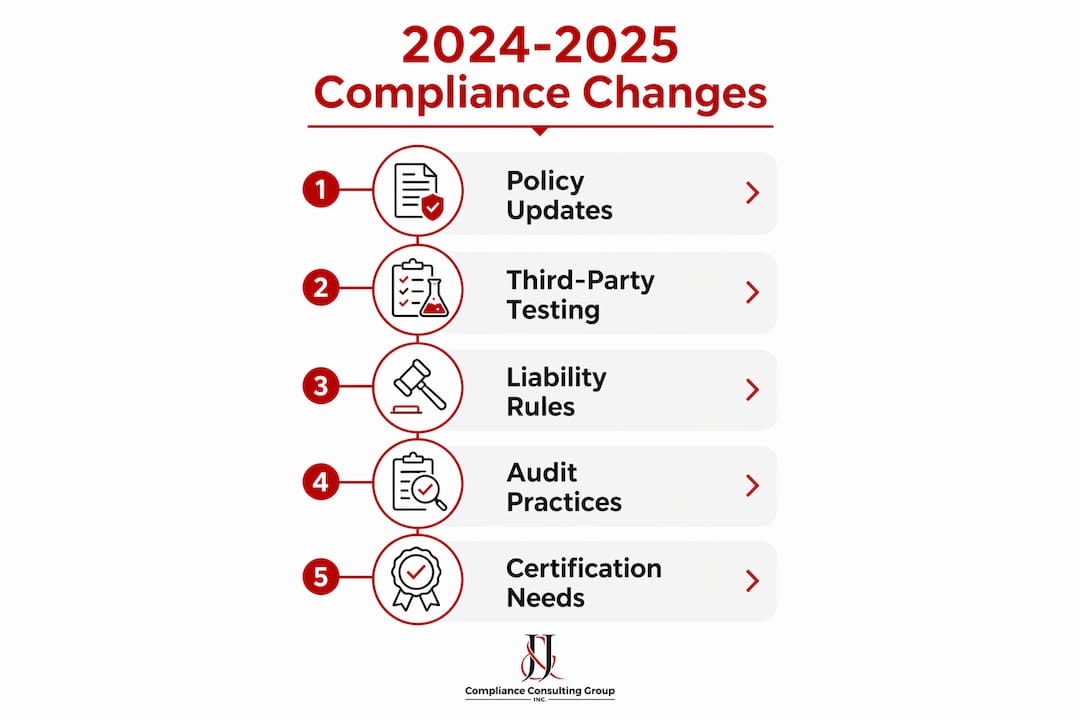
The regulatory and retailer policy environment shifted meaningfully over the past two years, and supplement brands need to account for those changes now.
| Update | Source | Impact on Brands |
|---|---|---|
| Amazon 2024 third-party testing policy | Amazon Seller Policy | Mandatory testing evidence required for all supplement listings |
| FDA increased inspection priorities for dietary supplement facilities | FDA Human Foods Program | Higher probability of facility inspections; cGMP gaps more likely to trigger enforcement |
| FTC updated health products compliance guidance | FTC Health Guidance | Stricter substantiation standards for health claims in advertising |
| Courts advancing retailer liability cases | Federal courts | Expanded legal exposure for e-commerce platforms selling supplements |
| CRN harmonization initiative | Council for Responsible Nutrition | Push to align retailer standards to reduce duplicative audit burden |
The FTC’s guidance makes clear that liability for deceptive health claims extends to all marketing participants, including retailers and distributors, not just manufacturers. Health claims must be supported by competent and reliable scientific evidence, typically high-quality human clinical trials. Retailers that market supplements with unsubstantiated claims face direct FTC exposure, which is why many now require brands to submit claims substantiation documentation before listing approval.
The FDA and FTC share jurisdiction over supplement marketing: FDA controls labeling while FTC governs advertising, but both agencies require truthfulness and substantiation. Brands that treat these as separate compliance tracks often create gaps that surface during retailer audits.
Key 2024–2025 policy developments to act on:
- Document all health claims with clinical trial evidence before submitting to any retailer
- Confirm your contract manufacturer holds current third-party cGMP certification recognized by your target retailers
- Register your facility with FDA and verify your registration is current before any retailer audit
- Review your Amazon listings against the 2024 third-party testing requirements if you sell through that channel
Legal risks and best practices for supplement brand compliance
Non-compliance with retailer standards carries consequences that go well beyond losing a purchase order. Courts increasingly view retailers as integral to the commercial distribution chain, which means brands that supply non-compliant products expose themselves to shared liability claims. FDA warning letters, product recalls, and FTC enforcement actions all become more likely when retailer audit findings reveal manufacturing or labeling deficiencies.

The financial exposure compounds quickly. Retailer chargebacks and deductions for non-compliant shipments, legal defense costs in class action suits, and the cost of reformulating or relabeling a recalled product can collectively exceed the revenue from an entire product line. Reputational damage in retail channels tends to outlast the original compliance failure.
Best practices that reduce both legal and commercial risk:
- Implement a quality management system with centralized document control covering all manufacturing records, testing data, and supplier qualifications
- Pursue third-party certifications such as NSF/ANSI 173 proactively, before retailers request them
- Maintain a claims substantiation file for every health claim in your labeling and advertising, updated as new science emerges
- Conduct internal mock audits against your top retailers’ requirements at least annually
- Assign clear compliance ownership across your operations, quality, and supply chain teams so audit responses do not fall through organizational gaps
Pro Tip: When managing multi-retailer audit demands, build a single master compliance matrix that maps each retailer’s specific requirements against your existing documentation. This approach surfaces gaps without requiring you to rebuild your compliance file from scratch for each new retail partner.
Viewing retailer standards as minimum requirements rather than ceilings better prepares brands for FDA inspections, since retailer programs typically exceed FDA baseline ingredient verification and manufacturing safety standards.
How to build a compliance program that satisfies retailers and strengthens your brand
A well-designed compliance program does more than check boxes. Proactive audits turn compliance from a cost center into a competitive advantage by uncovering operational gaps before regulators or retailers do. The brands that win shelf space consistently are the ones that treat compliance as an ongoing lifecycle, not a one-time certification event.
Building that program starts with a clear framework:
- Map your retailer requirements. List every retailer you sell through or plan to target, and document their specific audit, testing, and documentation requirements in a single matrix.
- Centralize your compliance documentation. A compliance dashboard linking master manufacturing records, third-party lab data, and supplier certifications lets you respond to any retailer audit request within days, not weeks.
- Assign ownership. Every compliance requirement needs a named owner across your quality, operations, and regulatory teams. Shared responsibility without named accountability creates gaps.
- Schedule proactive internal audits. Run mock audits against your most demanding retailer’s standards at least twice per year. Findings from those audits feed directly back into your quality system improvements.
- Build supplier qualification into your sourcing process. Require your contract manufacturers and ingredient suppliers to maintain current third-party certifications as a condition of your supplier agreements.
Pro Tip: Integrate audit findings into your corrective and preventive action (CAPA) process immediately after each audit cycle. Brands that close CAPA loops within 30 days consistently perform better in subsequent retailer and FDA inspections than those that treat findings as administrative paperwork.
Jjccgroup has supported supplement brands through exactly this kind of program development, drawing on over 30 years of FDA regulatory expertise to help clients build compliance frameworks that satisfy both retailer demands and federal requirements. Working with a partner who understands both the retailer compliance landscape and the FDA enforcement environment reduces the risk of building a program that passes retail audits but fails an FDA inspection.
What retailer compliance standards actually require from supplement brands
Retailer compliance standards for dietary supplements typically operate on three levels: manufacturing quality, product integrity, and marketing accuracy. At the manufacturing level, retailers require evidence that products were made under current Good Manufacturing Practices, verified by an accredited third-party auditor. At the product integrity level, they require certificate of analysis documentation confirming that finished products match label claims for potency, purity, and the absence of contaminants. At the marketing level, they require that all label and advertising claims meet FDA and FTC substantiation standards.
The Council for Responsible Nutrition (CRN) has actively pushed for harmonized retailer standards to reduce the duplicative burden on brands, recognizing that fragmented requirements across retailers create inefficiency without improving safety outcomes. Until harmonization advances further, brands must manage retailer-specific variations while maintaining a core compliance infrastructure that satisfies the most demanding requirements.
How retailer compliance affects your supply chain and logistics
Retailer compliance requirements reach deep into the supply chain, well past your own manufacturing floor. When a retailer requires NSF certification or a specific third-party audit standard, that requirement flows upstream to your contract manufacturer and ingredient suppliers. If your co-manufacturer does not hold the required certification, you face a choice between switching suppliers or losing the retail account.

Lot-by-lot testing requirements add lead time and cost to every production run. Brands that have not built testing timelines into their production schedules regularly miss retailer ship windows because third-party lab results arrive after the expected delivery date. Building a supplement distributor compliance checklist that includes testing lead times into your production planning calendar prevents that problem before it costs you a purchase order.
Labeling compliance adds another layer. Retailers often require label pre-approval before a product ships, and label changes triggered by FDA guidance updates or retailer feedback require reprinting and relabeling inventory already in the supply chain.
What retailer audits and inspections actually evaluate
Retailer audits go well beyond a paperwork review. An on-site cGMP audit conducted by an accredited third party typically evaluates your facility’s physical controls, personnel training records, equipment calibration logs, batch production records, and complaint handling procedures. The auditor is looking for evidence that your quality system functions consistently, not just that your documentation exists.
Audit findings are categorized by severity. Critical findings, such as evidence of contamination controls failure or falsified records, can result in immediate delisting. Major findings require a corrective action response within a defined timeframe, typically 30 days. Minor findings are documented and tracked across audit cycles. Brands that respond to findings with documented CAPA plans and evidence of correction build credibility with retail compliance teams over time.
Preparing for retailer audits using the same rigor you would apply to an FDA inspection readiness process is the most efficient approach, since the two share substantial overlap in what they evaluate.
How to communicate and negotiate compliance expectations with retailers
Supplement brands often treat retailer compliance as a one-way requirement, but the relationship has room for productive dialogue. Before submitting a new product for retailer review, request a pre-submission meeting with the retailer’s compliance or quality team to understand their specific documentation requirements. This prevents the common scenario where a brand submits a complete compliance package only to learn the retailer requires a different certification body or a different audit standard.
When a retailer introduces a new compliance requirement with a short implementation timeline, negotiate a phased compliance schedule backed by a written corrective action plan. Retailers generally prefer to work with brands that demonstrate good-faith compliance efforts over those that simply miss deadlines without communication. Documenting these conversations and agreements in writing protects both parties and creates a compliance record that supports future audits.
How retailer compliance affects product pricing and market access
Compliance costs are real and they flow directly into product pricing. Third-party certifications, lot-by-lot testing, and audit preparation collectively add to your cost of goods. Brands that absorb these costs without adjusting pricing often find their margins eroded to the point where retail channels become unprofitable.
The market access equation, however, favors compliant brands. Retailers are actively tightening their supplier qualification requirements, which means non-compliant brands face delisting while compliant brands face less competition for premium shelf placement. NSF certification, for example, opens doors at CVS, Wegmans, and a growing list of retailers that have made third-party certification a hard requirement. The brands that invest in FDA compliance requirements and retailer certification early recover those costs through expanded distribution and reduced risk of costly recalls or enforcement actions.
Key Takeaways
Retailer compliance for supplement brands requires proactive certification, centralized documentation, and a quality system that treats retailer standards as the floor, not the ceiling, for both market access and FDA readiness.
| Point | Details |
|---|---|
| Retailers enforce above FDA baseline | Retailer programs require third-party cGMP audits and ingredient testing that exceed federal minimums. |
| FTC liability extends to retailers | All marketing participants, including retailers, face FTC enforcement for unsubstantiated health claims. |
| Audit tourism increases operational costs | Brands selling through multiple channels face duplicative audits; a centralized compliance matrix reduces that burden. |
| Amazon’s 2024 policy raised the bar | Third-party testing evidence is now mandatory for supplement listings on the platform. |
| Compliance drives market access | NSF and similar certifications open shelf placement at major retailers and reduce recall and litigation exposure. |
