



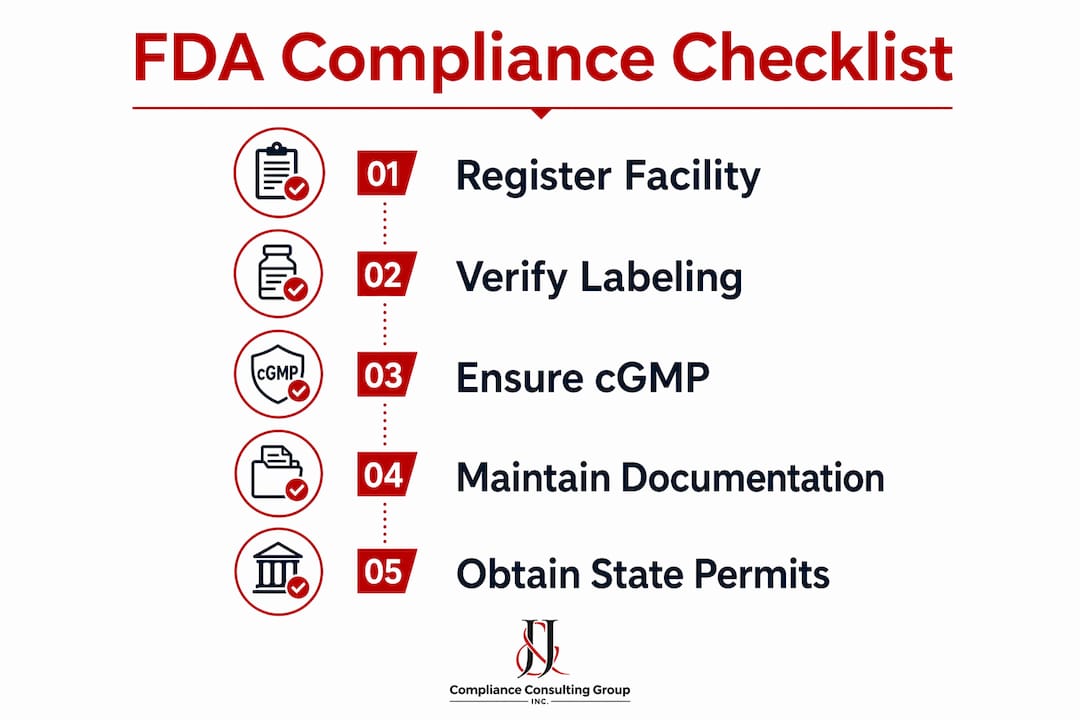
A supplement distributor is defined as any entity that receives, stores, and ships dietary supplement products within the U.S. supply chain, and every one of them carries direct legal obligations under the Federal Food, Drug, and Cosmetic Act (FD&C Act). The supplement distributor FDA obligation checklist covers five core areas: facility registration, labeling compliance, current Good Manufacturing Practices (cGMP) under 21 CFR Part 111, documentation standards, and state-level permits. Failing any one of these areas exposes your business to shipment detentions, import refusals, and FDA enforcement action. With 2026 bringing new ingredient traceability requirements, the time to audit your compliance posture is now.
What are the mandatory FDA registration requirements for supplement distributors?
Facility registration is mandatory for any domestic or foreign facility that manufactures, processes, packs, or holds dietary supplements. That definition captures most distributors operating a warehouse or fulfillment center. Non-compliance can result in shipment detentions and import refusals, which means a single missed renewal can freeze your entire distribution operation.
Key registration obligations include:
- Register with the FDA through the FDA Industry Systems (FIS) portal before beginning operations.
- Renew biennially during the October 1 through December 31 window in even-numbered years.
- Confirm 3PL registration before signing any third-party logistics contract. FDA registration records for dietary supplement businesses are not publicly searchable, so you must request direct copies of registration confirmation from your partners.
- Document every registration number you receive and store it in a retrievable compliance file.
- Update your registration within 60 days of any change to facility name, address, or ownership.
Registration confirms your facility exists in the FDA system. It does not confirm quality. That distinction matters because FDA registration confers no quality assurance; cGMP third-party audits are the mechanism that actually validates your handling practices.
Pro Tip: Request a copy of your 3PL’s FDA registration certificate and set a calendar reminder 90 days before the biennial renewal window. If your 3PL cannot produce documentation within 48 hours, treat that as a compliance risk.
Which labeling requirements must supplement distributors verify?
Labeling is the most visible compliance surface for any distributor. The FDA requires five specific statements on every dietary supplement label, and distributors who private-label or co-brand products carry direct responsibility for what appears on the package.
The five required label elements are:
- Statement of identity — the product must be clearly identified as a “dietary supplement.”
- Net quantity of contents — expressed in weight, measure, or numerical count.
- Nutrition labeling — the Supplement Facts panel, formatted per 21 CFR Part 101.
- Ingredient list — all ingredients listed in descending order of predominance by weight.
- Manufacturer’s name and place of business — the responsible party’s full address must appear on the label.
Labels must comply with specific formatting and placement guidelines, not just content requirements. Font size, panel placement, and contrast all factor into FDA compliance reviews.
A critical 2026 update affects every distributor reviewing product labels. From October 1, 2026, the FDA Ingredient Traceability Code on dietary supplement labels becomes mandatory. This requirement means distributors must audit every SKU in their catalog to confirm the traceability code is present before that date.
| Label Element | Common Compliance Pitfall |
|---|---|
| Statement of identity | Missing “dietary supplement” designation |
| Net quantity | Incorrect unit of measure for the dosage form |
| Supplement Facts panel | Outdated format not reflecting 2016 FDA updates |
| Ingredient list | Proprietary blends listed without total weight |
| Manufacturer info | P.O. box used instead of a physical address |
Beyond structure, the FDA requires that all label claims be truthful and non-misleading. Structure/function claims must include the disclaimer: “This statement has not been evaluated by the Food and Drug Administration. This product is not intended to diagnose, treat, cure, or prevent any disease.” Distributors who source products from contract manufacturers must verify this disclaimer is present and correctly formatted before accepting inventory.
Pro Tip: Build a label verification checklist into your receiving process. Before any new SKU enters your warehouse, a designated compliance reviewer should confirm all five required elements and the structure/function disclaimer are present and correctly formatted.
How must supplement distributors comply with cGMP and handling standards?
Current Good Manufacturing Practices, codified in 21 CFR Part 111, mandate specific storage conditions, contamination prevention protocols, and documentation requirements that apply directly to distributors. Many distributors assume cGMP obligations belong only to manufacturers. That assumption is wrong and costly.

What cGMP means for your warehouse
Distributors are responsible for maintaining product integrity from the moment inventory arrives at their facility. 21 CFR Part 111 mandates storage conditions that prevent contamination, proper lot traceability, and handling protocols that preserve product quality. Temperature-sensitive products require validated storage zones with continuous monitoring logs. Pest control records, cleaning schedules, and employee hygiene protocols must all be documented and available for inspection.
Compliant vs. non-compliant storage practices
| Practice | Compliant | Non-Compliant |
|---|---|---|
| Inventory rotation | FEFO (First Expired, First Out) picking enforced | FIFO only, ignoring expiration dates |
| Temperature control | Validated zones with continuous data loggers | Ambient storage without monitoring |
| Lot traceability | Lot numbers logged at receipt and at shipment | Lot numbers recorded only at receipt |
| Contamination prevention | Dedicated supplement storage area, segregated | Mixed storage with non-food products |
| Documentation | Written SOPs reviewed annually | Verbal procedures, no written records |
Choosing a third-party logistics provider requires the same scrutiny you apply to your own facility. Supplement distributors must partner with 3PLs that adhere to 21 CFR Part 111, with capabilities like lot-level traceability and FEFO picking. Non-compliant 3PLs expose brand owners to full regulatory liability. That liability does not transfer to the 3PL when the FDA comes knocking.
Pro Tip: Schedule a mock internal inspection twice per year. Assign a team member to walk your facility as an FDA investigator would, checking storage conditions, documentation availability, and lot traceability. Internal mock inspections are an effective early warning tool for identifying operational gaps before a real audit.
What documentation must supplement distributors maintain for FDA compliance?
Documentation is the evidence layer that proves your compliance program works. FDA inspections demand complete, accurate, and easily retrievable documentation including batch records, certificates of analysis (COAs), and facility registration documents. An inspector who cannot find a record in under five minutes will treat it as a missing record.
The core document set every distributor must maintain includes:
- Facility registration confirmations for your own facility and all 3PLs you use.
- Certificates of Analysis (COAs) from your manufacturer for every lot received, confirming identity, purity, strength, and composition.
- Lot traceability logs linking each lot number to its receipt date, storage location, and outbound shipment records.
- Temperature and storage monitoring logs with date, time, and responsible party signatures.
- Supplier qualification records documenting how you vetted each manufacturer and 3PL partner.
- Complaint and adverse event logs with documentation of any consumer reports and your response actions.
Validated electronic systems with audit trails are the recommended standard for record keeping, particularly for distributors operating at scale. When electronic records fall under 21 CFR Part 11, they must include access controls, audit trails, and electronic signature protocols. Paper-based systems are not prohibited, but they create retrieval delays that complicate inspections.
Pro Tip: Centralize all compliance documents in a single electronic system with role-based access. Organize folders by regulatory category so any team member can locate a specific COA or registration document within two minutes. Audit your retrieval speed quarterly.
What state permits do supplement distributors need beyond FDA registration?
Federal FDA registration is the compliance baseline, not the finish line. Many states require additional permits for supplement distributors, and failure to secure them can halt product distribution regardless of your federal compliance status.
| State | Required Permit | Issuing Agency |
|---|---|---|
| California | Processed Food Registration | California Department of Public Health |
| New York | Food Processing Establishment License | New York State Department of Agriculture |
| Texas | Food Manufacturer License | Texas Department of State Health Services |
| Florida | Food Permit | Florida Department of Agriculture and Consumer Services |
| Illinois | Food Manufacturer License | Illinois Department of Public Health |
Before entering any new state market, verify that state’s specific licensing requirements. Some states require registration before your first shipment; others trigger requirements based on annual revenue thresholds. Missing a state permit can result in product seizure or a cease-and-desist order even when your federal registration is current.
Marketing claims add another compliance layer. The FTC requires scientific evidence for supplement advertising claims, including efficacy and safety. Distributors who manage their own marketing channels must align their advertising with both FDA labeling rules and FTC substantiation standards. A claim that passes FDA’s structure/function test can still violate FTC guidelines if it lacks adequate scientific support.
For a broader view of how dietary supplement compliance requirements interact across federal and state levels, reviewing a consolidated compliance framework helps distributors map their full obligation set before launching in new markets.
Key takeaways
Supplement distributors who address all five obligation categories, registration, labeling, cGMP, documentation, and state permits, build a compliance foundation that withstands FDA inspection and supports long-term growth.
| Point | Details |
|---|---|
| FDA facility registration | Register before operations begin and renew biennially in even-numbered years. |
| Five required label elements | Verify statement of identity, net quantity, Supplement Facts, ingredient list, and manufacturer info on every SKU. |
| 2026 traceability code | Audit all product labels before October 1, 2026 to confirm the FDA Ingredient Traceability Code is present. |
| cGMP applies to distributors | Maintain FEFO rotation, temperature logs, and lot traceability in your own facility and through your 3PLs. |
| State permits are mandatory | Confirm state-specific licensing requirements before entering each new market to avoid distribution halts. |
Why most distributor compliance programs break at the 3pl level
After working with supplement distributors across a range of sizes and product categories, the most consistent compliance gap I see is not in labeling or registration. It is in 3PL oversight. Distributors invest real effort in their own facility protocols, then hand inventory to a logistics partner they have never audited. That partner may not maintain FEFO picking, may store supplements next to non-food products, and may have let their FDA registration lapse. The brand owner discovers this only when an FDA investigator does.
The 2026 changes make this gap more consequential. The Ingredient Traceability Code requirement and Amazon’s new cGMP audit certification standard mean that lot-level traceability must flow cleanly from manufacturer through distributor to end customer. A 3PL that cannot produce lot-level shipping records breaks that chain. When the FDA or a major retail platform asks for traceability documentation, “my 3PL didn’t keep those records” is not an acceptable answer.
My recommendation is to treat 3PL qualification as a compliance event, not a procurement decision. Request their FDA registration certificate, their cGMP audit report, and a sample of their lot traceability logs before signing any contract. Revisit those documents annually. The FDA regulatory compliance consulting framework we use at Jjccgroup includes 3PL qualification as a formal step in every distributor compliance program, because the liability always flows back to the brand.
The distributors who stay ahead of enforcement are the ones who treat compliance as an operational system, not a one-time filing exercise. Build the documentation habits now, before an inspection forces you to.
— Mike
How Jjccgroup supports supplement distributors with FDA compliance
Jjccgroup brings over 30 years of regulatory expertise to dietary supplement distributors who need more than a checklist. They offer regulatory approval consulting tailored to the specific obligations distributors face, from facility registration and cGMP audits to 2026 traceability code readiness and state permit mapping. Their team works directly with your operations to identify gaps, build documentation systems, and prepare your facility for FDA inspection.
If you are entering a new state market, onboarding a new 3PL, or preparing for the October 2026 labeling deadline, Jjccgroup’s supplement compliance services give you a structured path forward. Contact Jjccgroup to schedule a compliance assessment and get your FDA obligation checklist built to your specific distribution model.
FAQ
What is a supplement distributor under FDA regulations?
A supplement distributor is any entity that receives, stores, or ships dietary supplements within the U.S. supply chain. This includes third-party logistics providers, wholesalers, and private-label distributors.
When must supplement distributors renew FDA facility registration?
FDA facility registration must be renewed biennially during the October 1 through December 31 window in even-numbered years. Missing this window can result in shipment detentions and import refusals.
Does FDA registration guarantee cGMP compliance?
No. FDA registration confirms your facility is listed in the FDA system but confers no quality assurance. Separate cGMP third-party audits are required to validate manufacturing and handling practices.
What is the 2026 FDA ingredient traceability code requirement?
From October 1, 2026, all dietary supplement consumer labels must include an FDA Ingredient Traceability Code. Distributors must audit their full product catalog before that date to confirm compliance.
Are state permits required in addition to FDA registration?
Yes. States including California, New York, and Texas require separate licensing for supplement distributors beyond federal FDA registration. Failure to obtain state permits can halt distribution even when federal registration is current.
