



The FDA is the primary federal agency responsible for ensuring that pharmaceutical drugs sold in the United States are safe, effective, and manufactured to consistent quality standards. The role of FDA in pharma spans every stage of a product’s life cycle, from early preclinical research through post-market surveillance, making it the most consequential regulatory body in the drug development process. Two FDA centers carry most of this responsibility: the Center for Drug Evaluation and Research (CDER), which oversees conventional drugs, and the Center for Biologics Evaluation and Research (CBER), which regulates biologics including vaccines and gene therapies. The FDA currently oversees approximately $4 trillion in products, representing 21 cents of every dollar spent by U.S. consumers, funded through a hybrid model split roughly 54% federal appropriations and 46% industry user fees.
What is the FDA regulatory approval process for pharmaceutical drugs?
The FDA regulatory process for drugs follows a defined sequence of stages, each with specific submission requirements and review timelines. Understanding where each milestone sits helps pharmaceutical teams plan resources, anticipate delays, and make informed go/no-go decisions. The full drug approval process typically spans 10 to 15 years from discovery to market authorization.
The standard pathway moves through these stages:
- Preclinical research. Laboratory and animal studies establish initial safety and pharmacological profiles before any human exposure. Data from this phase forms the foundation of the Investigational New Drug (IND) application submitted to CDER or CBER.
- IND application. The sponsor files an IND to request authorization for human trials. The FDA has 30 days to review and may place a clinical hold if safety concerns arise.
- Phase 1 clinical trials. Small groups of healthy volunteers (typically 20 to 100 participants) test safety, dosage range, and pharmacokinetics.
- Phase 2 clinical trials. Hundreds of patients with the target condition receive the drug to assess efficacy signals and identify common side effects.
- Phase 3 clinical trials. Large-scale trials involving thousands of patients confirm efficacy and monitor adverse events across diverse populations. This phase generates the pivotal data required for a marketing application.
- NDA or BLA submission. Sponsors file a New Drug Application (NDA) for small-molecule drugs or a Biologics License Application (BLA) for biologics. The FDA’s standard review period is 10 months from the filing date.
- FDA review and approval decision. CDER or CBER reviewers evaluate clinical, preclinical, and manufacturing data. Approval is granted when benefits demonstrably outweigh risks for the intended population.
- Post-market surveillance (Phase 4). Approved drugs enter ongoing monitoring through systems like MedWatch, which collects adverse event reports. The FDA can require updated labeling with boxed warnings based on new risk information identified after launch.
For sponsors targeting serious or life-threatening conditions, the FDA offers four expedited review programs: Fast Track, Breakthrough Therapy, Accelerated Approval, and Priority Review. These designations can reduce review time from the standard 10 months to as few as 6 months without compromising the evidentiary standard for safety and efficacy. Eligibility depends on disease seriousness and the drug’s potential for meaningful therapeutic benefit over existing options.
Pro Tip: Submit a Pre-NDA meeting request to CDER at least six months before your planned NDA filing. This meeting surfaces format or data gaps early and prevents a Refuse to File action that would reset your review clock by months.

How does the FDA regulate manufacturing quality in pharma?
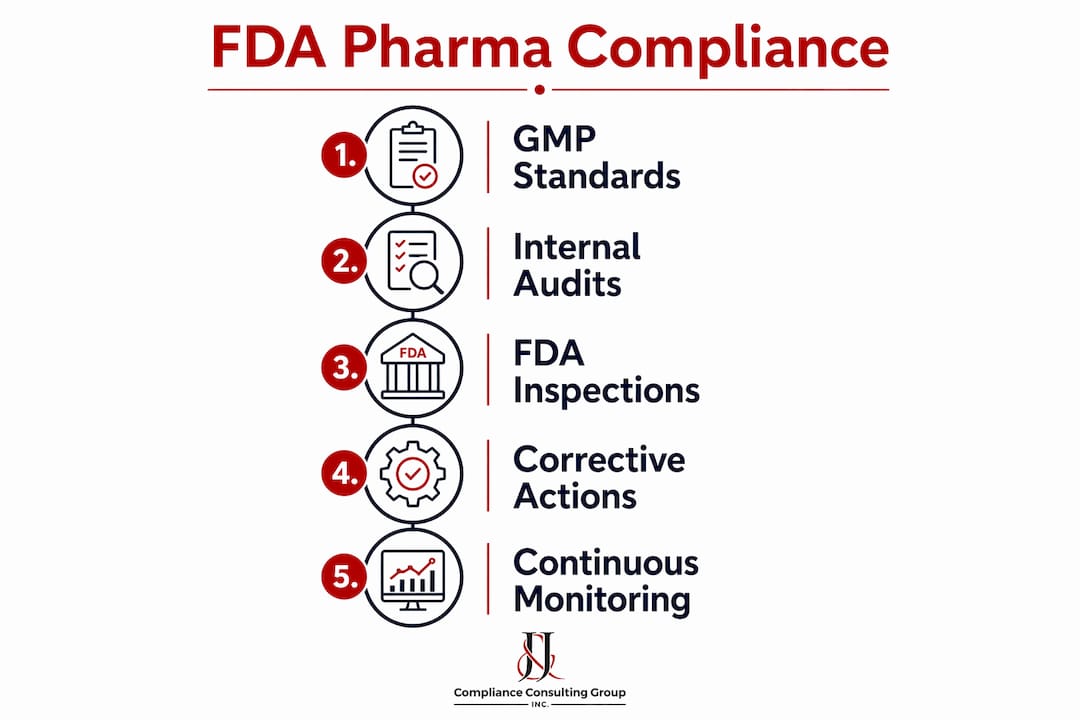
FDA oversight of pharmaceutical manufacturing does not end at approval. Current Good Manufacturing Practice (CGMP) regulations set the minimum standards for facilities, equipment, personnel, and processes involved in drug production. CGMP compliance is a continuous obligation, and the FDA enforces it through scheduled and unannounced facility inspections, both domestically and at foreign manufacturing sites supplying the U.S. market.
Key elements of CGMP oversight include:
- Facility inspections. FDA investigators conduct Pre-Approval Inspections (PAIs) before a drug is approved and Surveillance Inspections of commercial facilities on a risk-based schedule. Findings are classified from Voluntary Action Indicated (VAI) to Official Action Indicated (OAI), with OAI findings triggering formal enforcement.
- Third-party and supplier oversight. Contract manufacturers, testing laboratories, and API suppliers all fall under FDA jurisdiction. A sponsor remains responsible for the quality of any outsourced manufacturing step, which means supplier qualification programs are a regulatory requirement, not just a best practice.
- Warning letters and recalls. Non-compliance with CGMP can result in FDA Warning Letters, import alerts, consent decrees, or mandatory recalls. Each of these actions carries direct financial and reputational consequences for the affected company.
- Data integrity requirements. FDA investigators increasingly cite data integrity failures, including falsified batch records and inadequate audit trails, as primary CGMP violations. Electronic systems must meet 21 CFR Part 11 requirements for electronic records and signatures.
Understanding GMP compliance fundamentals is the baseline for any pharmaceutical manufacturer operating under FDA jurisdiction. Companies that treat CGMP as a living quality system rather than a periodic audit exercise consistently demonstrate fewer critical findings and faster resolution of any deficiencies identified.
Pro Tip: Conduct internal mock inspections using FDA’s Compliance Program Guidance Manuals as the inspection framework. Investigators follow these documents during actual inspections, so your team should know them as well as the investigators do.
FDA regulation vs. FDA approval: what is the difference?
FDA regulation and FDA approval are not interchangeable terms, and confusing them creates material compliance risk. FDA approval requires robust evidence that a product’s benefits outweigh its risks for a specific intended use, while FDA regulation refers to the broader, ongoing supervision of manufacturing, labeling, advertising, and adverse event reporting that applies to all regulated products regardless of approval status.
The table below clarifies how these concepts apply across product categories:
| Product category | Premarket approval required? | Primary FDA center | Post-market oversight |
|---|---|---|---|
| New prescription drugs (NDA) | Yes | CDER | MedWatch, Phase 4 trials, labeling updates |
| Biologics (BLA) | Yes | CBER | Lot release testing, adverse event reporting |
| Generic drugs (ANDA) | Yes (abbreviated) | CDER | Bioequivalence monitoring |
| Biosimilars | Yes | CDER or CBER | Interchangeability studies |
| Dietary supplements | No | CDER (limited) | Post-market safety reporting only |
| Cosmetics | No | CFSAN | Post-market adverse event reporting |
The distinction between regulatory supervision and approval is particularly consequential for dietary supplement and cosmetic manufacturers, who operate under post-market surveillance without premarket review. For pharmaceutical professionals, the practical implication is that FDA approval is a single milestone, while FDA regulation is a permanent operating condition that requires continuous attention to labeling claims, promotional materials, and pharmacovigilance obligations.
What operational challenges does the FDA face in 2026?
The FDA’s capacity to fulfill its regulatory mandate faces measurable pressure from staffing shortages and an expanding oversight portfolio. Drug inspector vacancy rates climbed from 9% in November 2021 to 16% in June 2024, and training a new investigator to full proficiency takes 2 to 3 years. This creates a compounding bottleneck: vacancies today translate into reduced inspection capacity well into the late 2020s.
The table below summarizes the primary operational challenges and their downstream effects on pharmaceutical companies:
| Challenge | FDA impact | Pharma industry effect |
|---|---|---|
| Inspector staffing shortages | Fewer domestic and foreign inspections completed annually | Longer pre-approval inspection wait times, potential NDA/BLA delays |
| 2 to 3 year inspector training timeline | Slow recovery from vacancy increases | Persistent inspection backlogs even after new hires are onboarded |
| Expanding product categories (cell/gene therapies, combination products) | Increased review complexity per submission | Higher documentation burden and longer review cycles |
| Budget constraints under hybrid funding model | Resource allocation trade-offs across FDA centers | Uneven enforcement capacity across product categories |
For pharmaceutical companies, these constraints translate into a direct risk management imperative. Inspection delays do not pause CGMP obligations. A facility that falls outside the regular inspection cycle still carries full compliance responsibility, and any deficiency identified during an eventual inspection will be evaluated against the full period since the last review. Proactive risk management for FDA-regulated companies means maintaining inspection readiness continuously rather than preparing reactively when an investigator schedules a visit.
The FDA’s dual mandate to protect public health while facilitating innovation creates regulatory tension that active risk management addresses more effectively than static compliance programs. Companies that build regulatory strategy into their operational planning, rather than treating it as a compliance function separate from business decisions, are better positioned to absorb FDA capacity constraints without disrupting their development timelines.
Key takeaways
The FDA’s role in pharma is a permanent, multi-stage regulatory relationship that governs drug development, manufacturing quality, labeling, and post-market safety from IND submission through the entire commercial life of a product.
| Point | Details |
|---|---|
| FDA oversight spans the full product lifecycle | Regulation begins at IND filing and continues through post-market surveillance, not just at approval. |
| CGMP compliance is continuous | Manufacturing quality obligations persist between inspections and apply to all contract partners. |
| Approval and regulation are distinct concepts | Approval is a milestone; regulation is an ongoing condition affecting labeling, advertising, and pharmacovigilance. |
| Staffing shortages create real timeline risk | Inspector vacancy rates at 16% in 2024 mean inspection backlogs will affect approval timelines through the late 2020s. |
| Expedited programs accelerate review, not standards | Fast Track and Priority Review reduce timelines to as few as 6 months but do not lower the evidentiary bar for safety and efficacy. |
Why proactive regulatory strategy matters more than ever
After working in regulatory affairs consulting for over three decades, the pattern I see most consistently is this: companies that treat FDA compliance as a reactive function spend significantly more time and money than those that build regulatory strategy into their product development planning from day one.
The staffing shortage data from the GAO is not just a headline. It represents a structural shift in how FDA oversight will operate for the foreseeable future. Fewer inspections do not mean less scrutiny. They mean that when an inspection does occur, the stakes are higher and the findings carry more weight. I have seen companies caught off-guard by a surveillance inspection after a three-year gap, only to discover that documentation practices had drifted in ways that would have been corrected immediately under a more frequent inspection schedule.
The expedited pathway programs are genuinely valuable, but they are also widely misunderstood. Breakthrough Therapy designation does not mean the FDA will accept weaker clinical data. It means the agency will engage more frequently during development to help sponsors design studies that meet the standard efficiently. That distinction matters enormously when setting internal timelines and communicating with investors.
My strongest advice for pharma professionals in 2026 is to treat the FDA’s resource constraints as a planning variable, not an excuse. Build inspection readiness into your quality management system as a standing operational state. Engage with CDER or CBER early through pre-submission meetings. And recognize that a sound regulatory strategy is not overhead. It is one of the highest-return investments a pharmaceutical company can make.
— Mike
How Jjccgroup supports FDA compliance in pharma
Pharmaceutical manufacturers and developers navigating FDA requirements benefit from specialized consulting expertise that addresses both the technical and strategic dimensions of compliance.
Jjccgroup brings over 30 years of FDA regulatory consulting experience to pharmaceutical clients across drug development, manufacturing quality, and post-market obligations. Services cover inspection readiness, CGMP gap assessments, regulatory submission strategy, and quality system audits. For companies managing the complexity of NDA or BLA submissions alongside ongoing manufacturing compliance, Jjccgroup’s FDA compliance services provide a structured, experienced resource that reduces submission errors and shortens time to market. Whether you are preparing for a Pre-Approval Inspection or building a post-market pharmacovigilance program, Jjccgroup’s pharmaceutical compliance consulting team delivers the operational depth that complex FDA processes require.
FAQ
What is the role of FDA in pharma?
The FDA regulates pharmaceutical drugs throughout their entire lifecycle, from preclinical research and clinical trials through manufacturing quality oversight and post-market safety monitoring. Its two primary centers, CDER and CBER, evaluate safety and efficacy data before approval and enforce CGMP standards after products reach the market.
How long does the FDA drug approval process take?
The FDA drug approval process typically spans 10 to 15 years from initial discovery to market authorization, though expedited programs like Fast Track and Priority Review can reduce the FDA review period itself to as few as 6 months for qualifying drugs.
What is the difference between FDA regulation and FDA approval?
FDA approval is a premarket authorization granted when clinical evidence shows a drug’s benefits outweigh its risks. FDA regulation is the broader, ongoing supervision of manufacturing, labeling, and adverse event reporting that applies to all regulated products, including those that do not require premarket approval.
What are CGMP requirements in pharmaceutical manufacturing?
Current Good Manufacturing Practice (CGMP) regulations set minimum standards for facilities, equipment, personnel, and processes in drug production. The FDA enforces CGMP through facility inspections and can issue Warning Letters, import alerts, or mandate recalls for non-compliant manufacturers.
How do FDA staffing shortages affect pharmaceutical companies?
Inspector vacancy rates reached 16% in June 2024, creating inspection backlogs that can delay Pre-Approval Inspections and extend NDA and BLA review timelines. Because training new inspectors takes 2 to 3 years, these delays are expected to persist through the late 2020s, making continuous inspection readiness a strategic priority for pharma manufacturers.
Recommended
- Regulatory Strategy Guide for Drug Development | Guide
- Mastering Regulatory Strategy for Drug Development – J&J Consulting Group- FDA Regulatory Compliance
- Pharmaceutical Regulatory Affairs: Your Career Guide – J&J Consulting Group- FDA Regulatory Compliance
- FDA Regulatory Compliance Consulting: A Guide – J&J Consulting Group- FDA Regulatory Compliance
