




Medical device manufacturing site registration is the mandatory process of formally registering your production facility with a regulatory authority, such as the FDA or a national health agency, before legally marketing devices in that jurisdiction. Without this registration, your products cannot clear customs, cannot be sold, and will trigger enforcement action ranging from import detentions to warning letters. The FDA, UAE’s Emirates Digital Authority (EDA), and other global bodies each maintain distinct portals and requirements, but all share one non-negotiable premise: registration is not optional, and it is not a one-time event.
What is medical device manufacturing site registration?
Medical device manufacturing site registration, formally called establishment registration in FDA terminology, is the legal mechanism by which a production facility declares its existence, activities, and device portfolio to a regulatory body. Establishment registration and device listing are distinct but related obligations with serious enforcement consequences if improperly managed. Registration identifies the facility; device listing identifies what is made there. Treating them as interchangeable is one of the most common and costly mistakes manufacturers make.
The process applies to domestic and foreign manufacturers alike. Any facility that manufactures, prepares, propagates, compounds, assembles, or processes a device intended for US distribution must register with the FDA annually. ISO 13485:2016, the international quality management standard for medical device manufacturers, underpins registration requirements across most major markets, including the EU, Canada, and the UAE. Understanding both the FDA-specific rules and the ISO framework gives your compliance program a foundation that scales across jurisdictions.

What prerequisites and documentation do you need before registering?
Preparation determines whether your registration submission succeeds on the first attempt or stalls for months. Regulatory bodies do not grant grace periods for missing documentation, and incomplete submissions are rejected outright.
The core prerequisites for most jurisdictions include:
- ISO 13485:2016 certification or documented evidence of a functioning Quality Management System (QMS) aligned to its requirements
- Good Manufacturing Practice (GMP) evidence, including facility inspection records, process validation data, and corrective action logs
- Site Master File (SMF), a structured document describing your facility layout, manufacturing processes, equipment, personnel qualifications, and quality controls
- Device classification records confirming the regulatory class of each product manufactured at the site
- Authorized agent designation for foreign manufacturers submitting to the FDA, since a US-based agent is legally required
- Proof of business registration in the country of operation, including tax identification and legal entity documentation
ISO 13485 focuses on quality management and regulatory compliance linked to safe device production, making it the single most transferable credential across global markets. A manufacturer certified to ISO 13485 by a recognized certification body enters the UAE EDA portal, the FDA’s FURLS system, and Health Canada’s Medical Devices Directorate with a significant documentation advantage.
Jurisdiction-specific requirements add layers on top of this foundation. The UAE’s EDA portal, for example, requires a site master file formatted to Gulf Cooperation Council (GCC) standards, which differs structurally from the FDA’s preferred format. Planning for these variations during facility design, rather than retrofitting documentation after construction, prevents the most expensive delays.
Pro Tip: Begin integrating compliance documentation requirements into your facility design phase, not after occupancy. Retrofitting a site master file to a facility that was not designed with regulatory visibility in mind routinely adds three to six months to the registration timeline.
How to complete the FDA medical device manufacturing site registration process
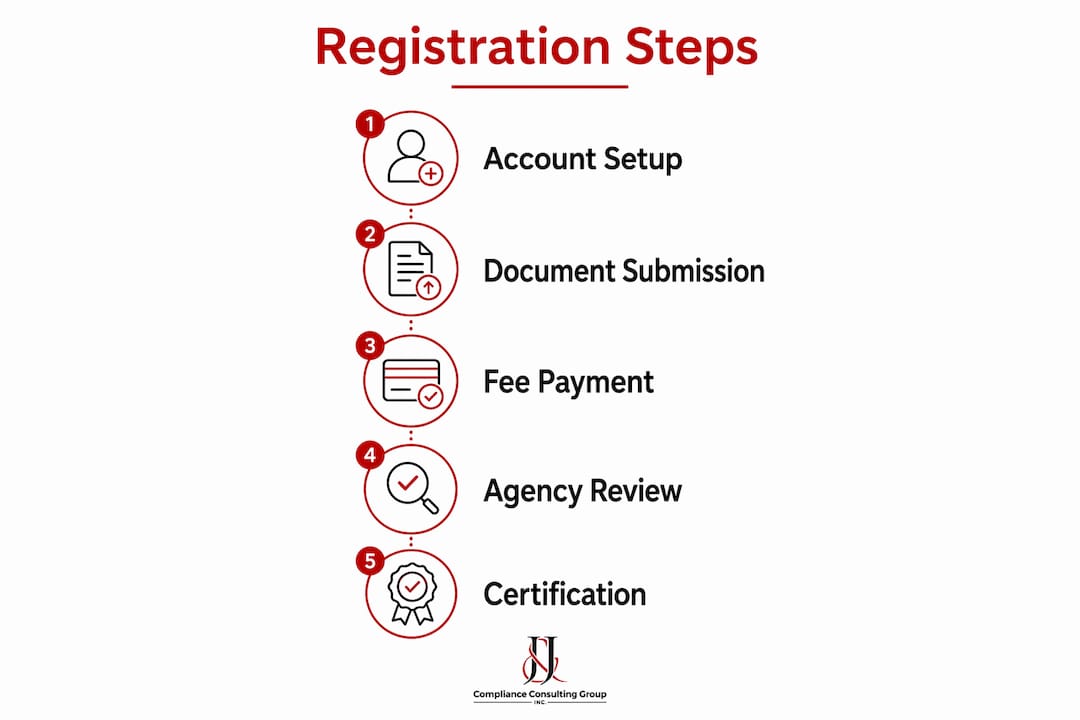
The FDA’s registration process is annual, electronic, and fee-based. Here is the step-by-step sequence for 2026:
-
Create or access your FDA account. Navigate to the FDA’s FURLS and DRLM portals (Unified Registration and Listing System and Device Registration and Listing Module). First-time registrants create an account through the FDA Industry Systems portal. Returning registrants log in with existing credentials.
-
Confirm your establishment type. Select the correct activity code for your facility: manufacturer, contract manufacturer, repackager/relabeler, or specification developer. Selecting the wrong activity code triggers a deficiency notice and delays approval.
-
Pay the annual registration fee. The FY 2026 registration fee is $11,423 per establishment. This fee applies to most domestic and foreign manufacturers, with limited exemptions for small businesses meeting specific revenue thresholds. Payment is processed through Pay.gov before the submission is accepted.
-
Submit establishment registration. Complete the DRLM registration form with facility address, contact information, authorized agent details (for foreign manufacturers), and official correspondent designation.
-
Complete device listing. After registration, list every device manufactured at the site. Each listing requires the device name, classification, product code, and 510(k) or PMA number if applicable. Device listing is free of charge.
-
Receive and retain your registration number. The FDA issues a 10-digit establishment registration number upon approval. This number must appear on device labels and shipping documentation.
-
Renew annually between October 1 and December 31. Registration expires on December 31 of each year. Missing the renewal window means your establishment is legally unregistered, and unregistered foreign products cannot clear US Customs.
| Step | Action | Timing |
|---|---|---|
| Account setup | Create FDA Industry Systems account | Before submission |
| Fee payment | Pay $11,423 via Pay.gov | Before submission accepted |
| Establishment registration | Submit via DRLM | Oct 1 – Dec 31 annually |
| Device listing | List all devices manufactured at site | Within 30 days of registration |
| Renewal | Update registration and listing | Oct 1 – Dec 31 each year |
Pro Tip: Submit your renewal no later than November 15. Submissions filed in the final two weeks of December frequently encounter processing backlogs, and a lapsed registration on January 1 creates immediate legal exposure for any shipments in transit.
How does site registration work in other key markets?
The FDA process is the most familiar to US-based manufacturers, but global distribution requires parallel registrations in each target market. The UAE offers a useful comparison because its EDA portal process is well-documented and increasingly required by Gulf Cooperation Council trading partners.
UAE site registration through the EDE portal requires 14 to 28 working days and costs 10,100 AED (approximately $2,748 USD) for first-time registration. That timeline assumes a complete submission. Missing the site master file or submitting GMP evidence that does not meet GCC formatting standards restarts the clock. The UAE also requires that the local authorized representative hold a valid medical device import license before the site registration application is accepted.
| Requirement | FDA (USA) | UAE EDA |
|---|---|---|
| Annual fee | $11,423 USD | 10,100 AED (~$2,748 USD) |
| Processing time | 1–5 business days (electronic) | 14–28 working days |
| Key prerequisite | Authorized US agent | Licensed local representative |
| QMS standard | 21 CFR Part 820 / ISO 13485 | ISO 13485 (GCC format) |
| Renewal frequency | Annual (Oct 1 – Dec 31) | Annual |
Harmonizing global QMS standards like ISO 13485 with local jurisdictional requirements prevents redundant compliance efforts and audit failures. A manufacturer that builds its QMS to ISO 13485 and then maps local requirements (OSHA, EPA, GCC standards) as documented addenda avoids maintaining parallel systems that drift apart over time.
Modern site registration in greenfield facilities increasingly incorporates cybersecurity standards. IEC 62443 and ISA-95 compliance are now integrated at the design phase to support scalable, audit-ready operations. Regulators in the EU and increasingly in the US are scrutinizing data integrity and network security as part of manufacturing site assessments, not just as post-market concerns.
Pro Tip: When registering in multiple jurisdictions simultaneously, build a master compliance matrix that maps each jurisdiction’s requirements against your ISO 13485 QMS controls. This single document becomes your audit response toolkit and dramatically reduces preparation time when inspectors arrive.
What are the most common compliance challenges in site registration?
Integrating regulatory compliance in the design phase reduces delays and audit failures significantly. Yet most manufacturers still treat site registration as a paperwork task assigned to a regulatory affairs coordinator in the final weeks before launch. That approach fails consistently, and the consequences are severe.
The most frequent compliance gaps include:
- Treating registration as separate from QMS. Registration is a declaration that your QMS is operational and compliant. Submitting a registration while your QMS is still under development invites an FDA inspection that your facility cannot pass.
- Failing to update registrations after facility changes. Moving to a new building, adding a manufacturing line, or changing your authorized agent requires a registration update within five days under FDA rules. Many manufacturers miss this window.
- Inadequate record keeping for audit readiness. FDA inspections typically occur 8 to 12 months after initial registration. Operations require audit-ready documentation well before inspectors arrive, not assembled in response to a notice.
- Ignoring cybersecurity documentation. The FDA’s 2023 cybersecurity guidance and the EU MDR both require manufacturers to demonstrate that connected devices and manufacturing systems meet defined security standards. Facilities that have not documented their IEC 62443 controls are increasingly cited during inspections.
- Underestimating foreign manufacturer obligations. Foreign manufacturers sometimes assume that their US importer handles registration. Under 21 CFR Part 807, the manufacturer bears primary responsibility, and the authorized agent is a communication channel, not a compliance substitute.
Pro Tip: Engage a manufacturing compliance consultant at least 12 months before your target registration date. The firms that consistently pass first-cycle inspections are the ones that treated compliance as an operational design requirement, not a submission deadline.
Key takeaways
Successful medical device manufacturing site registration requires integrating FDA establishment registration, ISO 13485 QMS documentation, and jurisdiction-specific prerequisites into a single, audit-ready compliance program before your facility begins operations.
| Point | Details |
|---|---|
| Registration and listing are distinct | Establishment registration identifies the facility; device listing identifies each product made there. |
| FDA fee for 2026 is $11,423 | This annual fee applies per establishment and must be paid before the submission is accepted. |
| UAE registration costs ~$2,748 USD | The EDA portal process takes 14 to 28 working days and requires ISO 13485 and a licensed local representative. |
| FDA inspections follow registration | Expect an FDA inspection 8 to 12 months after initial registration; audit-ready documentation must exist before that window. |
| QMS integration prevents failures | Embedding compliance into facility design and QMS from day one eliminates the most common causes of registration delays and inspection citations. |
Why registration strategy matters more than most manufacturers realize
After working with medical device manufacturers across multiple regulatory jurisdictions, one pattern stands out clearly: the companies that struggle most with site registration are not the ones with the most complex products. They are the ones that separated compliance from operations.
Registration is not a form you file. It is a declaration that your facility, your processes, your records, and your people are ready to be inspected at any time. The FDA does not announce most inspections far in advance. When an investigator walks through your door 10 months after registration, they are not checking whether you submitted the right paperwork. They are checking whether your facility actually operates the way your registration claims it does.
The manufacturers I have seen pass first-cycle inspections without a single Form 483 observation share one characteristic: they built their QMS before they built their production lines. ISO 13485 was not a certification they pursued after the fact. It was the architectural blueprint for how the facility was designed, staffed, and documented. That approach also makes global expansion far less painful. When your QMS already maps to ISO 13485, adapting it for UAE EDA requirements or EU MDR compliance is an addendum exercise, not a rebuild.
The other insight worth sharing is that cybersecurity is no longer a post-market concern. Manufacturers registering new facilities in 2026 who have not documented their IEC 62443 controls are walking into inspections with a visible gap. Regulators have made their expectations clear. The manufacturers who treat cybersecurity compliance as a manufacturing site requirement, not just a product requirement, are the ones building compliance programs that will hold up for the next decade.
— Mike
How Jjccgroup simplifies your site registration and FDA compliance
Navigating the FDA’s FURLS system, building an ISO 13485-aligned QMS, and preparing for inspections that arrive without much warning is a significant operational undertaking. Jjccgroup brings over 30 years of FDA regulatory consulting experience to exactly this challenge.
Jjccgroup’s FDA compliance services cover the full registration lifecycle: from pre-submission documentation review and ISO 13485 consulting to audit readiness assessments and post-registration inspection preparation. For manufacturers entering global markets, Jjccgroup’s medical device compliance consulting maps FDA requirements alongside UAE EDA, EU MDR, and other jurisdiction-specific obligations into a single compliance program. If your facility is preparing for its first registration or managing a renewal with outstanding inspection findings, Jjccgroup has the expertise to move you forward with confidence.
FAQ
What is the FDA registration fee for medical device manufacturers in 2026?
The FDA annual establishment registration fee for FY 2026 is $11,423 per facility. Small businesses meeting specific revenue thresholds may qualify for a reduced fee or exemption.
What is the difference between establishment registration and device listing?
Establishment registration identifies the physical facility and its manufacturing activities. Device listing identifies the specific devices produced at that facility. Both are required annually under 21 CFR Part 807, and both must be completed through the FDA’s DRLM portal.
How long does FDA medical device site registration take?
Electronic submissions through FURLS and DRLM are typically processed within one to five business days once the registration fee is confirmed. Deficiencies in the submission, such as missing authorized agent information, extend that timeline.
When does the FDA inspect a newly registered manufacturing site?
FDA inspections of new or alternate manufacturing sites typically occur 8 to 12 months after initial registration. Facilities must maintain audit-ready documentation from the moment registration is confirmed, not in response to an inspection notice.
Is ISO 13485 certification required for FDA establishment registration?
ISO 13485 certification is not explicitly required by the FDA for establishment registration, but it is the most widely recognized evidence of a compliant QMS. Many foreign regulatory bodies, including the UAE EDA, require ISO 13485 certification as a direct prerequisite for site registration approval.
