


Current Good Manufacturing Practice, known as cGMP, is defined as the set of FDA-mandated regulations that require pharmaceutical manufacturers to consistently produce drugs that meet standards for identity, strength, quality, and purity. The “c” stands for “current,” which signals that compliance is never static. The FDA establishes these requirements under 21 CFR Parts 210 and 211, covering everything from general manufacturing controls to finished pharmaceutical dosage forms. For professionals in pharma, medical devices, and dietary supplements, understanding what is pharmaceutical cGMP is not optional. It is the legal and operational foundation your entire quality system rests on.
What is pharmaceutical cGMP and why does it matter?
Pharmaceutical cGMP is the regulatory framework that governs how drugs are manufactured, tested, and released. The FDA enforces these rules to protect patients from products that are contaminated, mislabeled, subpotent, or otherwise unsafe. Non-compliance is not a paperwork problem. It can result in warning letters, consent decrees, product recalls, and facility shutdowns.
The cGMP framework treats quality as something built into the manufacturing process, not something tested into the final product. That distinction matters enormously in practice. A batch that passes final testing but was made under uncontrolled conditions still violates cGMP. The FDA expects manufacturers to control every step, from raw material receipt through finished product release.

Regulatory bodies enforcing cGMP include the FDA’s Center for Drug Evaluation and Research (CDER) and Center for Biologics Evaluation and Research (CBER). Both conduct routine inspections and can issue Form 483 observations when deficiencies are found. Manufacturers who ignore those observations face escalating enforcement action.
What FDA regulations govern pharmaceutical cGMP?
The legal backbone of pharmaceutical cGMP standards sits in two sections of the Code of Federal Regulations. Understanding both is non-negotiable for any compliance professional.
21 CFR Part 210 establishes the general minimum requirements for manufacturing, processing, packing, and holding of drugs. It applies broadly and sets the definitional and jurisdictional scope of cGMP across product types.
21 CFR Part 211 narrows the focus to finished pharmaceuticals. It covers specific requirements for:
- Organization and personnel: Qualified individuals must staff all quality-critical functions, and a Quality Control Unit (QCU) must operate with full independence from production.
- Buildings and facilities: Physical spaces must be designed to prevent contamination, mix-ups, and errors.
- Equipment: All manufacturing equipment must be qualified, calibrated, and maintained on documented schedules.
- Production and process controls: Written procedures must govern every manufacturing step, and deviations must be documented and investigated.
- Laboratory controls: Testing methods must be validated, and out-of-specification results require formal investigation before any disposition decision.
- Records and reports: Batch production records must be retained for at least 1 year after the product’s expiration date. That retention requirement is a legal mandate, not a best practice.
Additional cGMP regulations apply to biologics, positron emission tomography (PET) drugs, and active pharmaceutical ingredients (APIs). Knowing which rules apply to your specific product type prevents costly documentation errors during inspections.
Why does the “current” in cGMP change everything?
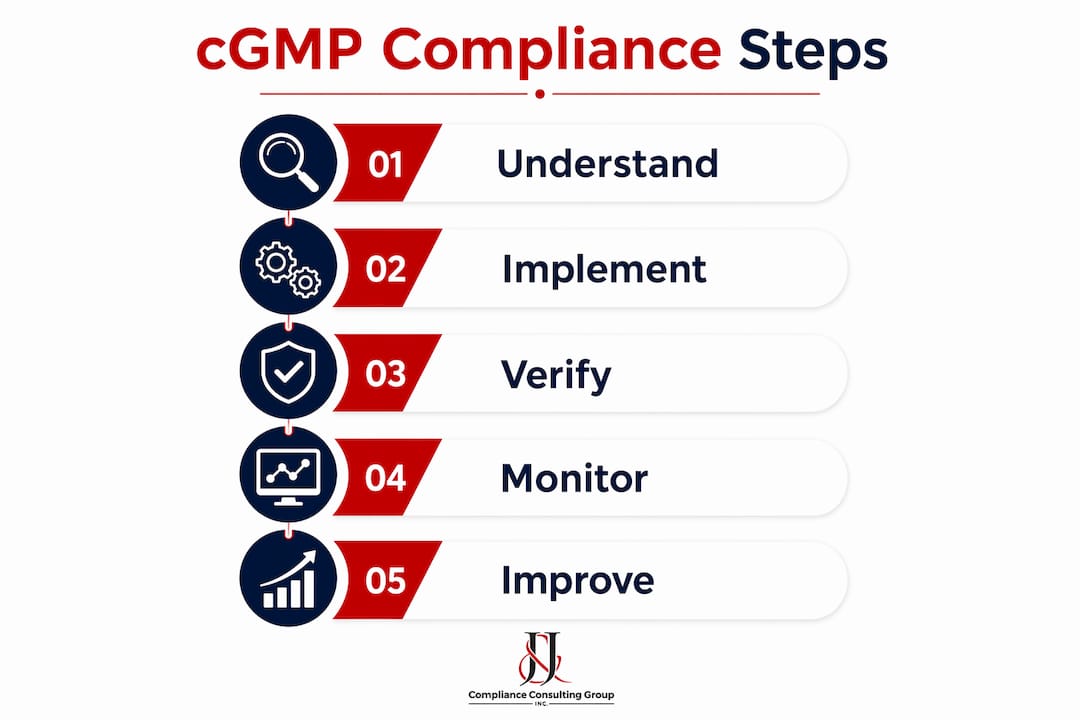
The word “current” is the most misunderstood element of cGMP. It means that manufacturers must continuously incorporate the latest scientific and technological advances into their processes. A manufacturing process that was fully compliant five years ago may be deficient today if better methods now exist and have become industry standard.
This is not a theoretical concern. FDA inspectors evaluate whether your practices reflect modern science, not just whether you followed your own procedures. A facility still using outdated analytical methods when validated alternatives are widely available will face scrutiny, even if no product failures have occurred.
Pro Tip: Review your process validation protocols and analytical methods annually against current FDA guidance documents and ICH guidelines. If the industry has moved forward and your procedures have not, you have a cGMP gap whether or not you have had a deviation.
The cGMP philosophy is fundamentally a risk management system. Quality is designed and controlled throughout production, not verified at the end. That means manufacturers must continuously assess risks, update controls, and document the rationale for every quality decision. Many leading manufacturers go well beyond the FDA’s baseline requirements, implementing advanced quality systems and risk management frameworks that reduce deviations and accelerate regulatory approvals. That proactive posture is what separates facilities that pass inspections from those that merely survive them.
How does pharmaceutical cGMP compare to related quality standards?
Pharmaceutical professionals frequently encounter multiple overlapping quality frameworks. Knowing how they relate prevents misapplication and compliance failures.
The term “GMP” refers to the broader concept of Good Manufacturing Practice. The “c” prefix signals that the version in use must reflect current science and technology. In practice, the FDA uses cGMP exclusively in its regulations, making the distinction more than semantic.
Finished pharmaceutical cGMP under 21 CFR Part 211 applies to dosage forms. APIs follow a separate standard, primarily ICH Q7, which the FDA has adopted as guidance. Applying Part 211 requirements to an API manufacturing site, or vice versa, creates documentation gaps that surface quickly during audits.
| Framework | Scope | Governing body |
|---|---|---|
| 21 CFR Part 211 | Finished pharmaceutical dosage forms | FDA (CDER, CBER) |
| ICH Q7 | Active pharmaceutical ingredients | FDA, EMA, and other ICH members |
| EU GMP (Annex 1, etc.) | Pharmaceuticals sold in European markets | European Medicines Agency |
| WHO GMP | Pharmaceuticals in WHO member markets | World Health Organization |
| 21 CFR Part 820 | Medical devices | FDA (CDRH) |
Global manufacturers must align with FDA, EU EMA, WHO, and ICH frameworks simultaneously to maintain market access across regions. That harmonization effort is substantial, but it is the cost of operating in multiple regulated markets. Dietary supplement manufacturers face a parallel set of rules under 21 CFR Part 111, which mirrors the structure of Part 211 but applies specifically to supplement products.
How to implement cGMP in pharmaceutical manufacturing
Practical cGMP compliance requires more than reading the regulations. It demands a functioning quality system embedded in daily operations. The following components are legally required and operationally critical.
-
Qualified personnel and training. Continuous training conducted by qualified individuals is a federal requirement. Every employee whose work affects product quality must understand the cGMP regulations relevant to their specific role. Training records must document what was taught, when, and by whom.
-
Facility and equipment design. Buildings must prevent contamination and cross-contamination. Equipment must be qualified before use and requalified after significant changes. Qualification documentation, including Installation Qualification (IQ), Operational Qualification (OQ), and Performance Qualification (PQ) protocols, must be on file and current.
-
Process validation. cGMP compliance applies from raw material receipt through finished product release, requiring process validation, equipment qualification, and environmental controls at every stage. Validation is not a one-time event. Continued process verification keeps your data current and your process in a state of control.
-
Quality Control Unit authority. The QCU must have independent authority over all quality decisions. Regulators treat insufficient documentation as legally equivalent to a lack of quality control. That means your QCU’s records are your legal defense during an inspection.
-
Deviation and CAPA management. Every deviation from an approved procedure must be documented, investigated for root cause, and resolved through a Corrective and Preventive Action (CAPA) system. Unresolved deviations are among the most common Form 483 observations FDA investigators cite.
Pro Tip: Build your deviation management system so that every open CAPA has an assigned owner, a due date, and an effectiveness check. Inspectors look for patterns in your deviation log. A well-managed CAPA system tells a story of a facility that finds problems and fixes them.
Common compliance failures include inadequate batch record completeness, undertrained personnel, and equipment calibration gaps. Addressing these proactively, rather than waiting for an inspection finding, is the difference between a facility that builds trust with regulators and one that spends years under consent decree. Jjccgroup’s cGMP compliance consulting services are built specifically to help manufacturers close those gaps before an FDA investigator does.
Key Takeaways
Pharmaceutical cGMP requires manufacturers to build quality into every step of production, from raw materials through finished product release, under a continuously evolving set of FDA-mandated standards.
| Point | Details |
|---|---|
| cGMP is legally mandated | FDA enforces cGMP under 21 CFR Parts 210 and 211 for all finished pharmaceutical manufacturers. |
| “Current” means ongoing updates | Manufacturers must adopt the latest science and technology or risk non-compliance, even without product failures. |
| Documentation is your legal record | Batch records must be retained for at least 1 year post-expiration; insufficient records equal insufficient quality control. |
| QCU independence is non-negotiable | The Quality Control Unit must have full authority over quality decisions, separate from production pressures. |
| Global alignment adds complexity | Companies selling internationally must satisfy FDA, EU GMP, WHO, and ICH Q7 requirements simultaneously. |
Why cGMP culture matters more than cGMP checklists
After working in regulatory consulting for over 30 years, the pattern I see most often is this: facilities that treat cGMP as a checklist fail inspections. Facilities that treat it as a culture pass them, and they pass them consistently.
The checklist mindset produces documentation that looks complete on paper but falls apart under questioning. An investigator asks a line operator why a step is performed a certain way, and the operator says, “Because the SOP says so.” That answer reveals a training program that taught procedure without teaching purpose. The FDA notices.
The culture mindset is different. When quality is embedded in how people think, not just what they document, deviations get caught earlier, root causes get identified accurately, and CAPAs actually prevent recurrence. I have seen facilities with modest resources outperform well-funded competitors simply because their quality team had the authority and the habit of asking hard questions before a batch was released.
The other mistake I see regularly is treating cGMP as a static target. Regulations do not change every year, but scientific standards do. A facility that validated its analytical methods in 2015 and has not revisited them is almost certainly behind current expectations. The FDA’s guidance documents, ICH guidelines, and ISPE baseline guides are living documents. Reading them annually is not optional for a compliance professional who wants to stay ahead.
My honest recommendation: invest in your QCU before you invest in anything else. Give them independence, resources, and the authority to stop a batch. That single structural decision does more for your cGMP posture than any software system or consultant ever will.
— Mike
How Jjccgroup supports your cGMP compliance program
Navigating FDA cGMP requirements takes more than reading the regulations. It takes experience applying them across real manufacturing environments, audit cycles, and enforcement scenarios.

Jjccgroup brings over 30 years of FDA regulatory expertise to pharmaceutical, medical device, and dietary supplement manufacturers. Whether you need a gap assessment before an FDA inspection, support building your quality system from the ground up, or guidance on regulatory approval consulting, Jjccgroup provides the depth and specificity your compliance program requires. The team works alongside your quality and operations staff to identify risks, close documentation gaps, and build the kind of quality culture that holds up under regulatory scrutiny. Contact Jjccgroup to discuss your cGMP compliance needs and get a clear path forward.
FAQ
What is pharmaceutical cGMP in simple terms?
Pharmaceutical cGMP is the set of FDA regulations that require drug manufacturers to consistently produce products that are safe, correctly labeled, and meet quality standards. The rules cover personnel, facilities, equipment, documentation, and testing.
What does the “c” in cGMP stand for?
The “c” stands for “current,” meaning manufacturers must continuously update their practices to reflect the latest scientific and technological advances. A process that was compliant years ago may be deficient today if better methods now exist.
Which FDA regulations cover pharmaceutical cGMP?
The primary regulations are 21 CFR Part 210 for general manufacturing requirements and 21 CFR Part 211 for finished pharmaceuticals. APIs follow ICH Q7 guidance, and dietary supplements fall under 21 CFR Part 111.
How long must batch records be retained under cGMP?
Manufacturers must retain batch production and control records for at least 1 year after the product’s expiration date, as required by 21 CFR Part 211.
Does cGMP apply to dietary supplements and medical devices?
Dietary supplements follow cGMP rules under 21 CFR Part 111, which mirrors the pharmaceutical framework. Medical devices are governed by Quality System Regulation under 21 CFR Part 820, which the FDA has aligned with ISO 13485 standards.
