


An FDA Complete Response Letter, formally known as a CRL, is defined as an official FDA communication issued at the end of a review cycle for a New Drug Application (NDA), Biologics License Application (BLA), or Abbreviated New Drug Application (ANDA), indicating the application cannot be approved in its current form. The CRL replaced older letter types like “not approvable” and “approvable” letters, consolidating FDA feedback into one structured document. Governed under 21 CFR 314.110, the CRL specifies every deficiency the applicant must resolve before approval can proceed. Roughly 41% of submissions receive a CRL, yet more than half of those applications ultimately achieve approval. That statistic reframes the CRL not as a dead end, but as a formal checkpoint in the FDA approval process stages.
What is an FDA complete response letter and why does it get issued?
The FDA issues a CRL when a review cycle concludes and one or more deficiencies prevent approval. The agency groups these deficiencies into several categories, and understanding them is the first step toward an effective response.
The most common triggers include:
- Safety concerns: New or unresolved safety signals from clinical trial data, post-market reports, or risk evaluation and mitigation strategy (REMS) gaps.
- Efficacy data gaps: Insufficient evidence that the product produces the claimed therapeutic benefit, often tied to inadequate trial design or underpowered endpoints.
- Manufacturing and quality control deficiencies: Facility inspection failures, current Good Manufacturing Practice (cGMP) violations, or process validation shortcomings. Manufacturing and quality control are among the most frequently cited CRL triggers.
- Benefit-risk assessment shortcomings: Cases where the FDA concludes the product’s risks outweigh its demonstrated benefits under the proposed labeling.
- Labeling and assay validation issues: Inadequate prescribing information, missing patient medication guides, or unvalidated analytical methods.
Each deficiency listed in the CRL is specific and documented. The FDA does not issue vague feedback. That specificity is actually an advantage for compliance teams, because it defines exactly what the resubmission must address. Regulatory professionals who treat the CRL as a detailed work order, rather than a verdict, position their teams for a faster path to approval.
Pro Tip: Read every CRL deficiency against your original submission package before drafting a response plan. Gaps between what was submitted and what the FDA expected are often more revealing than the deficiency text itself.

How do applicants respond to an FDA complete response letter?
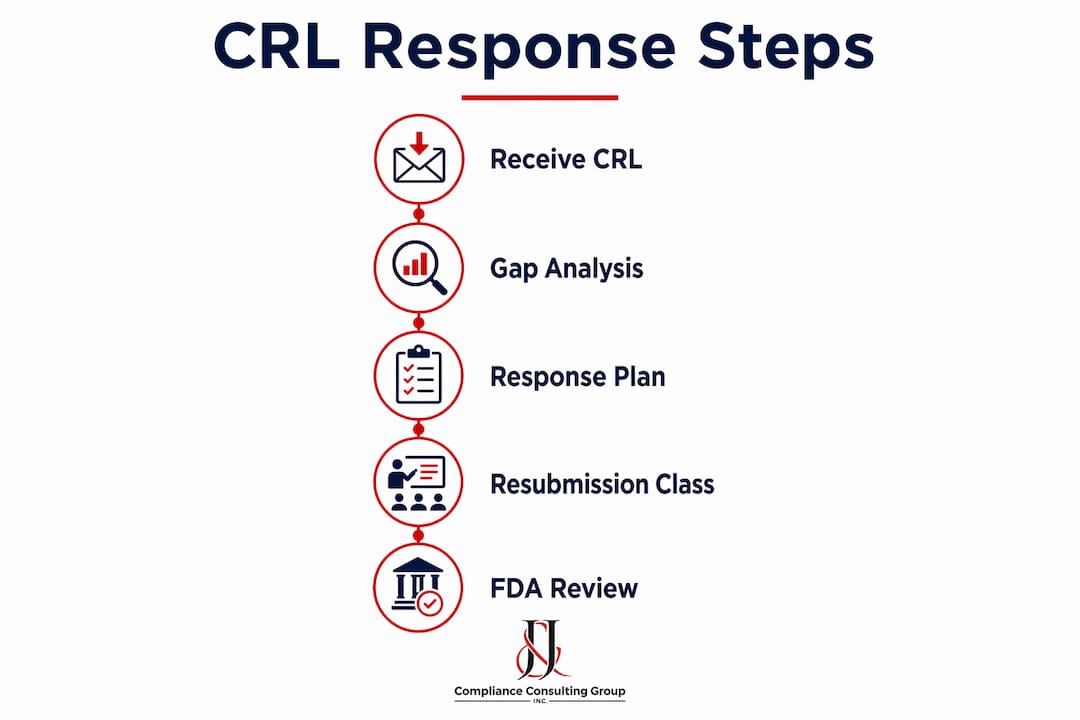
After receiving a CRL, the applicant has three formal options under 21 CFR 314.110: resubmit the application with all deficiencies addressed, withdraw the application, or request a formal hearing to dispute the FDA’s findings. Most sponsors choose resubmission.
The resubmission path follows a structured process:
- Request an FDA meeting within 15 days. Submitting a meeting request within 15 days is the recommended best practice. The FDA has a 30-day internal window to classify the resubmission, but early engagement accelerates feedback and clarifies expectations before significant resources are committed.
- Classify the resubmission as Class 1 or Class 2. The FDA makes this classification within 30 days of receiving the resubmission. Class 1 resubmissions, which typically address minor issues like labeling changes or assay validation, receive a 3-month FDA review. Class 2 resubmissions, which involve new clinical data or facility reinspections, receive a 6-month review.
- Address every deficiency in the CRL. This is non-negotiable. Incomplete resubmissions do not trigger a new FDA review cycle. The agency will not begin a new clock until the submission is complete, which means a partial response wastes time and delays approval.
- Monitor the one-year deadline. Per 21 CFR 314.110©, if no action is taken within one year of receiving the CRL, the FDA may consider the application withdrawn. Compliance teams must build this deadline into their project timelines from day one.
- Document every response decision. Maintain a clear audit trail showing how each CRL deficiency was resolved. This protects the sponsor during the FDA’s review and supports any future regulatory interactions.
The choice between Class 1 and Class 2 has real schedule consequences. A Class 2 resubmission adds at least six months to the approval timeline after the 30-day classification period. Teams that underestimate the complexity of their deficiencies and submit prematurely risk a second CRL, compounding delays further.
How has FDA transparency changed the complete response letter process?
The FDA’s 2025 transparency initiative fundamentally changed how CRLs function in practice. Starting in 2025, the FDA now releases all CRLs in real time after issuance, including a batch of previously unpublished decision letters. This shift means every deficiency cited in a CRL becomes public record almost immediately.
The FDA’s real-time publication of CRLs removes the sponsor’s ability to control the narrative around an application setback. Compliance teams must now treat every CRL deficiency as a public statement, not a private communication. Investor relations, public affairs, and regulatory affairs functions must coordinate their responses before the letter goes public, not after.
This transparency policy has two significant effects. First, it reduces speculation. Before 2025, investors and the public often had to guess why a drug or device application was delayed. Now, the exact deficiencies are visible, which reduces speculation by the public and investors and promotes accountability across the industry. Second, it raises the stakes for sponsors. A manufacturing deficiency or a safety concern cited in a CRL is now visible to competitors, patients, and the financial press simultaneously.
Compliance teams must build a pre-disclosure communication plan as part of their CRL response strategy. This plan should define who speaks publicly about the CRL, what language is used to characterize the deficiencies, and how the resubmission timeline will be communicated to stakeholders. Treating transparency as a risk to manage, rather than a surprise to react to, is the mark of a mature regulatory function.
How do complete response letters affect approval timelines and planning?
A CRL does not end the approval process, but it does reshape the timeline in ways that require careful planning. The table below summarizes the key timeline variables compliance teams must account for after receiving a CRL.
| Event | Typical Timeframe |
|---|---|
| FDA meeting request (recommended) | Within 15 days of CRL receipt |
| FDA resubmission classification | 30 days after resubmission |
| Class 1 resubmission review | 3 months from resubmission date |
| Class 2 resubmission review | 6 months from resubmission date |
| Application withdrawal deadline | 1 year from CRL receipt if no action |
More than half of CRL-receiving applications ultimately achieve FDA approval. That outcome rate supports treating the CRL as a correctable setback rather than a terminal event. However, the market often reacts negatively to CRL announcements, which creates pressure on compliance teams to move quickly and communicate clearly.
The most effective CRL response plans integrate three elements: a complete deficiency gap analysis, a realistic resubmission timeline that accounts for Class 1 or Class 2 classification, and a stakeholder communication strategy aligned with the FDA’s transparency requirements. Teams that skip the gap analysis and rush to resubmit frequently discover additional deficiencies during the FDA’s review, triggering another CRL and extending the delay by a year or more. Strategic, well-documented response plans consistently produce better outcomes than reactive submissions. Regulatory consulting expertise, particularly from firms with deep FDA experience, significantly reduces the risk of incomplete resubmissions and helps sponsors maintain momentum toward approval.
Key Takeaways
A CRL is a formal, correctable deficiency notice, and over half of applications that receive one ultimately reach FDA approval with a complete, well-planned resubmission.
| Point | Details |
|---|---|
| CRL definition | An official FDA notice under 21 CFR 314.110 that an NDA, BLA, or ANDA cannot be approved in its current form. |
| Common triggers | Safety gaps, efficacy shortfalls, manufacturing deficiencies, and labeling issues are the most frequently cited reasons. |
| Response options | Sponsors may resubmit, withdraw, or request a hearing; inaction for one year results in deemed withdrawal. |
| Resubmission classes | Class 1 (minor issues) gets a 3-month review; Class 2 (major issues) gets a 6-month review after a 30-day classification period. |
| FDA transparency | Since 2025, all CRLs are published in real time, requiring sponsors to coordinate public communications before disclosure. |
The CRL mindset that separates good teams from great ones
I have worked through enough CRL cycles to say with confidence that the single biggest mistake compliance teams make is treating the letter as a verdict. It is not. The FDA’s own data shows that most CRL-receiving applications eventually get approved. The letter is a detailed list of what needs to be fixed, written by the same agency that will ultimately approve the product.
What separates teams that recover quickly from those that spiral into multi-year delays is preparation before the CRL arrives. The best regulatory functions I have seen run pre-submission gap analyses that mirror what the FDA is likely to scrutinize. They have a CRL response protocol already drafted, including who owns each deficiency category, what the escalation path looks like, and when the FDA meeting request goes out. When the CRL lands, they are not starting from scratch.
The 2025 transparency shift adds a new dimension that many teams are still underestimating. The moment a CRL is issued, it is public. That means your investor relations team, your communications team, and your executive leadership all need to be briefed and ready before the FDA sends the letter, not after. I have seen companies lose significant market value not because of the deficiencies themselves, but because their public response was slow, inconsistent, or appeared to minimize serious issues.
My strongest advice: request the FDA meeting within 15 days, assign a single owner to each deficiency, and do not submit until every item on the CRL is fully resolved. A complete resubmission that takes four months beats a partial one that resets the clock and costs you a year. Firms with deep FDA regulatory consulting experience can help you build that discipline into your process before you need it.
— Mike
Jjccgroup’s support for teams navigating FDA complete response letters
Receiving a CRL is one of the most consequential moments in a product’s regulatory life. Jjccgroup brings over 30 years of FDA compliance experience to help pharmaceutical and medical device teams respond with precision and confidence.
Jjccgroup’s FDA compliance services cover the full CRL response cycle: deficiency gap analysis, resubmission preparation, FDA meeting strategy, and stakeholder communication planning. Whether your team is facing a Class 1 labeling correction or a Class 2 clinical data requirement, Jjccgroup provides the structured support needed to address every deficiency completely and on time. Explore how Jjccgroup’s regulatory approval consulting can reduce resubmission risk and keep your approval timeline on track.
FAQ
What is the complete response letter meaning in FDA terms?
A Complete Response Letter is an official FDA communication indicating that a drug or device application cannot be approved in its current form due to specific deficiencies. It is issued under 21 CFR 314.110 and applies to NDAs, BLAs, and ANDAs.
What does an FDA letter mean for a drug’s approval chances?
A CRL is not a rejection. More than half of applications that receive a CRL ultimately achieve FDA approval after addressing the cited deficiencies through a complete resubmission.
How long does a sponsor have to respond to a CRL?
Per 21 CFR 314.110©, sponsors must take action within one year of receiving a CRL or the FDA may consider the application withdrawn. Best practice is to request an FDA meeting within 15 days of receipt.
What is the difference between a Class 1 and Class 2 resubmission?
Class 1 resubmissions address minor issues like labeling or assay validation and receive a 3-month FDA review. Class 2 resubmissions involve major issues such as new clinical data or facility reinspections and receive a 6-month review after a 30-day classification period.
Are FDA complete response letters made public?
Yes. Since 2025, the FDA publishes all CRLs in real time after issuance, making every cited deficiency immediately available to the public, investors, and the press.
