


FDA food enforcement discretion is defined as the agency’s formal decision to not take enforcement action against a specific regulatory violation, even though the underlying legal requirement remains fully in effect. Food industry professionals and regulatory specialists need to understand what is FDA food enforcement discretion because it shapes labeling strategy, product development timelines, and litigation exposure in ways that strict statutory reading alone cannot predict. The FDA’s authority under the Federal Food, Drug, and Cosmetic Act (FD&C Act) gives it broad enforcement powers, yet the agency routinely applies selective non-enforcement when public health goals are better served by flexibility. Knowing when and how that discretion applies is a core competency for anyone managing FDA compliance in 2026.
What is FDA food enforcement discretion and how does it work?
FDA food enforcement discretion is a tactical shift in enforcement priority, not a change in the law itself. The underlying regulation stays on the books. The FDA simply chooses not to pursue violations in a defined, bounded situation, typically because the public health risk is low or because compliance is temporarily impractical.
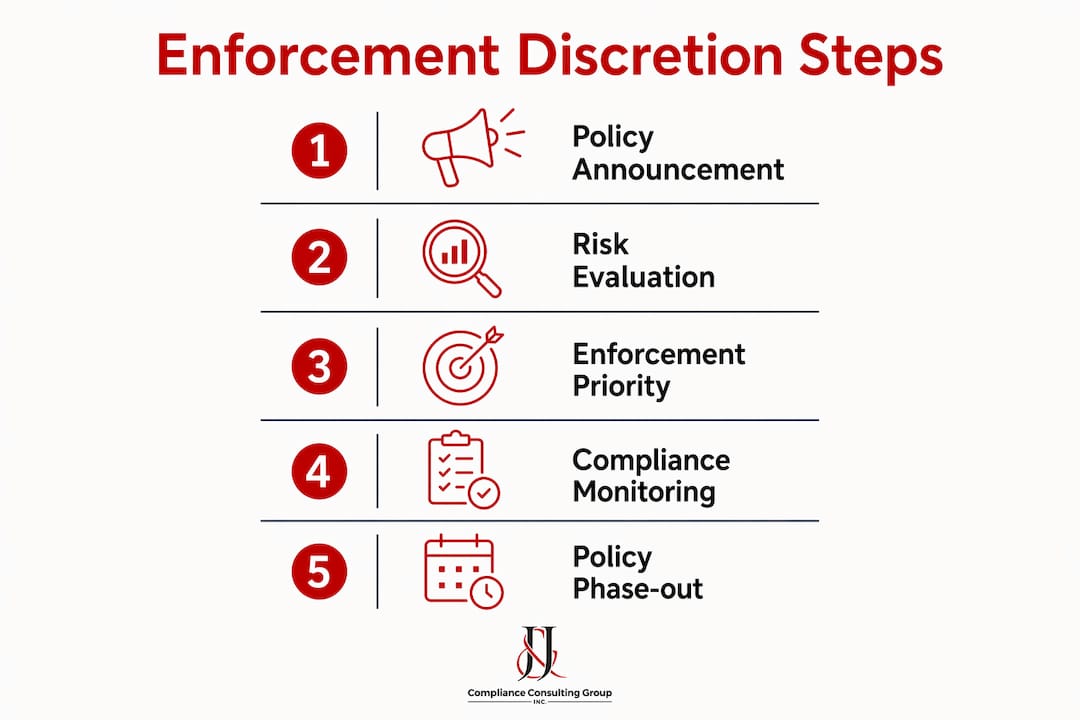
The agency’s risk-based enforcement approach drives these decisions. Enforcement tools available to the FDA range from Warning Letters and recalls to criminal prosecution. Discretion is applied when the lower end of that spectrum would not serve the public health goal better than non-action. That calculus is explicit, documented, and time-limited.
A practical example clarifies the concept. In 2026, the FDA issued a voluntary labeling policy allowing food manufacturers to use claims such as “Made without artificial food colors” on products that contain no synthetic colors listed under 21 CFR part 74. The FD&C Act’s labeling standards under section 403(a)(1) did not change. The FDA simply stated it would not take enforcement action against qualifying claims during the discretion period.

This distinction matters enormously. Regulatory specialists who treat a discretion policy as a green light for full regulatory flexibility create serious exposure for their companies. The policy is conditional, bounded, and reversible.
What are the common FDA enforcement discretion policies in the food sector?
Several categories of enforcement discretion appear repeatedly across FDA food regulation. Understanding each type helps food manufacturers anticipate where flexibility may exist and where it does not.
- “No artificial colors” labeling claims (2026): The FDA’s current policy permits claims like “Made without artificial food colors” for products free of FD&C-certified synthetic colors listed in 21 CFR part 74. This is the most prominent active example of enforcement discretion in food labeling today.
- Infant formula supply shortages (2022): During the 2022 infant formula crisis, the FDA issued case-by-case discretion to manufacturers who could not meet all labeling and composition requirements. The policy was explicitly temporary and tied to documented supply constraints.
- FSMA supplier audit requirements post-COVID-19: The FDA extended enforcement discretion on FSMA supplier verification and audit requirements because international travel restrictions made on-site audits impossible. The agency continued the policy while determining a withdrawal timeline.
- Risk-based prioritization: The FDA consistently deprioritizes enforcement against low-risk technical violations when resources are needed for higher-priority food safety threats. This informal discretion does not always produce a published guidance document.
Pro Tip: Monitor the FDA’s constituent update emails and the Compliance & Enforcement section of FDA.gov. New discretion policies are announced there before they appear in trade press, giving you a compliance head start.
The pattern across all these examples is consistent. Discretion is applied when a public health rationale supports flexibility, when compliance is temporarily impossible, or when the cost of strict enforcement outweighs the benefit. Food manufacturers who track these patterns can anticipate where the next discretion window may open.
How does FDA enforcement discretion affect compliance and product labeling?
Enforcement discretion creates real flexibility, but it does not eliminate legal risk. Food manufacturers who understand this distinction protect themselves far better than those who treat a discretion policy as blanket approval.
The compliance implications fall into four practical areas:
-
Legal requirements remain enforceable by other parties. FDA discretion is not a legal safe harbor from state enforcement or private litigation. State attorneys general, consumer protection agencies, and class-action plaintiffs operate independently of FDA enforcement priorities. A label claim the FDA chooses not to challenge can still generate a lawsuit under California’s Consumer Legal Remedies Act or New York’s General Business Law.
-
Transition plans are required documentation. The FDA expects manufacturers operating under a discretion policy to maintain documented progress toward full compliance. Firms without a transition plan risk immediate enforcement exposure once the discretion period ends. This is not a suggestion. It is a condition of eligibility.
-
All other labeling requirements remain in force. Discretion is narrow and situation-specific, not a blanket regulatory waiver. A manufacturer using the “no artificial colors” discretion policy must still comply with every other FD&C Act labeling requirement, including ingredient declarations, allergen statements, and nutrition facts panels.
-
Consumer trust is a parallel compliance consideration. Labeling claims made under discretion must still be truthful and not misleading under FD&C Act section 403(a)(1). A technically permitted claim that confuses or misleads consumers creates both regulatory and reputational risk.
Pro Tip: When a new discretion policy is announced, immediately review your product portfolio against the specific scope language. Discretion policies define their boundaries precisely. Assuming broad coverage is the most common mistake food manufacturers make.
Voluntary labeling decisions, such as those permitted under peptide ingredient labeling requirements, follow a similar logic: the legal framework stays fixed while the agency provides conditional flexibility. Knowing where those boundaries sit is the difference between a compliant label and a Warning Letter.
What are the procedural aspects of FDA enforcement during discretion periods?
FDA enforcement discretion does not suspend the agency’s inspection and communication activities. Understanding how the FDA communicates during these periods helps food manufacturers respond correctly and on time.
The distinction between Warning Letters and Untitled Letters is foundational. Warning Letters signal that the FDA has identified a significant violation and expects a corrective response. Warning Letters typically require a company response within 15 business days and are issued after the agency has already provided correction opportunities. Untitled Letters address less serious violations and carry lower procedural urgency. Receiving either during a discretion period does not mean the discretion policy protects you from the specific violation cited.
The table below summarizes key procedural differences relevant to food manufacturers during enforcement discretion periods:
| Communication type | Severity level | Typical response window | Public disclosure |
|---|---|---|---|
| Warning Letter | Significant violation | 15 business days | Yes, posted on FDA.gov |
| Untitled Letter | Minor violation | No fixed deadline | No |
| Inspection observation (FDA Form 483) | Potential violation | 15 business days | Yes, upon request |
| Enforcement discretion guidance | Policy-level flexibility | Ongoing until withdrawn | Yes, published on FDA.gov |
Discretion policies affect inspection priorities in a measurable way. When the FDA announces it will not pursue enforcement on a specific issue, inspectors generally deprioritize that issue during routine facility reviews. However, inspectors retain full authority to document observations on any violation they encounter, regardless of active discretion policies.
The FDA also phases out discretion policies gradually. The FSMA COVID-19 audit discretion is a clear example: the agency extended the policy multiple times while signaling a return to full enforcement. Food manufacturers who used that window to build compliant supplier verification programs were ready when the phase-out came. Those who did not were exposed. Guidance on responding to FDA enforcement communications is a practical resource for any team managing this transition.
How can food companies apply enforcement discretion knowledge strategically?
Enforcement discretion knowledge is most valuable when it informs proactive planning rather than reactive compliance. Food manufacturers who treat discretion policies as strategic inputs, not just temporary reprieves, build more durable regulatory positions.
The core strategic applications include:
- Use discretion as flexibility, not exemption. A discretion policy creates a window for reformulation, relabeling, or process adjustment. Use that window to achieve full compliance, not to delay it. The FDA’s enforcement consulting guide outlines how manufacturers can structure transition plans that satisfy FDA expectations during discretion periods.
- Document everything. Compliance transition plans, reformulation timelines, and internal review records all demonstrate good faith. If a discretion policy ends abruptly or a state regulator initiates action, documented progress is your primary defense.
- Engage legal and regulatory counsel early. State law divergence from FDA discretion policies creates a complex legal environment. Regulatory consultants with experience in both federal and state food law can identify exposure points that internal teams often miss.
- Adapt labeling claims to minimize litigation exposure. Claims permitted under FDA discretion are not automatically safe from consumer class actions. Review every discretion-permitted claim against the truthfulness and non-misleading standards of FD&C Act section 403(a)(1) before launch.
- Monitor the broader enforcement climate. USDA enforcement actions increased 36% in the first half of 2025, signaling a tightening regulatory environment across food safety agencies. FDA enforcement trends often follow similar directional shifts. Staying ahead of that curve requires continuous monitoring, not annual compliance reviews.
Food companies that integrate enforcement discretion awareness into their product development process gain a real competitive advantage. They launch faster, avoid costly reformulations after the fact, and maintain cleaner regulatory records. The food safety compliance requirements framework provides a structured starting point for building that kind of proactive compliance culture.
Key Takeaways
FDA food enforcement discretion is a conditional, time-limited policy tool that creates flexibility without eliminating legal risk from state laws, private litigation, or other regulatory requirements.
| Point | Details |
|---|---|
| Discretion is not a law change | The underlying FD&C Act requirement stays in force; only FDA enforcement action is paused. |
| State and litigation risk remains | State agencies and private plaintiffs can act independently of FDA discretion decisions. |
| Transition plans are mandatory | Documented progress toward full compliance is required to remain eligible under any discretion policy. |
| Scope is always narrow | Discretion applies only to the specific violation named; all other regulations remain fully enforceable. |
| Proactive monitoring pays off | Tracking FDA constituent updates and enforcement trends lets manufacturers use discretion windows strategically. |
The conditional nature of discretion is the part most companies get wrong
I have watched food manufacturers celebrate a new discretion policy as if the regulatory problem were solved. It never is. The FDA’s “no artificial colors” labeling guidance is a good example. The policy is real, the flexibility is genuine, and the labeling opportunity is legitimate. But the companies that moved fastest to update their labels without reviewing state law exposure or updating their compliance documentation are the ones who will face the most pain when the policy is eventually withdrawn or when a state AG decides to act.
The deeper issue is that enforcement discretion policies tend to compress timelines rather than extend them. When the FDA signals it will not enforce a rule for now, the clock starts on when it will. Companies that treat the discretion period as a planning window, rather than a permanent solution, consistently come out ahead. I have seen firms use FSMA audit discretion to build genuinely better supplier verification programs than they would have built under strict enforcement pressure. That is the right use of the tool.
The other underappreciated risk is private litigation. Class-action plaintiffs’ attorneys track FDA discretion policies closely. A label claim the FDA permits under discretion can still be challenged as misleading under state consumer protection law. The legal standard is different, and the FDA’s non-action provides no defense in civil court. Any regulatory strategy that does not account for that parallel risk is incomplete.
My recommendation is straightforward. Treat every discretion policy as a structured opportunity with a defined end date. Build your transition plan on day one. Document your progress monthly. And never assume that FDA silence equals FDA approval.
— Mike
How Jjccgroup supports food companies through enforcement discretion
Food manufacturers navigating FDA enforcement discretion need more than a policy summary. They need a compliance strategy that accounts for the full risk picture, including state law exposure, transition planning, and labeling accuracy.

Jjccgroup brings over 30 years of FDA regulatory consulting experience to food and beverage companies facing exactly these challenges. From interpreting new discretion policies like the 2026 “no artificial colors” guidance to building documented compliance transition plans, Jjccgroup provides the kind of FDA compliance services that turn regulatory complexity into a manageable process. Whether you are assessing a new labeling claim or preparing for the end of a discretion period, Jjccgroup’s team of regulatory specialists delivers clear, practical guidance tailored to your product portfolio and market.
FAQ
What is FDA food enforcement discretion?
FDA food enforcement discretion is the agency’s formal decision to not pursue enforcement action against a specific regulatory violation while the underlying legal requirement remains in effect. It is a conditional, time-limited policy tool, not a change in law.
Does FDA enforcement discretion protect manufacturers from lawsuits?
No. FDA discretion does not shield manufacturers from state enforcement actions or private litigation. Consumer class actions and state attorney general investigations operate independently of FDA enforcement priorities.
What is the current FDA enforcement discretion policy for food labeling?
The FDA’s 2026 policy permits voluntary “no artificial colors” labeling claims on products that contain no FD&C-certified synthetic colors listed under 21 CFR part 74. All other labeling requirements remain fully enforceable.
How long do FDA enforcement discretion policies last?
Discretion policies are temporary by design. The FDA sets transition timelines and phases out policies gradually, as seen with COVID-19 era FSMA guidances. Manufacturers should treat every discretion period as a defined window for achieving full compliance.
What documentation does a manufacturer need during an FDA discretion period?
Manufacturers must maintain documented transition plans showing progress toward full compliance. Firms without this documentation risk immediate enforcement exposure once a discretion policy ends.
