



Pharmaceutical cold chain compliance is the process of maintaining approved temperature ranges and complete documentation throughout the drug supply chain to protect sensitive products and meet global regulatory standards. The FDA, MHRA, and Good Distribution Practice (GDP) guidelines each mandate continuous temperature monitoring across three core tiers: frozen, refrigerated, and controlled room temperature ranges. Excursions must be investigated within 24–48 hours to remain GDP-compliant. For pharmaceutical and medical device professionals, this guide covers the regulations, technologies, and step-by-step processes required to build and sustain a compliant cold chain in 2026.
What are the regulatory requirements for pharmaceutical cold chain compliance?
GDP, enforced by the MHRA and mirrored in FDA guidance, sets the baseline for temperature-controlled shipping and storage. It requires validated shipping lanes, qualified storage facilities, and documented Quality Unit oversight at every stage of the supply chain. Failing to meet these standards results in observations, warning letters, or product rejection.
The FDA adds a critical layer through 21 CFR Part 11, which governs electronic records and signatures. All temperature monitoring systems must produce uneditable, timestamped records that investigators can retrieve within 5–10 minutes during a surprise audit. This is not a suggestion. Auditors arrive unannounced and expect immediate access.
Key regulatory obligations include:
- Lane and facility qualification: Shipping lanes must undergo formal qualification studies covering worst-case seasonal conditions. Any change to a lane, carrier, or packaging system triggers requalification. Unvalidated lanes are deemed non-compliant by both MHRA and FDA auditors.
- Temperature range categories: Frozen (−80°C to −20°C), refrigerated (2°C to 8°C), and controlled room temperature (15°C to 25°C) are the three regulated tiers. Each product label specifies which tier applies.
- Mean Kinetic Temperature (MKT): Simple averages are not acceptable for excursion assessment. MKT calculations account for the cumulative thermal impact of fluctuations over time, and auditors expect to see them in every excursion report.
- Chain-of-custody documentation: Every handoff, from manufacturer to carrier to distributor, must be recorded with timestamps, responsible party IDs, and temperature data.
| Regulatory Requirement | Standard/Body | Key Obligation |
|---|---|---|
| Good Distribution Practice | MHRA / EU GDP | Lane qualification, storage validation, QU oversight |
| Electronic records | FDA 21 CFR Part 11 | Uneditable, timestamped, retrievable within 5–10 minutes |
| Temperature monitoring | USP, GDP | Continuous logging across all three temperature tiers |
| MKT assessment | USP / GDP | Required for all excursion impact evaluations |
| Chain-of-custody records | FDA / GDP | Documented handoffs with timestamps and courier IDs |
Pro Tip: Schedule your lane requalification studies before seasonal transitions. Running a worst-case summer study in january gives you data that covers the full annual risk profile.
What technologies and tools are essential for maintaining cold chain compliance?
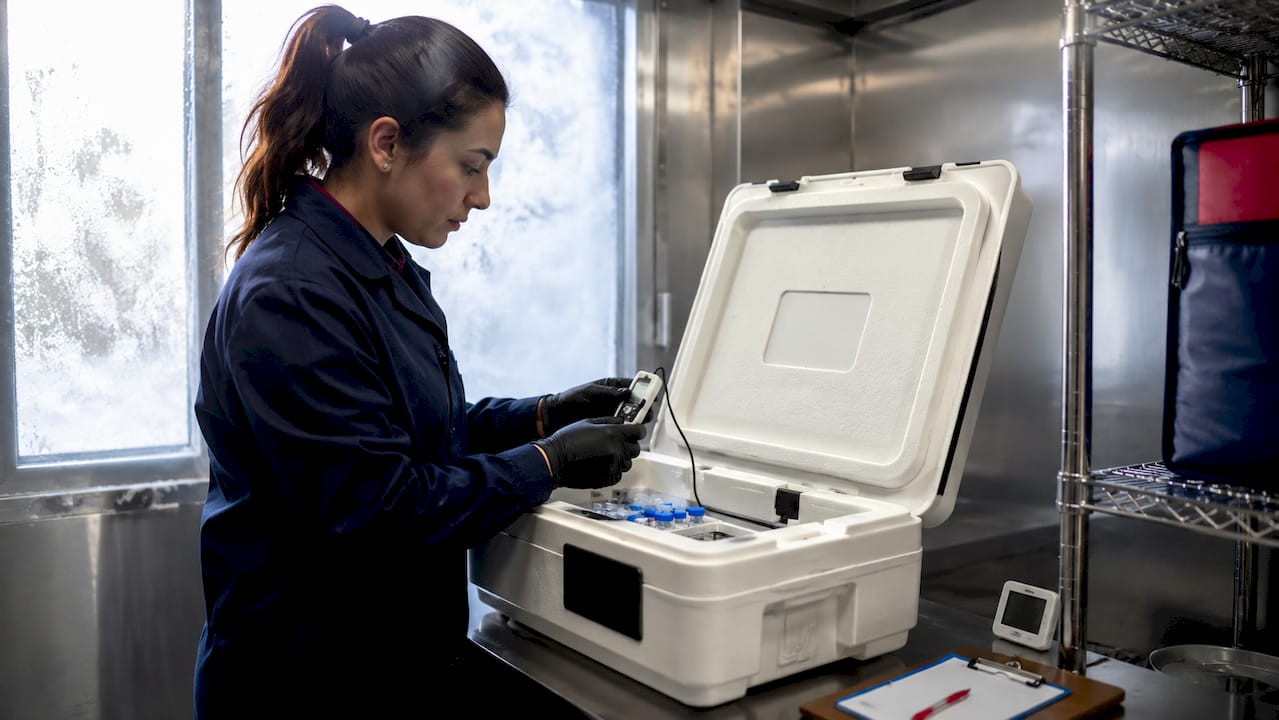
Calibrated electronic data loggers are the foundation of any compliant monitoring program. These devices must be traceable to national measurement standards and validated under 21 CFR Part 11 to produce audit-ready records. A logger that cannot prove calibration traceability is a liability during inspection.
Cloud-based data platforms extend that foundation by centralizing records from multiple sites, carriers, and lanes into a single audit trail. Real-time alert systems notify quality teams the moment a threshold is breached, enabling the 24–48 hour excursion response window required by GDP. Without automated alerts, teams rely on manual checks, which create gaps that auditors flag immediately.
Emerging technologies are raising the compliance bar further:
- IoT sensors: Provide continuous, wireless temperature readings at the pallet or unit level throughout transit.
- Blockchain: Creates an immutable record of each custody event, making data manipulation technically impossible and auditor suspicion moot.
- Digital twin technology: Links temperature data to batch numbers, courier IDs, and handoff timestamps, creating a complete virtual record of the product journey. This is particularly critical for complex biologics and cell therapies.
| Technology | Primary Compliance Function | Audit Benefit |
|---|---|---|
| Calibrated data loggers | Continuous temperature recording | Traceable, uneditable records |
| Cloud platforms | Centralized multi-site data | Single audit trail, rapid retrieval |
| IoT sensors | Real-time wireless monitoring | Eliminates manual check gaps |
| Blockchain | Immutable custody records | Removes data manipulation risk |
| Digital twin | Batch-linked journey mapping | Complete chain-of-custody evidence |
Pro Tip: When evaluating monitoring platforms, test record retrieval speed before purchase. Auditors expect access within 5–10 minutes. If your system takes longer, it will generate an observation regardless of the data quality inside it.
How to implement a compliant cold chain process step by step
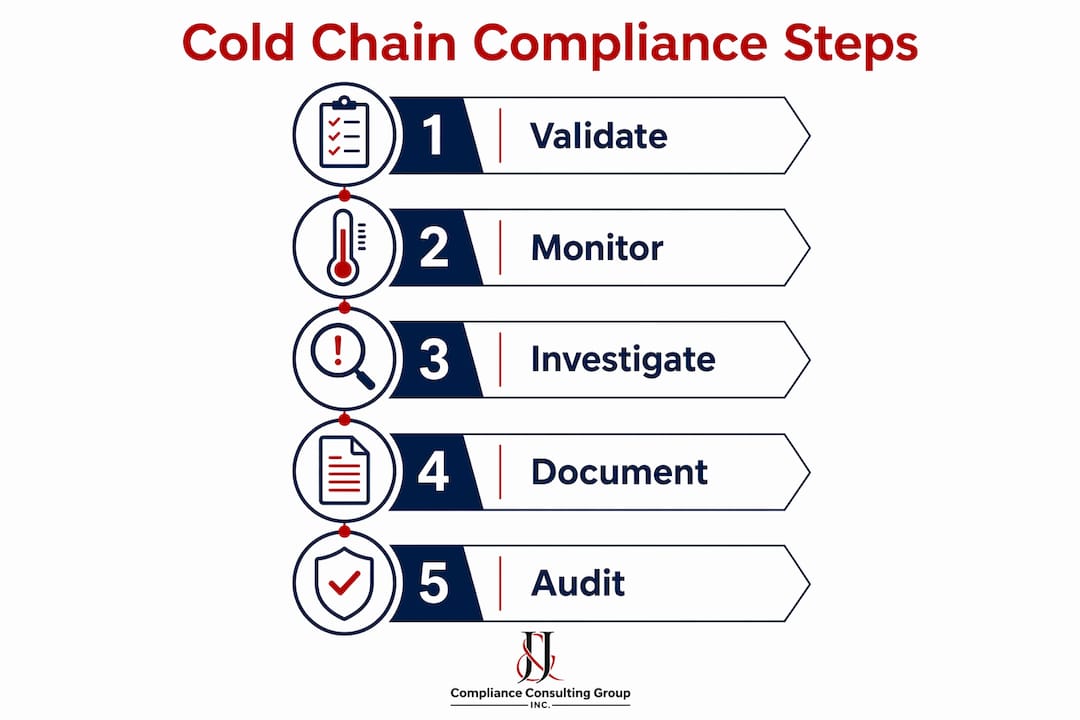
A compliant cold chain does not happen by accident. It requires a structured build from qualification through ongoing operations, with documented evidence at every stage.
-
Conduct temperature mapping studies. Map all storage areas and shipping lanes under worst-case conditions before any product moves. Document hot spots, cold spots, and seasonal variation. This data forms the scientific basis for your packaging and procedure design.
-
Qualify packaging and shipping procedures. Validate each packaging configuration against the temperature profile of its intended lane. A validated shipper for a 2-day refrigerated lane is not automatically valid for a 4-day frozen lane. Each scenario needs its own qualification data.
-
Develop and train on standard operating procedures (SOPs). Write SOPs for every step: loading, transit monitoring, receiving, and excursion response. Train every person who touches the product, including third-party logistics providers. Undocumented training is the same as no training in an auditor’s view.
-
Deploy continuous monitoring and set alarm thresholds. Configure alerts at the regulatory limit, not at the product specification limit. This gives your team a response window before a true excursion occurs.
-
Respond to excursions within 24–48 hours. Assign a Quality Unit owner to every alert. Document the investigation, calculate MKT, assess product impact using stability data, and record the corrective action. Speed and scientific rigor both matter here.
-
Maintain audit-ready records continuously. Do not wait for an inspection notice to organize records. Inspection readiness is a continuous operational philosophy. Annual mock audits identify data integrity gaps before official auditors do.
Pro Tip: Link every temperature record to a specific batch number and shipment ID at the time of data capture, not retroactively. Retroactive linking raises data integrity questions that are very difficult to resolve during an inspection.
What are common challenges and how to overcome them in pharmaceutical cold chain compliance?
The last mile is the most dangerous segment of any cold chain. Delays on unconditioned loading docks and missing transfer documentation are the most frequent sources of regulatory findings. The fix is procedural: require a signed, timestamped transfer record for every handoff, including the final delivery to the customer or clinic.
A second major challenge is the misconception that zero excursions equals compliance. Auditors view zero-excursion records with suspicion, interpreting them as possible evidence of data manipulation or incomplete monitoring. Excursions are a normal part of pharmaceutical logistics. What regulators evaluate is whether your Quality Unit responded correctly, documented the investigation thoroughly, and applied a scientifically sound impact assessment.
Common pitfalls and their solutions:
- Undocumented handoffs: Implement a carrier-signed transfer log for every custody change, including last-mile delivery.
- Data gaps in monitoring: Use continuous loggers rather than spot-check thermometers. Gaps in data are treated as potential excursions.
- Weak deviation management: All shipments eventually face deviations. Audit success depends on documented scientific justification, not on a perfect excursion-free record.
- Siloed temperature data: Temperature records that cannot be linked to a specific batch or shipment ID are nearly useless during an audit. Integrate your monitoring system with your batch record system.
“Compliance is not the absence of problems. It is the documented, scientific management of problems when they occur.” This principle defines how regulators distinguish a mature quality system from one that is merely performing compliance theater.
Incorporating formal mock audits and gap analysis into your annual quality calendar is the single most effective way to identify weaknesses before an FDA or MHRA investigator does. Teams that practice audit responses perform measurably better when the real inspection arrives.
Key takeaways
Pharmaceutical cold chain compliance requires validated lanes, continuous monitoring, MKT-based excursion assessment, and audit-ready documentation at every custody point.
| Point | Details |
|---|---|
| Temperature tiers are non-negotiable | Products must stay within frozen, refrigerated, or controlled room temperature ranges at all times. |
| MKT replaces simple averages | Use Mean Kinetic Temperature calculations for every excursion impact assessment to satisfy auditor expectations. |
| Zero excursions raises red flags | Document and investigate all excursions; auditors distrust records with no deviations over extended periods. |
| Last-mile documentation is critical | Require signed, timestamped transfer records at every handoff, especially the final delivery point. |
| Mock audits close compliance gaps | Annual mock audits identify data integrity weaknesses before official inspections expose them. |
Cold chain compliance is a culture, not a checklist
I have worked with pharmaceutical teams that built technically excellent monitoring systems and still failed inspections. The reason is almost always the same: they treated compliance as a project with a finish line rather than an operating standard with no end date.
The shift toward digital chain-of-custody for biologics and cell therapies has made this cultural gap more visible. When every custody event is digitally timestamped and linked to a batch record, there is nowhere to hide a procedural shortcut. That transparency is exactly what regulators want, and it is what mature quality organizations have already built.
The teams I respect most are the ones that run annual mock audits with the same seriousness as a real FDA inspection. They debrief, write corrective actions, and track closure. They also understand that a well-documented excursion is a sign of a healthy quality system, not a failure. Scientific justification and thorough deviation management are what separate organizations that pass audits from those that spend months in remediation. Build the culture first. The technology and documentation will follow.
— Mike
How Jjccgroup supports your cold chain compliance program
Cold chain compliance demands more than good intentions. It requires validated processes, audit-ready documentation, and a quality system that holds up under FDA and MHRA scrutiny.
Jjccgroup brings over 30 years of FDA regulatory expertise to pharmaceutical and medical device manufacturers navigating cold chain compliance requirements. From lane qualification support to deviation management frameworks, the team helps you build a program that satisfies regulators and protects your products. When an inspection is on the horizon, Jjccgroup’s inspection readiness services close the gaps before auditors find them. Contact Jjccgroup to build a compliance program that is ready for 2026 and beyond.
FAQ
What temperature ranges does pharmaceutical cold chain compliance require?
Pharmaceutical cold chain compliance covers three regulated tiers: frozen (−80°C to −20°C), refrigerated (2°C to 8°C), and controlled room temperature (15°C to 25°C). Each product’s label specifies which tier applies throughout storage and transit.
What is Mean Kinetic Temperature and why do auditors require it?
Mean Kinetic Temperature (MKT) is a calculation that accounts for the cumulative thermal impact of temperature fluctuations over time, unlike a simple average. Regulators require MKT in excursion reports because it more accurately reflects the thermal stress a product has experienced.
How quickly must a pharmaceutical company respond to a cold chain excursion?
GDP standards require excursion investigations to begin within 24–48 hours of detection. The Quality Unit must document the investigation, assess product impact using stability data, and record corrective actions to remain compliant.
Does zero excursions on a cold chain record mean full compliance?
Zero excursions over an extended period can trigger auditor suspicion of data manipulation or incomplete monitoring. Regulators expect to see documented excursions managed with scientific rigor, not a flawless record that suggests gaps in monitoring.
What is the most common source of cold chain regulatory findings?
The last-mile handoff is the most frequent source of regulatory observations. Missing or incomplete documentation during final delivery, including unsigned transfer records and undocumented dock delays, creates compliance gaps that auditors consistently identify.
