




Pharmaceutical contract manufacturer oversight is the process of managing outsourced manufacturing to confirm it meets all applicable quality and regulatory requirements. Sponsors retain full legal accountability under FDA 21 CFR Parts 210 and 211 regardless of what a contract manufacturing organization (CMO) produces on their behalf. The ICH Q10 framework reinforces this by requiring documented monitoring, corrective and preventive action (CAPA), change management, and management review. FDA enforcement in 2026 has intensified scrutiny on sponsors who cannot demonstrate active, documented oversight of their CMOs.
What does effective pharmaceutical contract manufacturer oversight require?
Effective oversight begins before a single batch is manufactured. Quality agreements must be executed before contract activities begin, mapping every current Good Manufacturing Practice (cGMP) activity to a responsible party. FDA cites sponsors under 21 CFR 211.22(a) and (d) when these agreements are absent or incomplete. The agreement is not a formality. It is a binding compliance document.
A well-structured quality agreement covers the following CGMP activities:
- Raw material release and testing
- Batch record review and approval
- Deviation identification, investigation, and closure
- CAPA initiation and verification
- Change control notification and approval
- Annual product reviews
- Out-of-specification (OOS) result reporting and escalation timelines
Beyond the agreement itself, sponsors need a formal audit program with defined schedules, reporting templates, and a responsibility matrix. Written quality agreements must specify immediate notification requirements for OOS results and process deviations, including exact reporting timelines. Failure to address these details is a direct path to warning letters.
The table below outlines the core prerequisites for CMO oversight:
| Prerequisite | Purpose | Regulatory Basis |
|---|---|---|
| Executed quality agreement | Assigns CGMP responsibility | 21 CFR 211.22(a),(d) |
| Initial qualification audit | Confirms CMO capability before production | ICH Q10 |
| Audit schedule | Ensures ongoing compliance verification | FDA guidance |
| Deviation notification protocol | Enables timely sponsor response | 21 CFR 211.192 |
| CAPA tracking system | Closes quality gaps systematically | ICH Q10 |
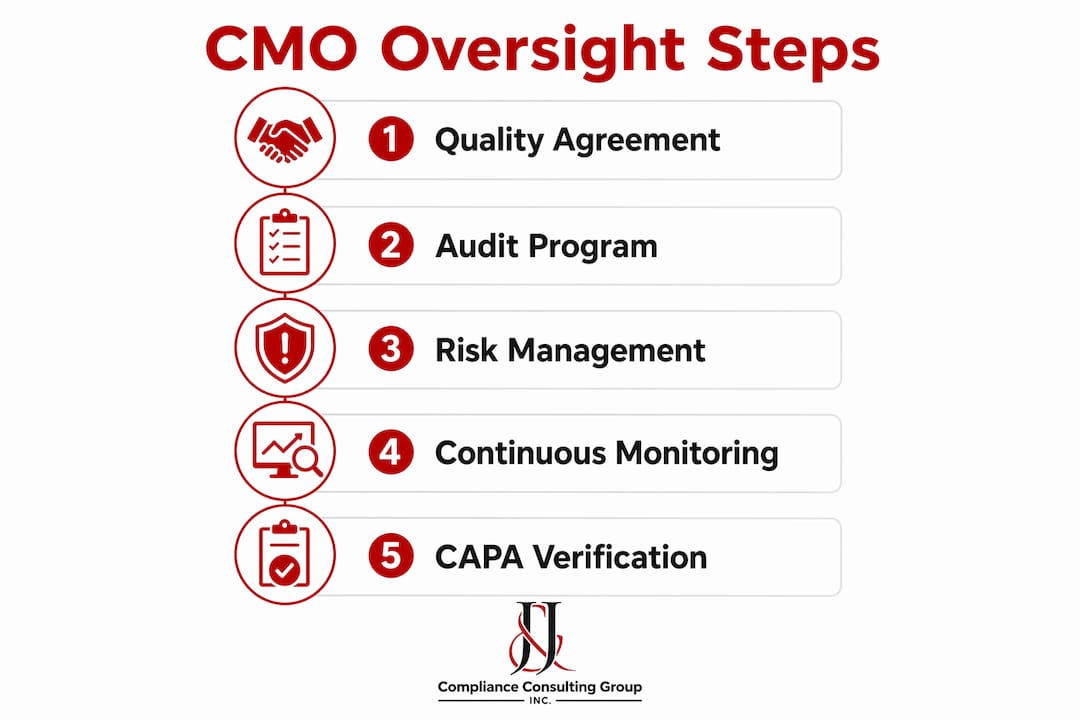
Annual reviews of quality agreements and audit outcomes are mandatory to keep pace with manufacturing changes. Oversight is a continuous program, not a contract signing event.
How to conduct audits and monitor CMOs for ongoing compliance
A structured audit is the primary tool for verifying that a CMO operates as agreed. An effective on-site audit covers four domains: Quality Systems, Manufacturing, Laboratory, and Materials. Standard audit duration runs 1–2 days, with formal scoring against predefined firm standards.
Follow this sequence to conduct a thorough CMO audit:
- Pre-audit preparation. Review the CMO’s previous audit reports, deviation logs, CAPA records, and any FDA inspection history. Define the audit scope and assign lead auditor responsibilities.
- Quality Systems review. Assess change control procedures, training records, document control, and management review practices. Verify that the CMO’s quality unit operates independently from production.
- Manufacturing floor assessment. Walk the production areas. Confirm equipment qualification status, cleaning validation records, and batch record completeness. Check that operators follow written procedures in real time.
- Laboratory evaluation. Review analytical method validation, instrument calibration logs, and OOS investigation records. Confirm that raw data is retained and accessible.
- Materials management check. Verify incoming raw material testing, vendor qualification records, and storage condition monitoring. Confirm that rejected materials are segregated and dispositioned properly.
- Post-audit report and scoring. Issue a formal written report within an agreed timeframe. Score findings by severity, assign corrective action owners, and set closure deadlines.
After the audit, monitoring does not stop. Track key quality metrics monthly: deviation rates, OOS frequencies, CAPA closure timelines, and change control volumes. Spikes in any of these metrics signal process instability before it becomes a regulatory event.
Pro Tip: Set a contractual requirement for the CMO to notify you within 24 hours of any critical deviation or OOS result. Delayed notification is one of the most common triggers for FDA warning letters against sponsors.

Communication plans matter as much as audit schedules. Define escalation paths in the quality agreement so that deviations above a defined severity threshold reach your quality leadership, not just the CMO’s site contact.
What are the common pitfalls in CMO oversight and how do you avoid them?
The most dangerous assumption in contract manufacturing quality control is that outsourcing production transfers regulatory risk. FDA enforces that sponsors remain legally responsible for product quality regardless of outsourcing arrangements. Recent enforcement actions have cited sponsors directly for insufficient CMO oversight and failure to conduct timely deviation investigations.
The most frequent compliance failures include:
- Missing or incomplete quality agreements. Agreements that omit deviation notification timelines, CAPA ownership, or change control approval rights leave sponsors exposed during inspections.
- Treating oversight as a one-time event. Signing a quality agreement and conducting a single qualification audit does not satisfy FDA expectations. Oversight requires scheduled, recurring audits and continuous metric review.
- Accepting zero deviations as a positive sign. A CMO reporting zero deviations in 12 months signals underreporting, not excellence. Healthy quality systems document deviations with root cause analysis. No deviations means no visibility.
- Weak CAPA follow-through. Opening a CAPA without verifying its effectiveness is a compliance gap. FDA inspectors check whether corrective actions actually resolved the root cause.
- Inadequate change control oversight. CMOs that implement manufacturing changes without sponsor approval violate the quality agreement and can invalidate product registrations.
“Sponsors cannot delegate quality accountability. Regulators treat CMOs as direct extensions of the sponsor’s own facilities, requiring equivalent oversight rigor.” — FDA enforcement perspective, 2026
The benefits of regulatory consulting become most visible when sponsors face these gaps. External expertise helps identify missing agreement clauses and audit program weaknesses before FDA does.
How does data and regulatory intelligence improve CMO oversight?
Data-driven oversight moves quality assurance in contract manufacturing beyond periodic audits into continuous governance. FDA inspections increasingly target data integrity, cross-checking raw data for anomalies and integrating inspection findings with product application reviews for BLAs and NDAs. Sponsors whose CMOs have data integrity violations face direct consequences in their own approval timelines.
Risk-based oversight adjusts audit intensity and review depth according to product criticality and the CMO’s historical quality performance. A CMO producing a sterile injectable warrants more frequent audits and deeper data review than one producing non-sterile solid dosage forms. Applying the same oversight intensity to every supplier wastes resources and misses high-risk gaps.
The table below shows how to tier oversight by risk level:
| Risk tier | Product type | Audit frequency | Key monitoring focus |
|---|---|---|---|
| High | Sterile injectables, biologics | Every 6–12 months | Data integrity, sterility assurance, CAPA |
| Medium | Non-sterile liquids, semi-solids | Every 12–18 months | Deviation rates, OOS trends, change control |
| Low | Solid oral dosage, packaging | Every 18–24 months | Batch record completeness, vendor qualification |
Use FDA warning letter databases and inspection trend data to assess a CMO’s regulatory history before and during the relationship. A CMO with recent FDA observations in data integrity or deviation management requires heightened oversight regardless of their tier assignment.
Pro Tip: Review your CMO’s FDA Establishment Inspection Report (EIR) history annually. Patterns in 483 observations reveal systemic weaknesses that internal audits may not surface.
Verifying CAPA effectiveness is the final step most sponsors skip. Close a CAPA only after confirming that the root cause no longer produces the original defect. Trend the same metric for at least three months post-closure before declaring the action effective.
Key Takeaways
Effective pharmaceutical contract manufacturer oversight requires executed quality agreements, scheduled audits, and continuous data monitoring. Sponsors who treat oversight as a one-time event face the highest regulatory risk.
| Point | Details |
|---|---|
| Quality agreements are mandatory | Execute before production begins and map every CGMP activity to a responsible party. |
| Sponsor accountability cannot be outsourced | FDA holds sponsors legally responsible for CMO quality regardless of contractual arrangements. |
| Zero deviations is a red flag | A CMO reporting no deviations signals underreporting, not quality excellence. |
| Risk-based audit frequency matters | Tier audit intensity by product criticality and the CMO’s historical quality performance. |
| Data integrity is a 2026 enforcement priority | FDA cross-checks raw data during inspections and links findings directly to product application reviews. |
What I’ve learned about oversight that most guides won’t tell you
After working with pharmaceutical companies across dozens of CMO relationships, the pattern I see most often is not a lack of quality agreements. It is a lack of conviction that those agreements will actually be enforced. Sponsors draft thorough documents, conduct a solid qualification audit, and then go quiet for 18 months. By the time the next audit happens, deviations have piled up, CAPAs are overdue, and the CMO has implemented three manufacturing changes without notification.
The uncomfortable truth is that oversight requires organizational commitment, not just documentation. A quality agreement sitting in a shared drive does not protect you during an FDA inspection. What protects you is a demonstrated pattern of scheduled audits, timely deviation reviews, and documented CAPA follow-up. Inspectors look for evidence of active engagement, not just signed paperwork.
The second lesson I keep coming back to is the value of reading FDA warning letters from your CMO’s sector. Warning letters are public. They tell you exactly what FDA is finding at facilities like yours. If FDA is citing sterile manufacturers for data integrity failures, and your CMO produces sterile products, that is your signal to add a data integrity review to your next audit scope. Regulatory intelligence is free. Not using it is a choice.
Finally, the sponsors who maintain the strongest CMO relationships treat their CMOs as quality partners, not just vendors. That means sharing your own quality expectations clearly, responding quickly when the CMO flags a deviation, and closing CAPAs on time from your side too. Oversight works in both directions.
— Mike
How Jjccgroup supports your CMO oversight program
Pharmaceutical companies managing CMO relationships face a consistent challenge: building oversight programs that satisfy FDA expectations while keeping operations moving. Jjccgroup brings over 30 years of FDA regulatory consulting experience to exactly this problem.
Jjccgroup supports pharmaceutical teams with quality agreement drafting, audit preparation, and ongoing CMO compliance monitoring. Their consultants understand the 2026 enforcement environment and help clients build oversight programs that hold up under FDA scrutiny. Whether you need a full CMO audit program or targeted support on a specific compliance gap, Jjccgroup’s regulatory affairs consulting delivers practical, experience-backed guidance. Contact Jjccgroup to build an oversight program that protects your product and your license to operate.
FAQ
What is pharmaceutical contract manufacturer oversight?
Pharmaceutical contract manufacturer oversight is the sponsor’s active management of a CMO to confirm compliance with cGMP requirements and product quality standards. It includes quality agreements, scheduled audits, deviation monitoring, and CAPA verification.
Who is legally responsible for CMO compliance?
The sponsor retains full legal responsibility for product quality under FDA 21 CFR Parts 210 and 211, regardless of outsourcing arrangements. FDA cites sponsors directly when CMO oversight is insufficient.
What must a quality agreement include?
A quality agreement must assign responsibility for raw material testing, batch record review, deviation handling, CAPA, change control, OOS reporting, and annual product reviews. It must be executed before manufacturing begins.
How often should sponsors audit their CMOs?
Audit frequency depends on product risk. High-risk products such as sterile injectables warrant audits every 6–12 months. Lower-risk solid oral dosage forms may require audits every 18–24 months based on historical quality performance.
What does a zero-deviation report from a CMO mean?
A CMO reporting zero deviations over 12 months signals underreporting rather than quality excellence. Functional quality systems document deviations with root cause analysis. No documented deviations means no visibility into actual process performance.
