




Risk management in pharma is not a compliance exercise you complete once and file away. Understanding why pharma needs risk management means recognizing it as the mechanism that protects patients, sustains product quality, and keeps your organization inspection-ready at all times. The pharmaceutical industry operates under conditions where a single undetected failure can trigger a recall, a warning letter, or worse, patient harm. Quality risk management (QRM), as defined by ICH Q9, gives companies a structured, science-based framework to make defensible decisions across the entire product lifecycle.
Table of Contents
- Key Takeaways
- Why pharma needs risk management: the QRM foundation
- Regulatory drivers and the compliance case
- Patient safety and product quality: the direct link
- Implementing proportional, science-based risk management
- My perspective on where pharma risk management actually breaks down
- How Jjccgroup supports your pharma risk management goals
- FAQ
Key Takeaways
| Point | Details |
|---|---|
| QRM is a lifecycle capability | Risk management applies from early development through post-market surveillance, not just at launch. |
| Regulators expect risk-based evidence | FDA and global regulators use risk documentation as a primary input for inspection focus and compliance assessment. |
| Patient safety depends on early hazard identification | Proactive risk assessment catches product and process failures before they reach patients. |
| Proportionality drives resource efficiency | ICH Q9(R1) requires scaling rigor to risk level, so your highest-risk areas receive the most attention. |
| Risk outputs must connect to operations | Risk assessments only work when they directly influence CAPA, change control, and supplier oversight decisions. |
Why pharma needs risk management: the QRM foundation
Quality risk management is, at its core, a decision-making capability. ICH Q9 frames QRM as a lifecycle tool for managing risks to product quality that directly impact patient safety and product availability. The 2023 revision, ICH Q9(R1), sharpened this by addressing subjectivity in risk assessments and reinforcing the principle of proportionality.
The QRM process follows four main steps:
- Risk assessment: Identify hazards, analyze their likelihood and severity, and evaluate the overall risk level using scientific rationale and cross-functional input.
- Risk control: Implement measures to reduce risk to an acceptable level, whether through elimination, mitigation, or acceptance with documented justification.
- Risk communication: Share risk information transparently across functions, management levels, and with regulators when required.
- Risk review: Revisit and update risk assessments continuously as new data, deviations, or process changes emerge.
These steps are not sequential checkboxes. They form a continuous loop integrated into your pharmaceutical quality system (PQS). From early formulation decisions in development to post-market pharmacovigilance monitoring, QRM informs every major quality decision your organization makes.
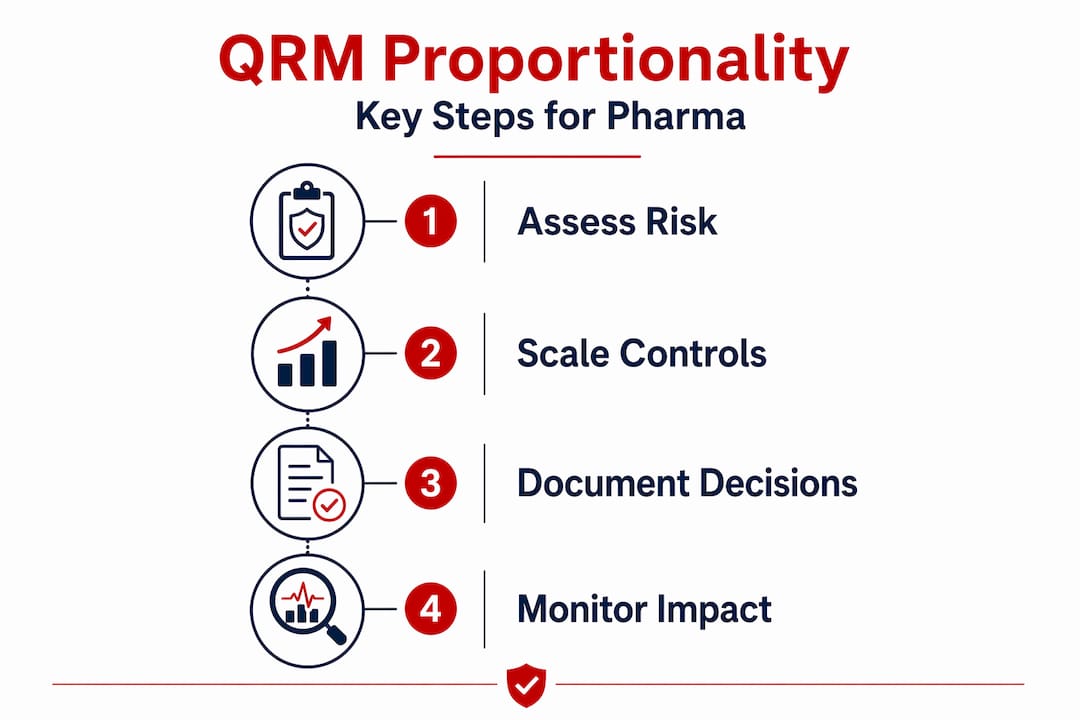
One principle that often gets underestimated is proportionality. ICH Q9(R1) requires organizations to scale the formality and rigor of risk management commensurate with the actual risk level. A lower-risk process change does not demand the same documentation depth as a critical manufacturing parameter affecting sterile product integrity. This calibration is what makes QRM a practical tool rather than an administrative burden.
Regulatory drivers and the compliance case
Regulators do not just encourage risk management. They expect it, and they assess it during inspections. FDA risk-based prioritization means inspectors focus their attention on areas where your risk evidence is weakest or where controls are least defensible. If your risk documentation is thin, you are signaling to regulators exactly where to look.
The compliance benefits of a mature risk management system include:
- Inspection readiness: Well-documented risk assessments demonstrate to investigators that your quality decisions are science-based and traceable.
- CAPA integration: Risk management identifies root causes more precisely, making corrective and preventive actions more targeted and effective.
- Change control support: Risk assessments determine the scope and validation requirements for process or equipment changes, preventing over- or under-engineering your response.
- Deviation handling: When deviations occur, existing risk data accelerates impact assessment and guides the appropriate level of investigation.
The regulatory shift from uniform control requirements to risk-based approaches reflects a broader maturity in how agencies think about compliance. Uniform rules applied to every situation regardless of actual risk are inefficient and often miss the highest-priority hazards. Risk-based frameworks let regulators and companies alike allocate oversight where it matters most.
Pro Tip: When preparing for an FDA inspection, organize your risk management documentation so investigators can trace each risk assessment directly to the control strategy it informed. Disconnected risk paperwork creates doubt about whether your quality system actually functions as described.
For a practical look at how this translates to inspection preparation, the compliance readiness planning resource from Jjccgroup offers structured guidance on building risk-based readiness plans.
Patient safety and product quality: the direct link
The most compelling reason why pharma needs risk management is straightforward: patients depend on it. When risk assessment in pharmaceuticals is done well, hazards are identified and controlled before a product reaches a patient. When it is done poorly, or not at all, the consequences range from product recalls to serious adverse events.

Consider how cross-functional safety decision-making works in practice. A sterile injectable manufacturer identifies a potential particulate contamination risk during a formulation change. A structured risk assessment brings together manufacturing, quality, and regulatory experts to evaluate severity, detectability, and likelihood. The outcome is a specific control strategy, not a generic one, grounded in the actual hazard profile of that product.
Here is how effective risk management directly protects patients and product quality:
- Early hazard identification catches process vulnerabilities during development, where changes are far less costly and disruptive than post-approval corrections.
- Benefit-risk planning throughout clinical development maintains a favorable safety profile, helping teams recognize when emerging safety signals require protocol adjustments.
- Pharmacovigilance integration connects post-market safety data back to the risk framework, so new signals trigger a structured review rather than an ad hoc response.
- CAPA effectiveness improves when risk insights drive root cause analysis. Many CAPA programs miss root causes because they are reactive rather than systemic. Risk management shifts that orientation.
- Continuous improvement becomes embedded in operations when risk reviews generate learning that feeds back into process controls, training, and quality standards.
“Safety evaluation helps maintain a favorable benefit-risk balance and manage safety barriers proactively throughout drug development and vigilance.” Pharmacovigilance due diligence research confirms that surfacing safety barriers early in development avoids far more costly downstream regulatory and market complications.
The benefit-risk analysis framework is particularly relevant here. When teams apply structured benefit-risk evaluation throughout development rather than only at submission, they build a more defensible regulatory package and a safer product.
Implementing proportional, science-based risk management
Knowing why risk management matters is one thing. Building a system that actually works is where most organizations encounter real difficulty. The most common failure mode is not a lack of effort. It is a lack of defensibility. Weak risk evidence and poor linkage between risk assessments and control decisions are the patterns that draw regulatory scrutiny during inspections.
Common pitfalls to avoid
- Superficial risk scoring: Assigning numerical risk scores without documented scientific rationale produces results that look structured but cannot withstand regulatory questioning.
- Disconnected outputs: Risk management outputs that do not directly influence change control scope, validation depth, CAPA decisions, or supplier qualification criteria are effectively decorative. They satisfy a procedural requirement without delivering actual control.
- Stale assessments: Risk assessments completed once and never revisited become inaccurate as processes evolve, new data emerges, and regulatory expectations shift. Without structured review loops, your risk framework loses its protective value.
- Single-function ownership: Risk management owned exclusively by quality teams, without manufacturing, regulatory, and clinical input, produces assessments that miss critical operational realities.
A practical comparison of risk management approaches
| Scenario | Informal approach | Formal, structured approach |
|---|---|---|
| Minor process parameter adjustment | Brief documented rationale with quality sign-off | Same, scaled to actual risk level per ICH Q9(R1) |
| Critical manufacturing step change | Undocumented team discussion | Full risk assessment with FMEA, cross-functional review, and control linkage |
| Supplier qualification | Questionnaire only | Risk-tiered qualification with audit scope driven by risk profile |
| Post-market safety signal | Reactive investigation | Structured benefit-risk review integrated with pharmacovigilance system |
The proportionality principle is your guide here. Scaling effort to risk level means your team spends the most time and rigor on the decisions with the highest patient impact, and applies lighter-touch approaches where the risk profile genuinely supports it.
Pro Tip: Build traceability directly into your risk management templates. Every risk assessment should include a field that explicitly documents which operational controls, validation activities, or CAPA actions it informed. This single practice closes the gap between risk paperwork and real-world control.
For organizations working to strengthen their CAPA and root cause programs alongside risk management, the connection between these systems is where the most meaningful quality improvements happen.
My perspective on where pharma risk management actually breaks down
I have worked with pharmaceutical organizations across development and commercial manufacturing, and the pattern I see most often is not ignorance of risk management. It is the disconnect between what the risk assessment says and what the control strategy actually does.
Teams complete thorough, well-documented risk assessments. Then those documents sit in a quality system while manufacturing decisions are made based on habit, cost pressure, or schedule constraints. The risk output never reaches the people making operational decisions. That is not a documentation problem. It is a culture problem.
What I have learned is that risk management only functions as intended when senior leaders treat it as a decision-making input, not a compliance artifact. When a quality director can walk into a production meeting and reference a risk assessment to justify a control decision, the system is working. When the risk assessment is something that gets written after the decision is made, the system has failed.
The continuous review principle matters more than most teams realize. Without review loops, risk assessments become stale and stop reflecting the actual state of your process or your product’s safety profile. I have seen companies face regulatory pressure not because their original risk assessment was wrong, but because they never updated it when their process changed.
My honest take: the organizations that treat risk management as a strategic capability, not a cost center, consistently outperform their peers in inspection outcomes, product quality metrics, and time to resolution when problems do arise. The investment is real. So are the returns.
— Mike
How Jjccgroup supports your pharma risk management goals
Effective risk management does not happen by accident. It requires structured systems, experienced guidance, and the organizational discipline to keep those systems current and connected to real operational decisions.

Jjccgroup brings over 30 years of FDA regulatory expertise to pharmaceutical companies navigating exactly these challenges. Whether you are building a QRM framework from the ground up, preparing for an FDA inspection, or strengthening your CAPA and pharmacovigilance systems, Jjccgroup offers the consulting depth to move from concept to execution. Their FDA regulatory compliance consulting services are designed specifically for pharmaceutical, medical device, and life sciences companies that need more than generic advice. They need a partner who understands the regulatory expectations your organization faces and can help you build systems that hold up under scrutiny. Explore their regulatory compliance consulting services to see how their team can support your risk management and compliance goals.
FAQ
What is quality risk management in pharma?
Quality risk management (QRM) is a systematic process for identifying, evaluating, controlling, and reviewing risks to product quality and patient safety across the pharmaceutical product lifecycle, as defined by ICH Q9.
Why do pharmaceuticals need risk assessment?
Risk assessment helps pharmaceutical companies identify hazards before they affect patients, supports regulatory compliance, and provides the scientific rationale needed to justify quality decisions during inspections and submissions.
How does risk management impact pharma regulatory compliance?
FDA and global regulators use risk-based prioritization to focus inspection and oversight efforts. Companies with well-documented, traceable risk management systems demonstrate compliance readiness and reduce the likelihood of regulatory findings.
What are the benefits of risk management in drug development?
Early risk management in drug development surfaces safety signals sooner, reduces costly late-stage failures, supports benefit-risk planning, and produces a more defensible regulatory submission package.
How often should pharma risk assessments be reviewed?
Risk assessments should be reviewed continuously as new data, process changes, deviations, or post-market safety signals emerge. Static risk documentation that is never updated loses its protective and regulatory value over time.
Recommended
- Regulatory Strategy Guide for Drug Development | Guide
- ISO 14971 Risk Management Consulting: A Guide
- Your Guide to Pharmaceutical Regulatory Consulting – J&J Consulting Group- FDA Regulatory Compliance
- Best Practices in Quality Risk Management Consulting – J&J Consulting Group- FDA Regulatory Compliance
