




Third-party audits in pharma are independent assessments conducted by external specialists to verify compliance with Good Manufacturing Practices (GMP), identify supply chain risks, and provide regulators like the FDA and EMA with defensible evidence of quality control. The formal industry term is third-party GMP audit, and understanding why pharma needs third party audits is no longer optional for compliance officers managing complex global supply chains. With 59% of organizations experiencing a third-party data breach in the past year at an average cost of $4.45 million per incident, the stakes for inadequate vendor oversight have never been higher. Firms like NSF International and Rephine have built entire practices around this gap. Internal reviews simply cannot replicate the objectivity that external auditors bring.
Why pharma needs third party audits to manage supply chain risk
The pharmaceutical supply chain carries four distinct risk categories that third-party audits directly address: data security failures, operational disruptions, regulatory penalties, and reputational damage. Each category compounds the others. A single supplier failure can trigger all four simultaneously.

Contracts and questionnaires reveal what a vendor claims about its compliance posture. An on-site audit reveals what is actually happening on the production floor, in the data systems, and across quality management records. That distinction is the core argument for external oversight.
The financial and regulatory data on third-party failures is stark:
- 74% of ransomware attacks are traced back through third-party access points, meaning your vendor network is your largest cybersecurity exposure.
- 76% of GDPR fines are linked to third-party failures, not internal breaches. Regulators hold the principal company accountable regardless of where the failure originated.
- The average cost of a third-party data breach sits at $4.45 million per incident. That figure does not include regulatory fines, product recalls, or litigation.
“The uncomfortable reality is that most third-party failures occur after initial compliance is confirmed. Risk is not static. It changes every time a supplier hires new staff, upgrades a system, or shifts a manufacturing process.” — Compliance Seminars Research, 2026
These numbers explain why supply chain compliance risks have moved from a quality department concern to a board-level priority. Pharma executives who rely solely on annual questionnaires are managing yesterday’s risk profile, not today’s.
How do third-party audits differ from internal and second-party audits?
The three audit types serve different purposes, and confusing them creates dangerous blind spots in your compliance program.
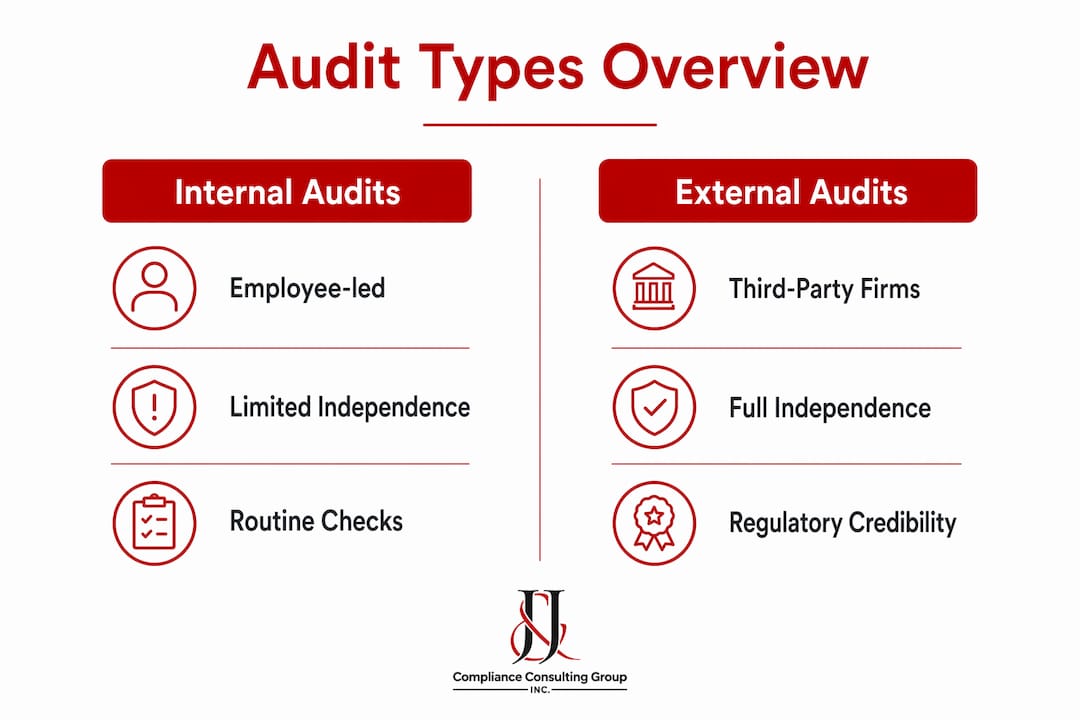
Internal audits are conducted by your own quality team. They are valuable for routine monitoring and process improvement, but they carry an inherent limitation: the auditor reports to the same organization being audited. That relationship limits objectivity, regardless of how skilled the internal team is.
Second-party audits are conducted by a customer auditing its supplier, or vice versa. They provide more independence than internal reviews, but the commercial relationship between the two parties still creates pressure to reach favorable conclusions.
Third-party audits remove that commercial pressure entirely. The auditing firm has no financial stake in the outcome beyond delivering an accurate report.
| Audit Type | Auditor Relationship | Independence Level | Regulatory Credibility | Typical Use Case |
|---|---|---|---|---|
| Internal | Same organization | Low | Limited | Routine monitoring |
| Second-party | Customer or supplier | Moderate | Moderate | Vendor qualification |
| Third-party | Independent firm | High | High | Regulatory submission, supplier oversight |
According to consultant James Griffiths, external audits create defensible records with documented deliverables and timelines that internal reports simply cannot match. Regulators at the FDA and EMA treat third-party audit reports as credible evidence precisely because the auditor has no incentive to soften findings.
The accountability structure matters as much as the findings themselves. Third-party auditors operate under contractual deliverable deadlines, which means the report is produced on a defined schedule with documented scope. That paper trail becomes your defense in an FDA inspection or an EMA query.
Pro Tip: When selecting a third-party auditor, verify that the firm holds recognized accreditations such as ISO 17021 or sector-specific certifications from bodies like NSF International. Accreditation signals that the auditor’s own processes have been independently verified.
What are best practices for third-party audit programs in pharma?
The most common mistake pharma companies make is treating a third-party audit as a one-time certification event rather than a continuous oversight mechanism. Continuous, risk-tiered monitoring programs reduce third-party risk exposure by 40% compared to annual compliance-focused audits. That reduction reflects a fundamental truth: risk changes between audits, and static snapshots miss those changes.
Effective audit programs integrate findings with broader supplier qualification tools. Supplier qualification requires consolidating audit results with FDA Warning Letters, EudraGMDP non-compliance statements, and documented risk assessments like Failure Mode and Effects Analysis (FMEA) or Hazard Analysis and Critical Control Points (HACCP). An audit report alone is a point-in-time snapshot. Combined with external regulatory intelligence, it becomes a living risk profile.
A well-structured audit cycle follows this sequence:
- Risk tier your supplier base. Classify suppliers by criticality, volume, and regulatory exposure. High-risk suppliers receive more frequent and deeper audits than low-risk commodity vendors.
- Define audit scope in writing. Document the specific systems, processes, and records to be reviewed before the audit begins. Scope creep wastes time and produces unfocused findings.
- Conduct on-site assessments. Remote document reviews have a role, but supplier audits typically require 1–3 days on-site plus additional evaluation phases. Physical presence reveals conditions that documents do not.
- Issue findings with corrective action timelines. Every finding must carry a deadline and an owner. Open findings with no closure date are compliance liabilities.
- Verify corrective actions. Follow-up verification, either through a desk review or a re-audit, confirms that the supplier actually fixed the problem rather than documenting a plan to fix it.
- Update the supplier risk profile. Feed audit outcomes back into your FMEA or HACCP documentation so the risk picture stays current.
India’s CDSCO provides a useful model for scaling this approach. The agency shifted to an outsourced audit model using QCI-certified agencies to improve GMP and GCP audit frequency across India’s $50 billion pharma industry, building a cadre of 1,500 scientific experts to carry out these assessments. The lesson for pharma companies is that audit capacity can be built through qualified external partners rather than trying to staff everything internally.
Pro Tip: Integrate your audit program with your risk management framework from day one. Audit findings that feed directly into your risk register are far more useful than findings that sit in a standalone report folder.
How do third-party audits support regulatory readiness?
Third-party GMP audits provide objective assurance that supports supplier qualification, regulatory inspection readiness, and patient safety simultaneously. That combination makes them one of the highest-return investments in a pharma quality system.
The specific regulatory readiness benefits include:
- FDA inspection preparation. A well-documented third-party audit history demonstrates to FDA investigators that your quality system includes independent verification, not just self-assessment. This posture reduces inspection duration and the likelihood of Warning Letters.
- EMA and CDSCO alignment. Both agencies increasingly expect audit evidence as part of marketing authorization dossiers and post-approval change notifications. Third-party reports carry more weight than internal records.
- Sub-supplier visibility. Contract manufacturers often use their own sub-suppliers for raw materials or packaging. Third-party audits can extend to these second-tier vendors, giving you visibility into risks that your direct contracts do not cover.
- Business continuity documentation. Audit records showing consistent supplier performance support business continuity planning by identifying which vendors are reliable under stress and which carry latent quality risks.
- Customer and partner confidence. Biotech partners and hospital systems increasingly require audit evidence as part of their own vendor selection processes before committing to supply agreements.
The regulatory trend line is clear. Global agencies are demanding more audit evidence, more frequently, with greater documentation depth. Pharma companies that build mature third-party audit programs now will be better positioned for inspections, partnerships, and market access than those treating audits as a reactive compliance checkbox.
Key takeaways
Third-party GMP audits are the most credible and defensible mechanism pharma companies have for verifying supplier compliance and demonstrating regulatory readiness to the FDA, EMA, and CDSCO.
| Point | Details |
|---|---|
| Independence drives credibility | Third-party auditors have no commercial stake in findings, making their reports more credible with regulators than internal reviews. |
| Risk is dynamic, not static | Continuous, risk-tiered audit programs reduce third-party risk exposure by 40% compared to annual snapshot audits. |
| Audits must integrate with broader tools | Combine audit findings with FDA Warning Letters, EudraGMDP data, and FMEA assessments for complete supplier risk profiles. |
| Regulatory agencies expect audit evidence | FDA, EMA, and CDSCO treat third-party audit records as primary evidence of quality system control during inspections. |
| One-time audits create false confidence | Treating a single audit as permanent risk mitigation is the most common and costly mistake in pharma compliance programs. |
The compliance theater problem nobody talks about
I have reviewed audit programs at pharma companies ranging from mid-size generics manufacturers to large biologics firms, and the pattern I see most often is not outright negligence. It is something more subtle: compliance theater. The audit gets done, the report gets filed, and leadership checks the box. Nobody asks whether the findings actually changed anything.
The independence question is where I push hardest with clients. An audit conducted by a firm with a long-standing commercial relationship with the supplier is not truly independent, regardless of what the contract says. The social dynamics of long-term business relationships soften findings in ways that are almost impossible to detect from the outside. That is why I recommend rotating auditors on a defined cycle and requiring auditors to disclose any prior relationship with the auditee.
The other issue I see consistently is the gap between audit findings and corrective action closure. Companies generate thorough findings and then lose track of whether the supplier actually fixed the problem. Verification is not optional. It is the step that converts an audit from a documentation exercise into actual risk reduction.
My honest assessment is that pharma companies underinvest in third-party audits relative to the risk they are managing. The $4.45 million average cost of a third-party breach dwarfs the cost of a rigorous annual audit program. The math is not complicated. What is complicated is getting leadership to treat audit programs as strategic investments rather than compliance overhead.
— Mike
How Jjccgroup supports your pharma audit and compliance program
Jjccgroup brings over 30 years of FDA regulatory expertise to help pharma companies design, implement, and manage third-party audit programs that hold up under scrutiny. Whether you are building a supplier qualification framework from scratch, preparing for an FDA inspection, or trying to close persistent audit findings, Jjccgroup’s consulting team provides the structured support you need.

From audit program design and supplier risk tiering to corrective action tracking and FDA compliance services, Jjccgroup offers a one-stop solution for pharma companies navigating complex regulatory requirements. The team also supports pharmaceutical compliance consulting across GMP, GCP, and supply chain oversight, giving you a single partner for your full compliance portfolio. Contact Jjccgroup to discuss how an independent audit program can reduce your regulatory exposure and strengthen your quality system.
FAQ
What is a third-party GMP audit in pharma?
A third-party GMP audit is an independent assessment conducted by an external firm to verify that a pharmaceutical manufacturer or supplier complies with Good Manufacturing Practices. The auditor has no commercial relationship with the auditee, which gives the findings higher credibility with regulators like the FDA and EMA.
How often should pharma companies conduct third-party audits?
Audit frequency depends on supplier risk tier. High-risk suppliers, such as active pharmaceutical ingredient manufacturers, typically require annual or biannual audits, while lower-risk vendors may be audited every two to three years. Continuous monitoring between formal audits is the most effective approach for detecting risk changes.
What is the difference between a second-party and a third-party audit?
A second-party audit is conducted by a customer auditing its own supplier, while a third-party audit uses an independent firm with no stake in the outcome. Third-party audits carry greater regulatory credibility because the auditor’s findings are not influenced by the commercial relationship between buyer and seller.
Can third-party audit reports be used in FDA inspections?
Yes. Third-party GMP audit reports serve as primary evidence of supplier oversight during FDA inspections. Properly documented reports with defined scope, findings, and corrective action timelines demonstrate that your quality system includes independent verification, which reduces inspection risk.
Why do contracts alone not protect pharma companies from third-party risk?
Contracts establish obligations but cannot verify actual compliance. 76% of GDPR fines linked to third-party failures occurred after initial compliance was confirmed, meaning the risk emerged after the contract was signed. Only ongoing audits and monitoring detect the operational changes that create new risks over time.
