




Pharmaceutical labeling compliance, the industry term for maintaining regulatory conformity across all drug product labeling components, sits at the intersection of patient safety and business continuity. Understanding why labeling compliance matters in pharma starts with a sobering reality: a single missing contraindication or an unscannable barcode can trigger a recall, delay an approval, or directly harm a patient. Regulators at the FDA and EMA have grown increasingly specific about what constitutes compliant labeling, and 2026 has introduced new standardization requirements that raise the stakes further. This guide walks through what the rules actually require, what goes wrong when they are not met, and how modern compliance operations keep products on the market.
Table of Contents
- Key takeaways
- Why labeling compliance matters: the regulatory foundation
- Patient safety and the real cost of non-compliance
- Operational and quality management for compliant labeling
- Global challenges in pharmaceutical labeling
- My perspective on where labeling compliance programs actually break down
- How Jjccgroup supports your labeling compliance program
- FAQ
Key takeaways
| Point | Details |
|---|---|
| Labeling spans more than the label | FDA-regulated labeling includes Prescribing Information, Medication Guides, and carton labels, all of which must stay current. |
| 2026 NDC rule changes everything | The FDA’s new uniform 12-digit NDC format directly ties labeling accuracy to medication safety at the point of dispensing. |
| Audit trails are non-negotiable | Documenting who approved label changes and when is as legally significant as the label content itself. |
| Global markets multiply complexity | Managing EU QRD templates, US FDA requirements, and regional variations simultaneously demands coordinated content governance. |
| Non-compliance is expensive | Recalls, delayed approvals, and reputational damage from labeling errors cost far more than building the right processes upfront. |
Why labeling compliance matters: the regulatory foundation
Before examining consequences, it helps to define the full scope of pharmaceutical labeling. The FDA defines prescription drug labeling as encompassing approved Prescribing Information, Medication Guides, Patient Package Inserts, carton and container labeling, and safety update tracking through Drugs@FDA. That breadth matters. Compliance officers who treat labeling as only the carton text are working with an incomplete picture.
The regulatory frameworks governing these components include:
- FDA 21 CFR Parts 201, 202, and related guidance: Sets out labeling content requirements, format rules, and update obligations for human drug products marketed in the United States.
- EMA Quality Review of Documents (QRD) template: The European standard mandating specific structure, standardized phrases, and readability testing for all EU product information.
- ICH Q10 and GxP principles: Define the quality systems within which labeling review and change control must operate.
- Country-specific requirements: Markets including Japan, Canada, Brazil, and India each impose distinct format, language, and submission requirements.
One of the most significant 2026 developments is the FDA’s final NDC standardization rule, which mandates a uniform 12-digit format using a 6-digit labeler code, 4-digit product code, and 2-digit package code. This replaces the patchwork of competing NDC formats that had persisted for years, creating conversion errors at pharmacy systems and dispensing software. The rule directly links labeling accuracy to downstream medication safety in ways that were previously left to industry convention.
Lifecycle management adds another layer. Regulators do not just expect correct labeling at initial approval. They expect approved content and update tracking to remain current across the entire product lifespan. A label that was accurate at launch but has not been updated to reflect a new safety signal is a compliance failure even if nothing on the physical label has visibly changed.
| Regulatory framework | Jurisdiction | Key labeling requirement |
|---|---|---|
| FDA 21 CFR Part 201 | United States | Content, format, and update obligations for prescription drugs |
| EMA QRD Template | European Union | Structured language, standardized phrases, multilingual consistency |
| ICH Q10 | Global | Quality system requirements for labeling change control |
| NDC Final Rule 2026 | United States | Uniform 12-digit format to prevent dispensing and coding errors |
Patient safety and the real cost of non-compliance
Labeling errors are a leading cause of pharmaceutical product recalls and direct patient harm. The most common failure modes are wrong language on market-specific labels, missing or outdated contraindications, incorrect dosing information, and unscannable barcodes. Any one of these can result in regulatory action, market withdrawal, or worse, a preventable adverse event reaching a patient.
Medication Guides illustrate how compliance obligations extend well beyond the manufacturer. These guides are federally required for drugs posing serious public health concerns, and their distribution creates a multi-tier compliance chain. Approximately 191 distributors provide guides to around 9,000 dispensers annually, and each dispenser spends roughly 1.25 hours preparing and 3 minutes providing guides directly to patients. This operational burden lands on organizations that are often not the original manufacturer, which means your compliance program must account for partners and downstream handlers, not just your own labeling team.
The business case for getting labeling right is equally direct:
- Recalls: A label-driven recall requires not just product withdrawal but investigation, reporting, corrective action, and often a consent decree process that delays future approvals.
- Delayed approvals: An FDA Complete Response Letter citing labeling deficiencies can push a launch back by six months or more, with corresponding revenue impact.
- Reputational damage: Repeated labeling issues signal to regulators that quality systems are not functioning, which invites more frequent inspections and closer scrutiny on subsequent submissions.
- Litigation exposure: Patient harm linked to labeling failures creates product liability risk that no compliance investment can fully cover after the fact.
Pro Tip: Build your labeling compliance risk assessment around the most likely failure modes for your specific product class. A controlled-substance label carries different risk profiles than an over-the-counter monograph product. Tailor your review intensity accordingly.
Operational and quality management for compliant labeling
Good labeling compliance is a process problem as much as a content problem. Failures to document who approved label changes and when are among the most common causes of audit findings, even when the final label text is entirely correct. Regulators are not just evaluating your label. They are evaluating your system for producing and controlling that label.
A GxP-compliant labeling workflow typically involves these sequential steps:
- Initiation and impact assessment: Document the source of the change request, whether a safety update, regulatory revision, or new indication, and assess which label components and markets are affected.
- Cross-functional review: Subject matter experts in regulatory affairs, medical writing, and quality review each version against applicable standards before any change is approved.
- Software validation: Any system used to generate, store, or track labels in a regulated environment must be validated per 21 CFR Part 11 or equivalent GxP requirements. Unvalidated tools create automatic compliance exposure.
- Audit trail generation: Every decision, comment, and approval must be captured in a time-stamped record that is tamper-evident and retrievable during inspection.
- Approved content archiving: Final approved versions are stored in a controlled document management system with version history, not in shared drives or email threads.
- Lifecycle monitoring: Scheduled reviews confirm that approved labels remain current with the latest safety information and regulatory guidance documents.
Comparing manual versus software-driven labeling operations reveals why technology investment pays off quickly.
| Capability | Manual process | Validated software system |
|---|---|---|
| Audit trail completeness | Inconsistent, often reconstructed | Automatic, time-stamped, tamper-evident |
| Multi-market version control | Error-prone spreadsheet tracking | Centralized, locked versions per market |
| Change impact assessment | Manual cross-reference | System-generated affected label list |
| Inspection readiness | Depends on individual diligence | Consistent, reproducible records |
Pro Tip: When selecting labeling management software, prioritize audit trail architecture before feature lists. A system that generates a complete, uneditable record of approvals will serve you better during an FDA inspection than one with more formatting options but weaker documentation controls.
Working with specialists who understand GMP labeling control workflows can shorten the validation and implementation timeline significantly, particularly for companies managing multiple product lines simultaneously.

Global challenges in pharmaceutical labeling
Pharmaceutical companies operating across multiple markets face a content governance challenge that goes well beyond translation. A 2026 peer-reviewed study found that e-labeling maturity varies substantially across regions, with the US and EU maintaining advanced electronic systems and markets like India operating more manual processes. That gap creates interoperability risks when label content must travel across systems designed with different assumptions about format, language encoding, and version control.
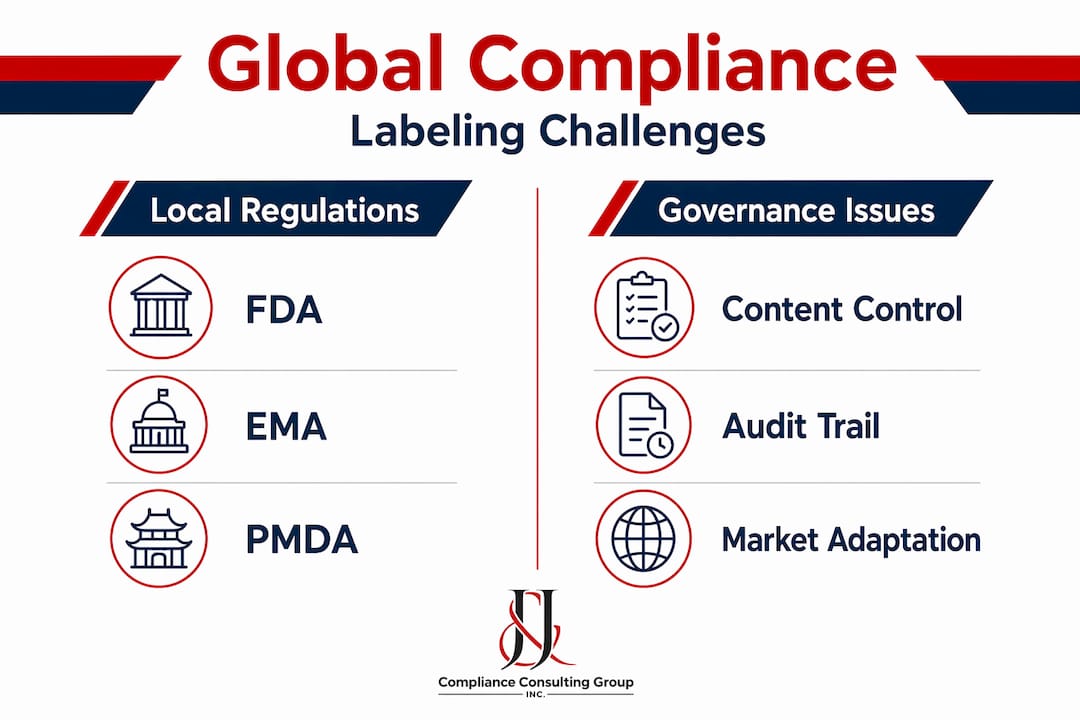
The EMA’s QRD template is a particular source of difficulty for companies new to EU submissions. Non-compliance with QRD requirements triggers regulatory delays, and translation errors carry both safety and legal consequences. The template mandates specific standard phrases, a defined document structure, and readability testing with patient cohorts. Getting this right across 24 official EU languages requires both linguistic expertise and regulatory knowledge working together.
Key considerations for multi-market labeling governance include:
- Maintaining a single authoritative source document per product, from which market-specific versions are derived, rather than maintaining parallel independent versions.
- Building translation workflows that include back-translation review and subject matter expert sign-off, not just language conversion.
- Monitoring regulatory agency update cycles for each relevant market so that template and guidance changes are incorporated before they become compliance failures.
- Assigning clear ownership for each market-specific label version, with documented accountability for both content accuracy and submission status.
The global regulatory complexity in pharmaceutical labeling is fundamentally a content governance challenge. Cross-functional coordination across regulatory affairs, medical writing, translation services, and local market teams is not optional. It is the mechanism by which pharmaceutical labeling standards are actually met in practice.
My perspective on where labeling compliance programs actually break down
I have spent considerable time working through labeling compliance challenges with pharmaceutical clients at various stages of maturity, and the pattern I see most often is a gap between policy and practice. A company will have a labeling change control SOP that reads well on paper but runs on email threads and shared folders in reality. The SOP says “audit trail required.” The actual process produces a chain of email approvals that is nearly impossible to reconstruct during an inspection.
The second thing I see is over-reliance on content correctness as a proxy for compliance. Teams spend enormous effort perfecting label language while treating the approval documentation as administrative overhead. Regulators do not share that priority ordering. They will find a label with perfect text and still issue a Form 483 observation because the approval records are incomplete.
What actually works is treating labeling compliance as a system, not a document. That means validated tools, assigned ownership, scheduled lifecycle reviews, and inspection-ready records at all times, not just when an audit is approaching. Speed to market is a real business pressure, and I understand the temptation to cut corners on documentation when a launch deadline looms. But the delays caused by a labeling-related Complete Response Letter will cost far more time than the careful process would have required.
The 2026 NDC standardization rule is a good example of where staying ahead of regulatory changes pays off. Companies that mapped their NDC formats proactively and updated their labeling systems before the deadline are moving forward. Companies that waited are now managing the change under time pressure, which is exactly when documentation errors happen.
— Mike
How Jjccgroup supports your labeling compliance program
Labeling compliance does not have to be a source of ongoing uncertainty. Jjccgroup brings over 30 years of FDA regulatory experience to pharmaceutical labeling challenges, from initial label development and regulatory submissions to lifecycle management and inspection readiness. Whether you are managing a single product’s Prescribing Information update or coordinating a multi-market label revision across US and EU requirements, the right consulting support reduces errors and keeps timelines on track.

Jjccgroup’s regulatory approval consulting services help pharmaceutical companies build labeling workflows that satisfy agency expectations and hold up under audit. For teams developing their regulatory strategy from the ground up, the pharmaceutical compliance consulting guide offers a practical framework for aligning labeling processes with FDA requirements. If you are working through a specific labeling challenge or preparing for an upcoming inspection, contact Jjccgroup to discuss how expert guidance can move your program forward with confidence.
FAQ
What does pharmaceutical labeling compliance include?
Pharmaceutical labeling covers Prescribing Information, Medication Guides, Patient Package Inserts, carton and container labeling, and ongoing safety update tracking. Compliance means all of these components are current, accurate, and maintained through a documented, controlled process.
What is the 2026 FDA NDC standardization rule?
The FDA’s 2026 NDC final rule mandates a uniform 12-digit format using a 6-digit labeler code, 4-digit product code, and 2-digit package code, replacing the inconsistent formats that caused medication errors at dispensing systems.
Why do labeling compliance failures lead to product recalls?
Common recall triggers include incorrect language, missing contraindications, and unscannable barcodes. Each of these represents a direct patient safety risk that regulators treat as grounds for market withdrawal.
What makes audit trails so critical in labeling compliance?
Regulators evaluate the approval process, not just the final label text. Incomplete approval records tracking who approved changes and when are among the most frequent compliance failure points found during FDA inspections.
How does the EMA QRD template affect labeling submissions in Europe?
The EMA QRD template requires specific document structure, standardized phrases, and readability testing across all EU official languages. Non-compliance with QRD requirements causes regulatory delays and, when translation errors are involved, poses direct safety risks to patients.
Recommended
- The Role of Pharmacovigilance in Compliance: 2026 Guide
- FDA Product Compliance: A Step-by-Step Guide – J&J Consulting Group- FDA Regulatory Compliance
- Pharmaceutical Development Compliance: Your Essential Guide – J&J Consulting Group- FDA Regulatory Compliance
- 8 Best Pharmaceutical Compliance Providers (2025)
