



FDA drug approval is the formal determination by the U.S. Food and Drug Administration that a drug is safe and effective for its intended use and meets federal quality standards. This evaluation covers three pillars: clinical safety, therapeutic efficacy, and manufacturing quality. With rare exceptions, no new drug or biological product can be legally marketed in the United States without completing this process. Whether you are a pharmaceutical professional managing a regulatory submission, a clinician interpreting a product label, or a policy analyst tracking market authorizations, understanding the FDA drug approval process is the foundation of informed decision-making.
What is FDA drug approval and why does it matter?
FDA drug approval is the agency’s formal authorization for a sponsor to market a drug product in the United States. The process is governed by the Federal Food, Drug, and Cosmetic Act and administered by the FDA’s Center for Drug Evaluation and Research (CDER) for small-molecule drugs and the Center for Biologics Evaluation and Research (CBER) for most biologics.
The approval determination rests on a benefit-risk analysis. FDA reviewers weigh the clinical evidence of a drug’s therapeutic benefit against its known and potential risks for the specific patient population described in the proposed labeling. This is not a generic safety stamp. A drug approved to treat metastatic non-small cell lung cancer carries a very different benefit-risk profile than one approved for seasonal allergies, and the FDA evaluates each indication on its own terms.

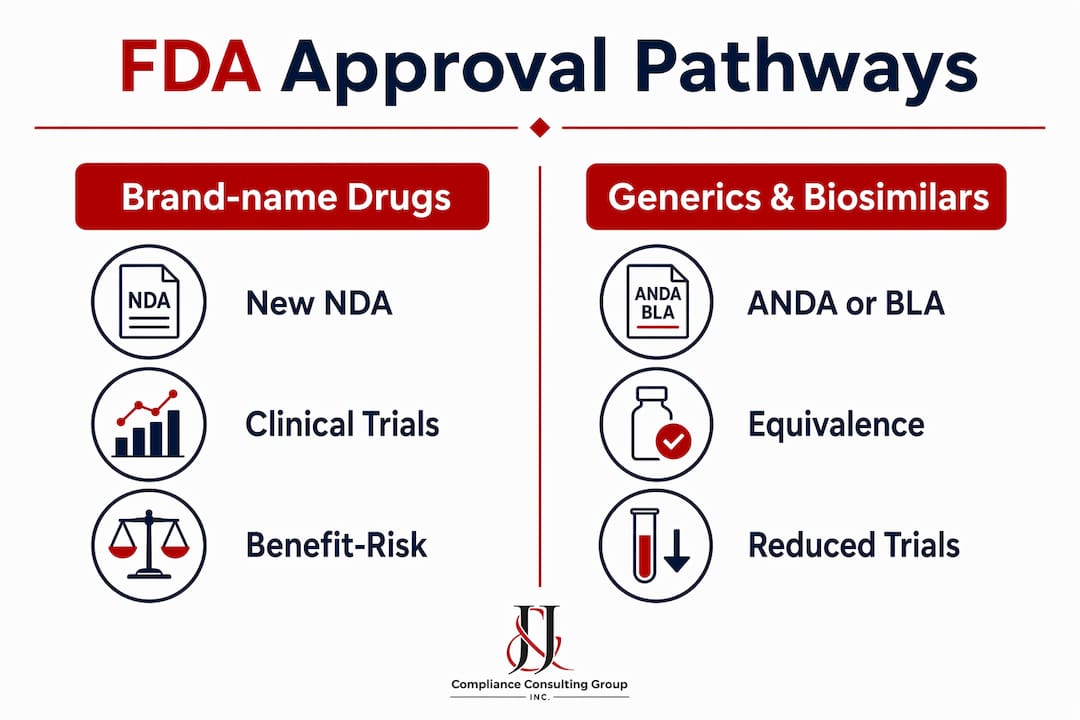
Three categories of products require FDA approval before marketing: new brand-name drugs, generic drugs, and biological products including biosimilars. Each follows a distinct regulatory pathway, but all share the same core standard. The agency must conclude that the evidence supports the product’s safety and effectiveness for its labeled indication before an approval letter is issued.
What are the key stages in the FDA drug approval process?
The FDA drug approval process follows a structured sequence that typically spans 10 to 15 years from initial discovery to market authorization. Each stage generates data that informs the next, and no stage can be skipped.
-
Preclinical testing. Laboratory studies and animal trials establish initial safety and pharmacological data. These results form the scientific basis for requesting permission to test the drug in humans.
-
Investigational New Drug (IND) application. The sponsor submits an IND to the FDA. The IND takes effect automatically 30 days after FDA receipt unless the agency places the study on clinical hold. Critically, IND authorization permits clinical trials. It is not marketing approval.
-
Phase 1 clinical trials. A small group of healthy volunteers or patients receives the drug to assess safety, dosing, and pharmacokinetics. These trials typically enroll 20 to 100 participants.
-
Phase 2 clinical trials. Hundreds of patients with the target condition receive the drug to evaluate preliminary efficacy and identify common side effects.
-
Phase 3 clinical trials. Large-scale trials involving hundreds to thousands of patients confirm efficacy, monitor adverse reactions, and compare the drug to existing treatments or placebo. Phase 3 data form the core of the marketing application.
-
New Drug Application (NDA) or Biologics License Application (BLA) submission. The sponsor compiles all preclinical and clinical data into a formal application. The FDA then issues a 60-day filing decision to accept or refuse the application before substantive review begins.
-
FDA multidisciplinary review. Teams of physicians, pharmacologists, statisticians, chemists, and manufacturing specialists review the full application. The agency may convene advisory committees for complex or novel products and conducts facility inspections to verify manufacturing quality.
-
FDA decision. The agency issues either an approval letter authorizing marketing or a Complete Response Letter detailing deficiencies the sponsor must resolve before approval can be granted.
-
Post-approval monitoring. Approval triggers ongoing obligations including Phase 4 studies, adverse event reporting, and labeling updates as new safety data emerge.
Pro Tip: Submit a pre-NDA meeting request to FDA before filing your NDA or BLA. These meetings frequently surface formatting or data gaps that, if unaddressed, can trigger a Refuse to File decision and delay your program by months.
How does FDA approval differ for brand-name drugs, generics, and biologics?
The requirements for drug approval vary meaningfully depending on the product category. Understanding these differences is practical knowledge for anyone involved in pharmaceutical development, procurement, or formulary management.
| Drug category | Regulatory pathway | Core approval standard | Key databases |
|---|---|---|---|
| New brand-name drug | NDA (505(b)(1)) | Full clinical safety and efficacy data | Drugs@FDA |
| Generic drug | Abbreviated NDA (ANDA) | Bioequivalence to reference listed drug | Orange Book |
| Biologic | BLA | Safety, purity, and potency data | Purple Book |
| Biosimilar | 351(k) BLA | No clinically meaningful differences from reference product | Purple Book |
Generic drug approvals require demonstrating substitutability for the brand-name reference drug. Specifically, generics must show the same active ingredient, equivalent labeling (with allowances for patent carve-outs), and similar degradation profiles over time. This is why a generic can reach the market without repeating the full clinical trial program that supported the original approval.
Patent and exclusivity protections routinely delay generic entry. Legal exclusivities and patents are managed as part of regulatory strategy, not just legal strategy. A sponsor filing an ANDA must certify against all listed patents in the Orange Book, and a Paragraph IV certification challenging a patent can trigger a 30-month stay of approval. This intersection of intellectual property and FDA regulations for pharmaceuticals is one of the most consequential planning decisions in drug development.
Biosimilars follow a separate pathway under the Biologics Price Competition and Innovation Act. The FDA evaluates whether the biosimilar has no clinically meaningful differences from the reference biologic in terms of safety, purity, and potency. Interchangeability designation, which permits pharmacist-level substitution without prescriber intervention, requires additional switching study data beyond standard biosimilar approval.
What FDA databases help verify drug approval status?
Confirming whether a drug is approved and understanding the scope of that approval requires going directly to official FDA approval databases rather than relying on secondary summaries. The FDA maintains several purpose-built tools for this.
- Drugs@FDA. The primary database for searching approved NDAs and ANDAs. It provides approval letters, labeling history, and review documents for most approved drug products.
- Orange Book. The official source for therapeutic equivalence evaluations. Pharmacists, payers, and formulary managers use it to confirm whether a generic is rated as substitutable for a brand-name product.
- Purple Book. The biologics equivalent of the Orange Book. It lists licensed biological products and identifies biosimilars and interchangeable biosimilars.
- FDALabel and the Online Label Repository. These tools provide current and historical prescribing information, allowing professionals to verify exactly what indications and populations an approval covers.
- FDA Adverse Event Reporting System (FAERS). The postmarketing safety database. FAERS contains voluntary and mandatory reports of adverse events and medication errors submitted after approval.
Pro Tip: When verifying a drug’s approval status for formulary or procurement decisions, cross-reference Drugs@FDA with the Orange Book or Purple Book. A product may appear in one database but not qualify for therapeutic equivalence substitution, which has direct reimbursement and liability implications.
What ongoing obligations exist after FDA approval?
FDA approval is a regulatory baseline, not a finish line. Post-approval obligations include labeling updates, safety monitoring, and manufacturing quality compliance. Sponsors who treat approval as the end of the regulatory relationship routinely encounter enforcement actions, warning letters, and market withdrawals.
Several specific obligations take effect immediately upon approval:
- Postmarketing safety reporting. Sponsors must submit expedited reports for serious and unexpected adverse events and periodic safety update reports on a defined schedule.
- Manufacturing compliance. Current Good Manufacturing Practice (cGMP) requirements continue indefinitely. FDA conducts routine and for-cause inspections of approved facilities.
- Labeling updates. As new safety data emerge from postmarketing surveillance, FAERS signals, or Phase 4 studies, sponsors must update prescribing information. The FDA can require labeling changes, including black box warnings, at any point in a product’s lifecycle.
- Post-approval commitments and requirements. Many approvals are conditioned on completing additional studies, particularly for products approved under accelerated approval pathways.
A common misconception is that FDA approval covers all uses of a drug. It does not. FDA approval is indication-specific. A drug approved for one cancer type is not automatically approved for another, even if physicians prescribe it off-label. Labeling carve-outs for generics add another layer of complexity. When a generic receives approval with a carve-out excluding a patented indication from its label, that carve-out affects substitution practices and can create liability exposure for pharmacists and prescribers who substitute without reviewing the approved labeling.
Approval letters specify marketing authorization and labeling requirements. Reading the actual approval letter and current prescribing information, not a press release or database summary, is the only reliable way to understand what a given approval authorizes.
Key takeaways
The FDA drug approval process requires sponsors to demonstrate safety, efficacy, and manufacturing quality through a structured sequence of preclinical studies, clinical trials, and regulatory submissions before any drug can be marketed in the United States.
| Point | Details |
|---|---|
| Approval is indication-specific | FDA authorizes a drug for a defined use; off-label use is not covered by the approval determination. |
| IND is not marketing approval | An IND permits clinical trials to begin but does not authorize commercial marketing. |
| Generics use an abbreviated pathway | ANDAs require bioequivalence data, not full clinical trials, but must navigate patent and exclusivity protections. |
| Post-approval obligations are continuous | Labeling updates, safety reporting, and cGMP compliance are required for the full lifecycle of an approved product. |
| Use official FDA databases | Drugs@FDA, the Orange Book, and the Purple Book are the authoritative sources for verifying approval status and therapeutic equivalence. |
What I have learned after 30 years of FDA regulatory work
After three decades working at the intersection of pharmaceutical development and FDA compliance, the single most consistent mistake I see is treating FDA approval as a destination rather than a status. Companies invest years and hundreds of millions of dollars reaching approval, then understaff the regulatory function that keeps the approval intact. A warning letter for cGMP violations or a labeling dispute can suspend manufacturing and pull a product from the market faster than any competitor.
The second pattern I see repeatedly is over-reliance on secondary sources to interpret approval scope. I have watched formulary decisions, reimbursement disputes, and liability cases hinge on whether someone read the actual FDA-approved labeling or a database summary that was six months out of date. The FDA’s own tools, particularly Drugs@FDA and the Online Label Repository, are free, current, and authoritative. There is no professional justification for not using them.
For professionals entering drug development or regulatory affairs, I would prioritize understanding the IND-to-NDA continuum before specializing. The regulatory pathways for specialty treatments have grown considerably more complex with accelerated approval, breakthrough therapy designation, and the biosimilar interchangeability framework. Knowing how these pathways interact with standard review timelines gives you a strategic advantage that pure technical knowledge does not.
The FDA drug approval process rewards preparation, documentation discipline, and proactive communication with the agency. Sponsors who engage FDA early, through pre-IND and pre-NDA meetings, consistently achieve faster review timelines and fewer Complete Response Letters than those who submit and wait.
— Mike
How regulatory consulting accelerates FDA drug approval
The FDA drug approval process demands precision at every stage, from IND strategy through post-approval lifecycle management. A single gap in clinical data, a manufacturing deficiency identified during pre-approval inspection, or a labeling inconsistency can trigger a Complete Response Letter and add 12 to 18 months to your timeline. Jjccgroup brings over 30 years of regulatory expertise to pharmaceutical, biotech, and specialty drug programs, providing regulatory approval consulting that covers IND preparation, NDA and BLA submissions, and post-approval compliance. Jjccgroup’s team has guided clients through FDA’s most demanding review pathways, reducing submission errors and accelerating time to market. If your program is approaching a major regulatory milestone, connect with Jjccgroup to build a submission strategy grounded in real FDA experience.
FAQ
What does FDA drug approval mean?
FDA drug approval means the agency has determined that a drug is safe and effective for its intended use and that its manufacturing meets federal quality standards. Approval is indication-specific and does not cover all potential uses of the drug.
How long does the FDA drug approval process take?
The full process from preclinical development through NDA approval typically takes 10 to 15 years. Standard FDA review of an NDA or BLA takes 10 to 12 months, while priority review is targeted at 6 months.
What is the difference between an IND and an NDA?
An IND authorizes a sponsor to begin clinical trials in humans but does not permit commercial marketing. An NDA is the formal application for marketing authorization and requires complete safety, efficacy, and manufacturing data from all development phases.
How do I verify whether a drug is FDA approved?
Use Drugs@FDA to search approved NDAs and ANDAs, the Orange Book for generic therapeutic equivalence ratings, and the Purple Book for biologics and biosimilars. These official FDA databases are the authoritative sources for approval status.
What happens if FDA does not approve a drug application?
The FDA issues a Complete Response Letter identifying the deficiencies the sponsor must address. The sponsor can resubmit with additional data, request a meeting with FDA to discuss the path forward, or formally dispute the agency’s findings through the dispute resolution process.
Recommended
- Regulatory Pathways for Specialty Treatments Explained
- FDA Product Compliance: A Step-by-Step Guide – J&J Consulting Group- FDA Regulatory Compliance
- FDA Meeting Preparation Consulting: A How-To Guide – J&J Consulting Group- FDA Regulatory Compliance
- FDA Regulatory Compliance Consulting: A Guide – J&J Consulting Group- FDA Regulatory Compliance
